Aging & Cumulative Exposure Factors in Gum Recession
Gingival recession exhibits a dramatic increase in prevalence and severity with advancing age, affecting the majority of adults over the age of 50. Historically, this led to the popular misconception that understanding gum recession are an unavoidable, natural consequence of growing older—a belief immortalized in the phrase "long in the tooth." Modern periodontal science reveals that while chronological aging causes subtle physiological tissue alterations, the overwhelming majority of recession in older adults reflects the cumulative, lifetime exposure to mechanical trauma, microbial inflammation, and restorative dental procedures.
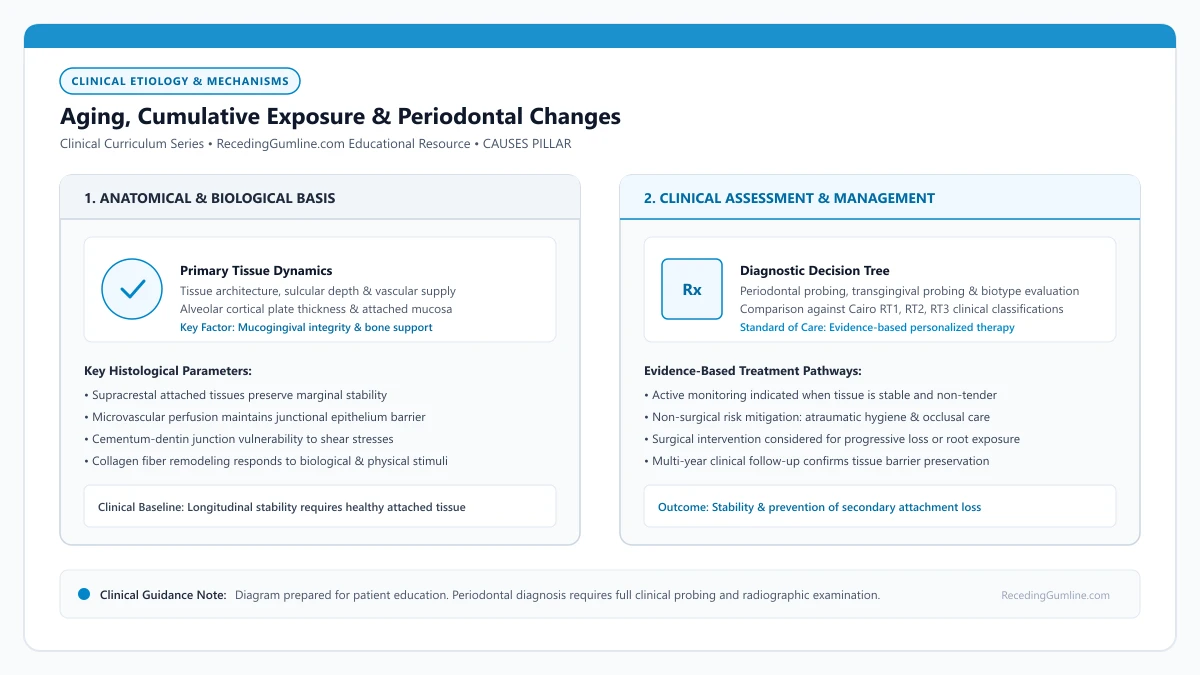
Educational illustration: Aging, Cumulative Exposure & Periodontal Changes. Clinical management requires comprehensive periodontal evaluation rather than isolated self-assessment.
Source: RecedingGumline.com Clinical Editorial Team (Proprietary educational diagram for RecedingGumline.com)
Cumulative Lifetime Insult vs. Physiological Aging
The high prevalence of recession among older populations is primarily a mathematical function of cumulative exposure over time. A 65-year-old individual has brushed their teeth approximately 45,000 times, consumed millions of masticatory cycles, and experienced decades of microbial challenge within the gingival sulcus. Minor physical or inflammatory insults that remove a fraction of a millimeter of tissue over a single year compound into noticeable, multi-millimeter recession defects over four or five decades.
Controlled longitudinal research has demonstrated that healthy older individuals who maintain exemplary oral hygiene without excessive brushing force and who receive regular periodontal maintenance exhibit virtually no progressive attachment loss. This disproves the fatalistic dogma that gums must inevitably recede with advancing years.
Therefore, clinicians categorize age as a risk indicator reflecting cumulative lifetime duration of exposure to primary etiologies—such as toothbrush abrasion, subgingival biofilm dysbiosis, and occlusal wear—rather than an independent, destructive biological mechanism.
Key Etiological Insights
- High recession prevalence in seniors primarily reflects decades of cumulative mechanical and microbial wear.
- True age-related tissue shrinkage is minimal; severe recession represents past pathological exposure.
- Healthy older adults with atraumatic hygiene can maintain stable, non-receded gumlines throughout life.
Biological & Cellular Alterations in the Aging Periodontium
While chronological aging alone does not cause recession, senescence induces subtle physiological changes within periodontal tissues that reduce their adaptive and reparative capacity. Periodontal ligament (PDL) fibroblasts in older adults exhibit reduced mitotic activity, decreased synthesis of type I and type III collagen, and elevated baseline expression of matrix metalloproteinases.
In addition, the microvasculature supplying the attached gingiva undergoes age-related changes, including thickening of vessel basement membranes and reduced capillary loop density. This diminished microcirculatory perfusion slows the rate of revascularization and cellular turnover, meaning that when physical microtrauma occurs, tissue healing takes longer to complete.
The attached gingiva also undergoes histological thinning of the epithelium, reduced degree of keratinization, and flattening of the epithelial rete pegs that interlock with connective tissue papillae. This subtle thinning renders the tissue slightly more fragile when challenged by hard food boluses or stiff manual bristles.
Key Etiological Insights
- Aging fibroblasts synthesize collagen at a reduced rate and exhibit slower cellular turnover.
- Microvascular perfusion decreases slightly, prolonging recovery times following mechanical trauma.
- Epithelial thinning and reduced keratinization slightly lower the physical tear resistance of the margin.
Continuous Tooth Eruption & Attrition Dynamics
Another critical factor influencing apparent gumline changes across the lifespan is the biological phenomenon of continuous or compensatory tooth eruption. Throughout adult life, functional mastication results in gradual mechanical wear (attrition) of incisal edges and occlusal cusps.
To maintain continuous contact with opposing teeth and preserve vertical facial height, human teeth continuously erupt at a slow physiological rate (approximately 0.01 to 0.05 mm per year). When compensatory eruption occurs without corresponding coronal bone deposition, the clinical crown appears longer, and the anatomical cementoenamel junction (CEJ) shifts into a more visible position relative to adjacent soft tissue.
Furthermore, past restorative dental work—such as crowns, bridges, and subgingival fillings placed during middle age—may slowly become exposed as minor tissue changes occur, creating visible margins that require careful professional evaluation.
Key Etiological Insights
- Continuous compensatory eruption occurs throughout life to counterbalance occlusal chewing wear.
- Slow tooth eruption can alter the visual relationship between the crown, root, and gingival margin.
- Older dental restorations with subgingival margins frequently become exposed as decades pass.
Senior Periodontal Care: Adaptation & Preservation
Managing periodontal health in older adults requires tailoring oral hygiene protocols to match changing physical and biological capabilities. Age-related systemic conditions—such as osteoarthritis, rheumatoid arthritis, Parkinson's disease, or stroke—can impair manual dexterity, leading patients to scrub vigorously with hard brushes to compensate for lost fine-motor control.
Transitioning senior patients to high-quality electric toothbrushes with large, ergonomic handles and built-in pressure sensors eliminates the physical strain of manual brushing while guaranteeing gentle, atraumatic plaque removal. Using therapeutic mouthwashes and low-abrasivity dentifrices protects exposed root surfaces from both mechanical abrasion and root caries.
With regular periodontal supportive care (typically on a 3- to 4-month recall cycle), older adults can successfully arrest existing recession, prevent root decay, and maintain their natural dentition comfortably for the rest of their lives.
Key Etiological Insights
- Manual dexterity limitations can lead to compensatory, aggressive scrub brushing habits in seniors.
- Ergonomic electric toothbrushes provide safe, effortless plaque control without soft-tissue trauma.
- Personalized periodontal recall visits every 3 to 4 months preserve natural teeth well into advanced age.
Clinical Reality Check
Receding gums in older adults should never be dismissed as an inevitable symptom of aging. Active disease and destructive mechanical habits can and should be identified, halted, and stabilized regardless of patient age.
Questions to Ask Your Dentist or Periodontist
- Is my receding gumline due to past brushing habits, active periodontal disease, or natural wear?
- Are my exposed root surfaces at risk for root caries (cavities), and what fluoride regimen do you recommend?
- Would an electric toothbrush help me clean my teeth more gently given my manual dexterity?
- Are my old crown margins contributing to inflammation or recession around these teeth?
- What is the best professional cleaning interval to keep my remaining bone and gums stable?
Unsure What Your Gum Changes Mean?
Take our free, evidence-based Gum Recession Assessment — approximately 3 minutes. Identify potential risk factors, evaluate symptoms, and receive personalized discussion questions for your dentist or periodontist.
Non-diagnostic educational triage. Private, secure, completed in your browser.
Related Educational Topics
Scientific Literature & Clinical Guidelines
4sources · Hide ▲
- Pihlstrom BL, Michalowicz BS, Johnson NW (2005).
"Periodontal diseases." The Lancet.
Clinical relevance: Peer-reviewed Lancet seminar review synthesizing global periodontal epidemiology, microbial etiology, host immunopathology, and systemic interactions, emphasizing prevention, biofilm disruption, and early risk factor modification.
- Tonetti MS, Greenwell H, Kornman KS (2018).
"Staging and grading of periodontitis: Framework and proposal of a new classification and case definition." Journal of Clinical Periodontology.
Clinical relevance: Consensus framework establishing the multidimensional staging (severity and extent of periodontal tissue breakdown) and grading (biological rate of disease progression, incorporating smoking and diabetes as grade modifiers) for periodontitis. It addresses periodontitis diagnosis and staging, not the classification of localized gingival recession defects.
- Caton JG, Armitage G, Berglundh T, Chapple ILC, Jepsen S, Kornman KS, et al. (2018).
"A new classification scheme for periodontal and peri-implant diseases and conditions - Introduction and key changes from the 1999 classification." Journal of Clinical Periodontology.
Clinical relevance: Introductory consensus overview of the 2018 international classification scheme, introducing periodontal phenotype (incorporating gingival thickness and keratinized tissue width), defining gingival recession independently of inflammatory periodontitis, and standardizing mucogingival diagnostic terminology.
- Chapple ILC, Mealey BL, Van Dyke TE, Bartold PM, Dommisch H, Eickholz P, et al. (2018).
"Periodontal health and gingival diseases and conditions on an intact and a reduced periodontium: Consensus report of workgroup 1 of the 2017 World Workshop on the Classification of Periodontal and Peri-Implant Diseases and Conditions." Journal of Clinical Periodontology.
Clinical relevance: Consensus report establishing diagnostic criteria for periodontal health and gingivitis across intact and reduced periodontia, defining clinical gingival health as <10% bleeding on probing without attachment loss and strictly differentiating gingivitis from periodontitis.
Important Medical Notice
The contents of RecedingGumline.com, including text, graphics, self-assessment calculators, and other materials, are intended solely for educational and informational purposes. This content is not intended to replace professional dental examination, diagnosis, or treatment. Always seek the advice of a qualified dentist, periodontist, or other licensed oral healthcare provider with any questions you may have regarding a medical or dental condition. Never disregard professional medical advice or delay seeking it because of something you read on this website.