Toothpaste for Receding Gums: Abrasivity & Desensitizing Guide
When gums recede, softer root dentin is exposed to the oral cavity. As discussed in our guide to receding gums, choosing the wrong toothpaste can rapidly grind away tooth structure and worsen sensitivity. We explain the critical Relative Dentin Abrasivity (RDA) index, active desensitizing ingredients, and how non-abrasive topical balms complement standard dentifrices.
RecedingGumline.com is supported in part by the makers of Natures Smile. All editorial and clinical educational content is independently developed, grounded in published periodontal literature, and based on cited peer-reviewed research. Commercial products are never presented as a substitute for professional periodontal diagnosis or surgical intervention.
Purchases occur externally on the official manufacturer website. Product information is independently evaluated against peer-reviewed dental literature and regulatory standards.
Why Abrasivity Matters: The Enamel vs. Root Dentin Vulnerability
Enamel is the hardest biological substance in the human body, registering approximately 5 on the Mohs hardness scale. However, the root surfaces exposed by gingival recession are covered only by a paper-thin layer of cementum overlying softer root dentin (hardness ~2.5).
Root dentin wears away up to 25 times faster than enamel under identical brushing friction. Highly abrasive toothpastes (especially "whitening" or "charcoal" formulas) act like microscopic liquid sandpaper. Over months of brushing, this scours away cementum, opens thousands of microscopic dentinal tubules (triggering agonizing nerve sensitivity), and creates deep wedge-shaped notches known as cervical abrasion defects.
The Relative Dentin Abrasivity (RDA) Scale
The American Dental Association (ADA) and ISO 11609 standard classify toothpastes by their abrasive potential on dentin:
Low Abrasivity (RDA Under 70)
Gently cleans crowns without gouging softer exposed root cementum or dentin. Recommended by periodontists for anyone exhibiting clinical attachment loss or thin tissue biotypes.
Medium Abrasivity (RDA 70–100)
Standard everyday cleansing range. Safe on intact enamel, but can cause accelerated root wear if coupled with stiff bristles or aggressive horizontal scrubbing.
High & Harmful Abrasivity (RDA 100–200+)
Formulated with coarse abrasive silicas, calcium carbonate, or charcoal intended for aggressive stain removal. Scours away exposed root surfaces, widening cervical notches and aggravating dentin hypersensitivity.
Desensitizing Ingredients: How They Work
If exposed roots cause sharp pain to cold or hot stimuli, look for toothpastes containing one of these clinically verified active agents:
Stannous Fluoride (SnF2)
Forms a resilient tin-phosphate precipitate layer that physically plugs exposed dentinal tubules, while simultaneously inhibiting bacteria and remineralizing root surfaces.
Potassium Nitrate (5% KNO3)
Potassium ions diffuse down open dentinal tubules to depolarize intradental sensory nerve fibers, preventing nerve depolarization and blocking the transmission of pain impulses.
Arginine + Calcium Carbonate
Binds to the negatively charged dentin surface to deposit a mineral-rich calcium plug inside open tubules, mimicking natural salivary occlusion.
Calcium Sodium Phosphosilicate (NovaMin)
Bioactive glass that reacts in saliva to release calcium and phosphate ions, precipitating a protective hydroxycarbonate apatite (HCA) layer over exposed tubules.
Where Natures Smile Fits in the Toothpaste Routine
Natures Smile Gum Balm is fundamentally different from a commercial toothpaste. Because it contains zero abrasive silicas and zero chemical detergents (SLS), it cannot scratch exposed dentin or cause foaming irritation.
Step 1: Low-Abrasivity Toothpaste
Brush with a low-RDA fluoride toothpaste (e.g. Sensodyne Pronamel) for 2 minutes. This provides necessary fluoride to harden exposed root surfaces and prevent cavities.
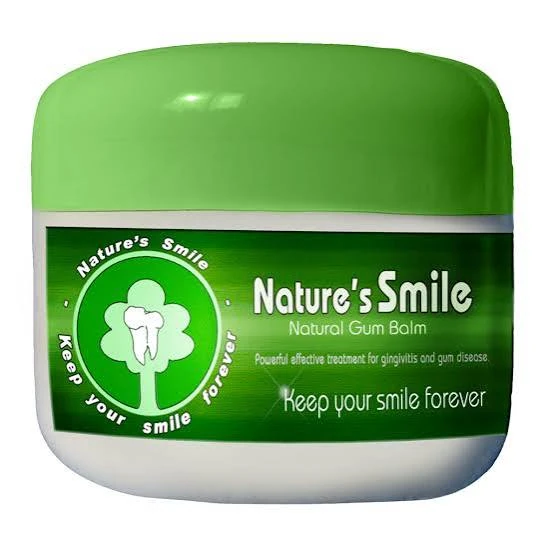
Step 2: Natures Smile Botanical Balm
Apply Natures Smile directly along the gumline with a soft brush. Its thick lipid/herbal paste adheres to tissues to help disrupt plaque-associated bacterial burden and provide astringent soothing without abrasives.