Swollen, Red or Tender Gingival Margins in Gum Recession
Swollen, erythematous (red), and tender gingival margins are the direct physical manifestations of acute or chronic vascular inflammation within the periodontium. As outlined in our management of receding gums guide, in a state of health, attached gingiva is coral pink (or melanin-pigmented), firm, resilient, tightly adapted to underlying bone, and displays a characteristic stippled texture resembling an orange peel. When bacterial biofilms, hormonal shifts, or physical trauma trigger inflammation, fluid exudation causes the tissue to swell, lose stippling, and become tender to touch.
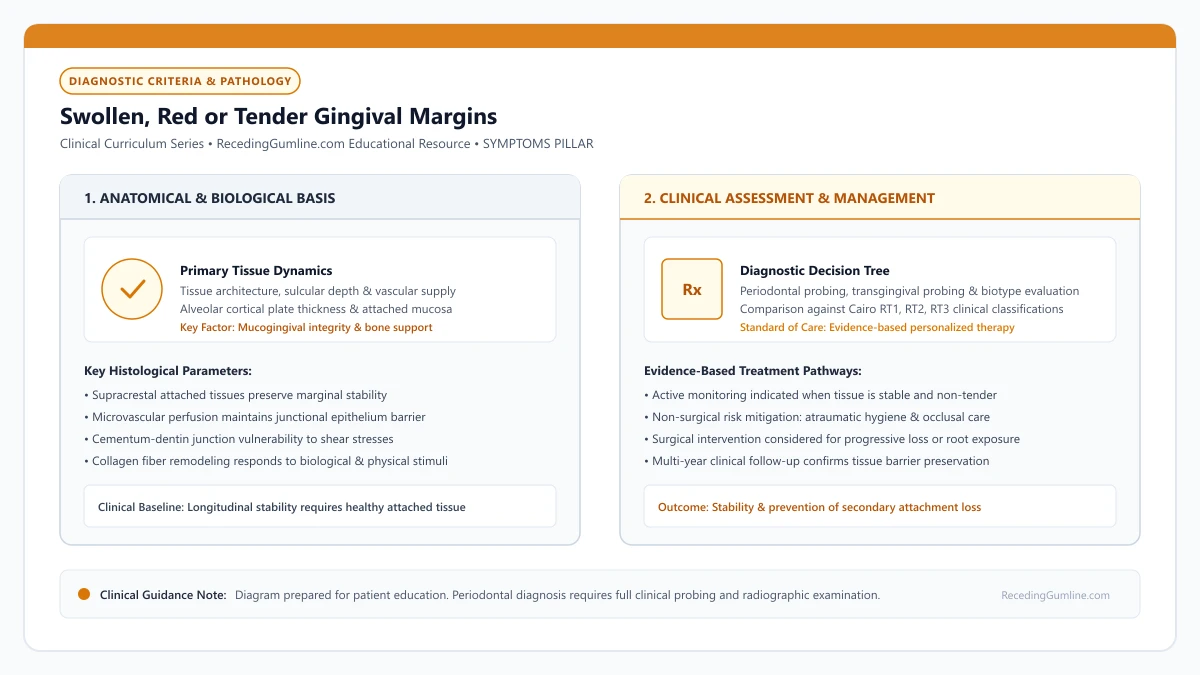
Educational illustration: Swollen, Red or Tender Gingival Margins. Clinical management requires comprehensive periodontal evaluation rather than isolated self-assessment.
Source: RecedingGumline.com Clinical Editorial Team (Proprietary educational diagram for RecedingGumline.com)
Microvascular Dynamics: Erythema, Edema & Stippling Loss
Gingival inflammation begins within hours of bacterial biofilm stagnation along the cervical margin. Bacterial lipopolysaccharides and metabolic byproducts diffuse through the junctional epithelium, activating mast cells, macrophages, and endothelial cells to release vasoactive mediators, including histamine, prostaglandins (PGE2), and bradykinin.
These chemical mediators trigger profound vasodilation of the post-capillary venules within the gingival plexus, causing blood flow to surge and creating the characteristic fiery red or purplish-red discoloration (erythema). Simultaneously, endothelial cell junctions widen, permitting massive fluid exudation (inflammatory edema) and extravasation of serum proteins into the extracellular connective tissue space.
As the lamina propria becomes engorged with interstitial fluid, the tissue swells and expands. The collagen fiber bundles that maintain surface stippling are degraded by matrix metalloproteinases, causing the gingival surface to lose its textured appearance and become taut, smooth, and glossy with rounded, rolled margins.
Key Clinical Insights
- Bacterial toxins provoke histamine and prostaglandin release, inducing localized vasodilation.
- Extravasation of fluid into connective tissue creates inflammatory edema and tissue enlargement.
- Degradation of collagen bundles eliminates stippling, transforming firm tissue into glossy, rolled margins.
Pseudo-Pockets: How Swelling Artificially Masks Recession
A critically important clinical concept in periodontology is the distinction between a true periodontal pocket and a gingival pocket (pseudo-pocket). In health, the gingival sulcus measures 1 to 3 mm in depth. When marginal tissue undergoes inflammatory swelling, the coronal margin expands outward and upward toward the incisal edge.
This coronal enlargement increases the measured probing depth to 4 or 5 mm, even if the underlying connective tissue attachment has not moved apically. This condition is termed a "pseudo-pocket" because the increased pocket depth reflects coronal soft-tissue enlargement rather than apical bone destruction.
Crucially, inflammatory swelling can completely mask underlying gingival recession. A tooth that has lost 2 mm of bone and attachment may appear to have a normal gumline because 2 mm of inflammatory edema covers the exposed root. When the patient undergoes scaling and root planing, the swelling resolves, the tissue shrinks, and the true extent of recession is revealed.
Key Clinical Insights
- Coronal soft-tissue enlargement creates pseudo-pockets that mimic deep periodontal disease.
- Inflammatory edema can artificially cover exposed roots, masking true attachment loss.
- Post-treatment resolution of swelling contracts the margin, unmasking the true level of bone and root.
Systemic & Medication-Induced Gingival Enlargement
While dental plaque biofilm is the primary cause of swollen gums, clinicians must evaluate non-plaque-induced factors that drive chronic tissue enlargement. Hormonal fluctuations—during puberty, pregnancy, or oral contraceptive use—exaggerate the vascular response, causing intense swelling even in the presence of minimal plaque.
Furthermore, several widely prescribed systemic medications induce Drug-Induced Gingival Overgrowth (DIGO). Common causative agents include calcium channel blockers (such as amlodipine and nifedipine) used for hypertension, immunosuppressants (such as cyclosporine) used post-transplant, and anticonvulsants (such as phenytoin).
These medications interfere with intracellular calcium metabolism in gingival fibroblasts, leading to excessive accumulation of extracellular collagen matrix. When drug-induced enlargement occurs alongside underlying bone dehiscences, surgical gingivectomy or medication adjustment is required to restore normal contours.
Key Clinical Insights
- Hormonal surges during pregnancy or puberty amplify vascular permeability and marginal swelling.
- Medications like amlodipine, cyclosporine, and phenytoin can trigger severe drug-induced gingival overgrowth.
- Managing drug-induced swelling requires coordinating medication substitution with the patient's physician.
Atraumatic Resolution Protocols & Tissue Stabilization
Resolving swollen, tender gums requires methodical elimination of microbial biofilms without inflicting traumatic injury on the hyperemic, friable tissue. Patients should utilize ultra-soft toothbrushes, applying the Modified Bass vibratory technique with light, gentle pressure to sweep the inflamed sulcus.
Chemical plaque control with warm saline rinses or short-term therapeutic antimicrobial mouthwashes (0.12% chlorhexidine or cetylpyridinium chloride) provides potent anti-inflammatory and antiseptic action, soothing tender margins while suppressing bacterial load.
Most importantly, professional scaling and root planing must be performed to dislodge subgingival calculus deposits that harbor bacteria beyond the reach of at-home brushes. Once the bacterial trigger is removed, the inflammatory cascade halts, interstitial fluid reabsorbs into the lymphatic system, and the gingiva returns to a firm, stippled, pink state within 10 to 14 days.
Key Clinical Insights
- Ultra-soft bristles and the Modified Bass technique clean inflamed margins without painful lacerations.
- Warm saline and therapeutic antimicrobial rinses reduce localized edema and soothe tender tissues.
- Professional subgingival scaling eliminates calculus, enabling full inflammatory resolution in 10-14 days.
Long-Term Structural Consequences of Unresolved Marginal Swelling
Allowing chronic gingival swelling to persist without professional periodontal therapy transforms a manageable soft-tissue condition into permanent structural attachment loss. Chronic inflammatory exudate contains high concentrations of osteoclast-activating factors and proteolytic matrix metalloproteinases that gradually degrade the underlying supracrestal connective tissue fibers.
Over months of persistent inflammation, the crestal bone margin resorbs apically. When the patient finally receives periodontal debridement or when acute swelling subsides, the newly contracted tissue margin settles at the reduced bone level, presenting as permanent, irreversible gingival recession.
Early therapeutic intervention within the initial stages of marginal swelling preserves the underlying alveolar bone architecture, preventing the development of permanent aesthetic and functional recession defects.
Key Clinical Insights
- Chronic swelling harbors destructive enzymes that degrade supracrestal connective tissue.
- Sustained inflammation activates osteoclasts, driving irreversible crestal bone resorption.
- Prompt resolution of swelling preserves alveolar bone and prevents permanent recession.
Clinical Reality Check
Patients frequently stop brushing swollen, bleeding gums because the tissue is tender. This creates a destructive feedback loop: neglected oral hygiene leads to rapid plaque maturation, triggering even worse swelling and accelerated attachment loss. Gentle, atraumatic brushing must be maintained.
Questions to Ask Your Dentist or Periodontist
- Is my gum swelling caused strictly by plaque, or could my daily medications or hormones be contributing?
- Do I have true periodontal pockets with bone loss, or are these swollen pseudo-pockets?
- How much will my gumline recede or shrink once this inflammation and swelling resolve?
- What gentle mouthrinse or desensitizing paste do you recommend while my gums are tender and healing?
- How soon should I return for a follow-up exam to verify that the swelling has completely resolved?
Unsure What Your Gum Changes Mean?
Take our free, evidence-based Gum Recession Assessment — approximately 3 minutes. Identify potential risk factors, evaluate symptoms, and receive personalized discussion questions for your dentist or periodontist.
Non-diagnostic educational triage. Private, secure, completed in your browser.
Related Educational Topics
Scientific Literature & Clinical Guidelines
4sources · Hide ▲
- Chapple ILC, Mealey BL, Van Dyke TE, Bartold PM, Dommisch H, Eickholz P, et al. (2018).
"Periodontal health and gingival diseases and conditions on an intact and a reduced periodontium: Consensus report of workgroup 1 of the 2017 World Workshop on the Classification of Periodontal and Peri-Implant Diseases and Conditions." Journal of Clinical Periodontology.
Clinical relevance: Consensus report establishing diagnostic criteria for periodontal health and gingivitis across intact and reduced periodontia, defining clinical gingival health as <10% bleeding on probing without attachment loss and strictly differentiating gingivitis from periodontitis.
- Tonetti MS, Greenwell H, Kornman KS (2018).
"Staging and grading of periodontitis: Framework and proposal of a new classification and case definition." Journal of Clinical Periodontology.
Clinical relevance: Consensus framework establishing the multidimensional staging (severity and extent of periodontal tissue breakdown) and grading (biological rate of disease progression, incorporating smoking and diabetes as grade modifiers) for periodontitis. It addresses periodontitis diagnosis and staging, not the classification of localized gingival recession defects.
- Löe H, Theilade E, Jensen SB (1965).
"Experimental gingivitis in man." The Journal of Periodontology.
Clinical relevance: Classic experimental gingivitis study demonstrating that withdrawal of oral hygiene leads to bacterial plaque accumulation and reversible marginal gingival inflammation within 10 to 21 days, establishing the microbial etiology of gingival inflammation. It serves as foundational evidence for plaque-induced gingivitis, not modern comprehensive models of periodontitis or gingival recession.
- Pihlstrom BL, Michalowicz BS, Johnson NW (2005).
"Periodontal diseases." The Lancet.
Clinical relevance: Peer-reviewed Lancet seminar review synthesizing global periodontal epidemiology, microbial etiology, host immunopathology, and systemic interactions, emphasizing prevention, biofilm disruption, and early risk factor modification.
Important Medical Notice
The contents of RecedingGumline.com, including text, graphics, self-assessment calculators, and other materials, are intended solely for educational and informational purposes. This content is not intended to replace professional dental examination, diagnosis, or treatment. Always seek the advice of a qualified dentist, periodontist, or other licensed oral healthcare provider with any questions you may have regarding a medical or dental condition. Never disregard professional medical advice or delay seeking it because of something you read on this website.