Plaque Inflammatory Cascade: Gingivitis to Gum Recession
How does bacterial plaque trigger inflammation that destroys gum tissue and jawbone?
While mechanical forces play a substantial role in localized recession, the primary challenge in the clinical management of receding gums care is plaque-induced periodontal disease. When bacterial biofilms accumulate at the gingival margin, they trigger an aggressive host immune-inflammatory response. Left unresolved, this chronic immune cascade destroys collagen fibers, degrades the junctional epithelium, and resorbs alveolar bone.
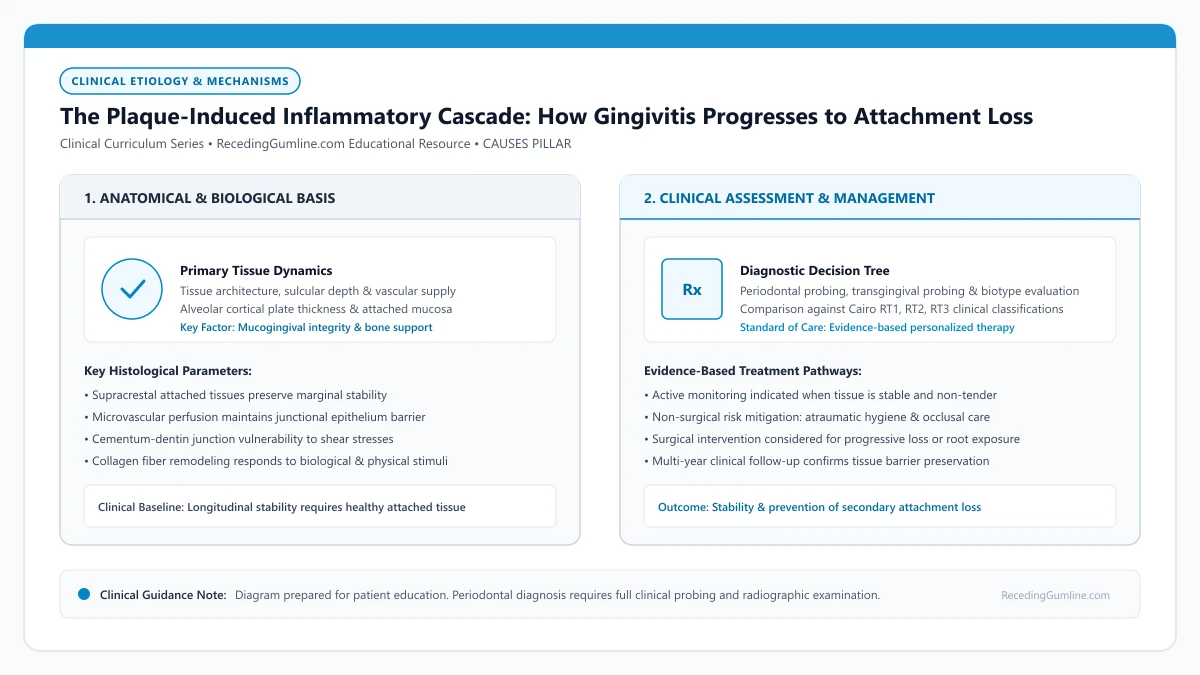
Educational illustration: The Plaque-Induced Inflammatory Cascade: How Gingivitis Progresses to Attachment Loss. Clinical management requires comprehensive periodontal evaluation rather than isolated self-assessment.
Source: RecedingGumline.com Clinical Editorial Team (Proprietary educational diagram for RecedingGumline.com)
Key Clinical Distinctions & Diagnostic Boundaries
- Gingivitis is an inflammatory lesion confined to the soft gingival margin; it is 100% reversible with proper hygiene.
- Periodontitis occurs when the inflammatory front reaches the alveolar crest and periodontal ligament, causing irreversible attachment loss.
- It is not the bacteria directly eating the bone; it is the host's own hyper-activated immune cells that resorb the bone in an attempt to retreat from infection.
- Recession in periodontitis occurs when the overlying soft tissue follows the resorbing bone downward.
Phase 1: Biofilm Endotoxins and Neutrophil Infiltration
Within hours of brushing, salivary glycoproteins form an acquired pellicle on the teeth, quickly colonized by pioneer oral bacteria. If left undisturbed, this supragingival biofilm matures and migrates subgingivally into the protective crevice of the gingival sulcus.
Gram-negative anaerobic bacteria shed toxic cell wall fragments known as lipopolysaccharides (endotoxins). These endotoxins penetrate the permeable junctional epithelium, signaling the host vascular system. Blood vessels dilate, and millions of polymorphonuclear neutrophils (PMNs) extravasate into the sulcus to form a defensive immune barrier.
The accumulation of subgingival microbial biofilm triggers an intensive host immune response characterized by the recruitment of polymorphonuclear neutrophils and macrophages. These immune cells release pro-inflammatory cytokines such as interleukin-1 beta, tumor necrosis factor-alpha, and prostaglandin E2.
Clinical Considerations:
- Unchecked supragingival plaque matures into virulent subgingival anaerobic biofilms
- Bacterial lipopolysaccharides (LPS) penetrate the fragile junctional epithelial seal
- Vessels dilate and neutrophils infiltrate, manifesting as red, bleeding gingivitis
Phase 2: The Host Response and Collagen Lysis by MMPs
If biofilm is not removed, acute gingivitis transitions into a chronic inflammatory lesion dominated by macrophages, T-lymphocytes, and plasma cells. These immune cells release pro-inflammatory cytokines, including Interleukin-1 beta (IL-1β) and Tumor Necrosis Factor alpha (TNF-α).
These cytokines stimulate resident gingival fibroblasts to produce destructive collagen-cleaving enzymes called Matrix Metalloproteinases (principally MMP-8 and MMP-1). In their effort to clear space for immune cells to combat bacteria, MMPs liquefy the collagen fiber bundles of the gingival connective tissue and periodontal ligament.
In an effort to prevent bacterial invasion into deeper skeletal structures, host-derived matrix metalloproteinases (MMPs) degrade collagen fibers within the gingival connective tissue and periodontal ligament. This enzymatic breakdown dissolves the structural scaffold supporting the gingival margin.
Clinical research proves that resolving soft-tissue inflammation through biofilm suppression halts ongoing matrix metalloproteinase production, allowing damaged periodontal ligament fibers to stabilize and arrest further clinical attachment loss.
Clinical Considerations:
- Chronic inflammation stimulates macrophages to release pro-inflammatory IL-1β and TNF-α
- Matrix Metalloproteinases (MMP-8 and MMP-1) dissolve gingival collagen fiber networks
- Destruction of connective tissue attachment allows the epithelial cuff to migrate apically
Phase 3: The RANKL Cascade and Bone Resorption
The definitive boundary separating reversible gingivitis from irreversible periodontitis is the involvement of alveolar bone. Inflammatory cytokines stimulate osteoblasts and stromal cells to express Receptor Activator of Nuclear Factor Kappa-B Ligand (RANKL).
RANKL binds to receptors on pre-osteoclasts, activating them into mature bone-resorbing osteoclasts. These osteoclasts dissolve the mineralized matrix of the alveolar crest. As the bone crest melts away, the overlying soft-tissue margin loses its skeletal support and recedes apically, creating exposed roots.
Simultaneous activation of the RANKL signaling pathway stimulates osteoclast differentiation, leading to irreversible resorption of the crestal alveolar bone. As underlying bone height diminishes, the overlying soft-tissue envelope recedes apically to establish a new supracrestal biological width.
Clinical Considerations:
- Cytokines activate the RANKL signaling pathway, stimulating mature osteoclasts
- Osteoclasts dissolve the alveolar bone crest to maintain a safe biological distance from infection
- Gingival margin collapses into the resorbed space, manifesting as clinical gum recession
The Biochemical Destruction Cascade: Cytokines & Collagenases
The transition from superficial gingivitis to destructive recession is driven by an uncoupling of the host immuno-inflammatory response. When dental plaque biofilm accumulates subgingivally, pathogenic bacteria release virulence factors including lipopolysaccharides (LPS) and gingipains.
In response, host immune cells (neutrophils and macrophages) infiltrate the connective tissue and secrete pro-inflammatory cytokines such as Interleukin-1 beta (IL-1β), Interleukin-6 (IL-6), and Tumor Necrosis Factor-alpha (TNF-α). These signaling molecules trigger host fibroblasts and neutrophils to overproduce Matrix Metalloproteinases—predominantly MMP-8 (collagenase-2) and MMP-9.
These destructive host enzymes cleave Type I and Type III collagen fibers within the gingival matrix, dissolving the connective tissue framework and causing the marginal tissue to collapse and migrate apically away from the inflammatory source.
Clinical Considerations:
- Subgingival biofilm lipopolysaccharides trigger a hyperactive host immune response.
- Pro-inflammatory cytokines (IL-1β, TNF-α) stimulate massive release of host MMP-8 collagenases.
- Host collagenase enzymes cleave dense connective tissue fibers, causing marginal tissue collapse.
Therapeutic Resolution: Breaking the Inflammatory Feedback Loop
Halting the inflammatory recession cascade requires complete disruption of the subgingival biofilm and removal of bacterial endotoxins embedded within the root surface cementum. Ultrasonic instrumentation paired with sharp micro-curettes delivers precise scaling and root planing.
Following meticulous mechanical debridement, the continuous influx of neutrophils ceases, cytokine concentrations drop precipitously, and endogenous tissue inhibitors of metalloproteinases (TIMPs) regain dominance over destructive MMPs. This restores biochemical equilibrium, allowing healing by a long junctional epithelium.
Patients must maintain meticulous daily biofilm control and adhere to a 3- to 4-month periodontal maintenance schedule to prevent re-colonization by red-complex pathogens and avert recurrent inflammatory tissue degradation.
Clinical Considerations:
- Meticulous scaling and root planing removes subgingival biofilm and endotoxins.
- Halting bacterial stimulation restores the balance between tissue inhibitors (TIMPs) and MMPs.
- Regular periodontal maintenance intervals prevent pathogenic biofilm re-establishment.
Clinical Reality Check
Periodontitis is fundamentally a host-mediated disease; your own immune system destroys the bone and gums in a desperate attempt to protect the rest of your body from deep bacterial invasion.
Questions to Ask Your Periodontist or Dentist
- Do my clinical findings indicate reversible gingivitis or irreversible periodontitis with bone loss?
- What are my current bleeding-on-probing percentages across my mouth?
- What specific home hygiene regimen will disrupt this subgingival inflammatory cascade?
- How long after my deep cleaning will it take for the tissue-destroying enzymes to deactivate?
Unsure What Your Gum Changes Mean?
Take our free, evidence-based Gum Recession Assessment — approximately 3 minutes. Identify potential risk factors, evaluate symptoms, and receive personalized discussion questions for your dentist or periodontist.
Non-diagnostic educational triage. Private, secure, completed in your browser.
Related Educational Topics
Clinical Evidence & Claim Traceability (3 Mapped Assertions)
Scientific Literature & Clinical Guidelines
3sources · Hide ▲
- Löe H, Theilade E, Jensen SB (1965).
"Experimental gingivitis in man." The Journal of Periodontology.
Clinical relevance: Classic experimental gingivitis study demonstrating that withdrawal of oral hygiene leads to bacterial plaque accumulation and reversible marginal gingival inflammation within 10 to 21 days, establishing the microbial etiology of gingival inflammation. It serves as foundational evidence for plaque-induced gingivitis, not modern comprehensive models of periodontitis or gingival recession.
- Tonetti MS, Greenwell H, Kornman KS (2018).
"Staging and grading of periodontitis: Framework and proposal of a new classification and case definition." Journal of Clinical Periodontology.
Clinical relevance: Consensus framework establishing the multidimensional staging (severity and extent of periodontal tissue breakdown) and grading (biological rate of disease progression, incorporating smoking and diabetes as grade modifiers) for periodontitis. It addresses periodontitis diagnosis and staging, not the classification of localized gingival recession defects.
- Chapple ILC, Mealey BL, Van Dyke TE, Bartold PM, Dommisch H, Eickholz P, et al. (2018).
"Periodontal health and gingival diseases and conditions on an intact and a reduced periodontium: Consensus report of workgroup 1 of the 2017 World Workshop on the Classification of Periodontal and Peri-Implant Diseases and Conditions." Journal of Clinical Periodontology.
Clinical relevance: Consensus report establishing diagnostic criteria for periodontal health and gingivitis across intact and reduced periodontia, defining clinical gingival health as <10% bleeding on probing without attachment loss and strictly differentiating gingivitis from periodontitis.
Important Medical Notice
The contents of RecedingGumline.com, including text, graphics, self-assessment calculators, and other materials, are intended solely for educational and informational purposes. This content is not intended to replace professional dental examination, diagnosis, or treatment. Always seek the advice of a qualified dentist, periodontist, or other licensed oral healthcare provider with any questions you may have regarding a medical or dental condition. Never disregard professional medical advice or delay seeking it because of something you read on this website.