Subgingival Plaque Biofilm Ecology in Gum Recession: Keystone Pathogens and Dysbiosis
What bacteria live beneath receding gums, and how does microbial dysbiosis destroy tissue?
In the human mouth, hundreds of bacterial species coexist in complex biological communities known as biofilms (see our receding gumline guide). In a state of health, this oral microbiome lives in harmonious symbiosis with the host. However, when plaque is left undisturbed beneath the gingival margin, the microbial ecosystem undergoes a profound ecological shift—termed dysbiosis—transforming into a virulent anaerobic community that destroys periodontal bone and tissue.
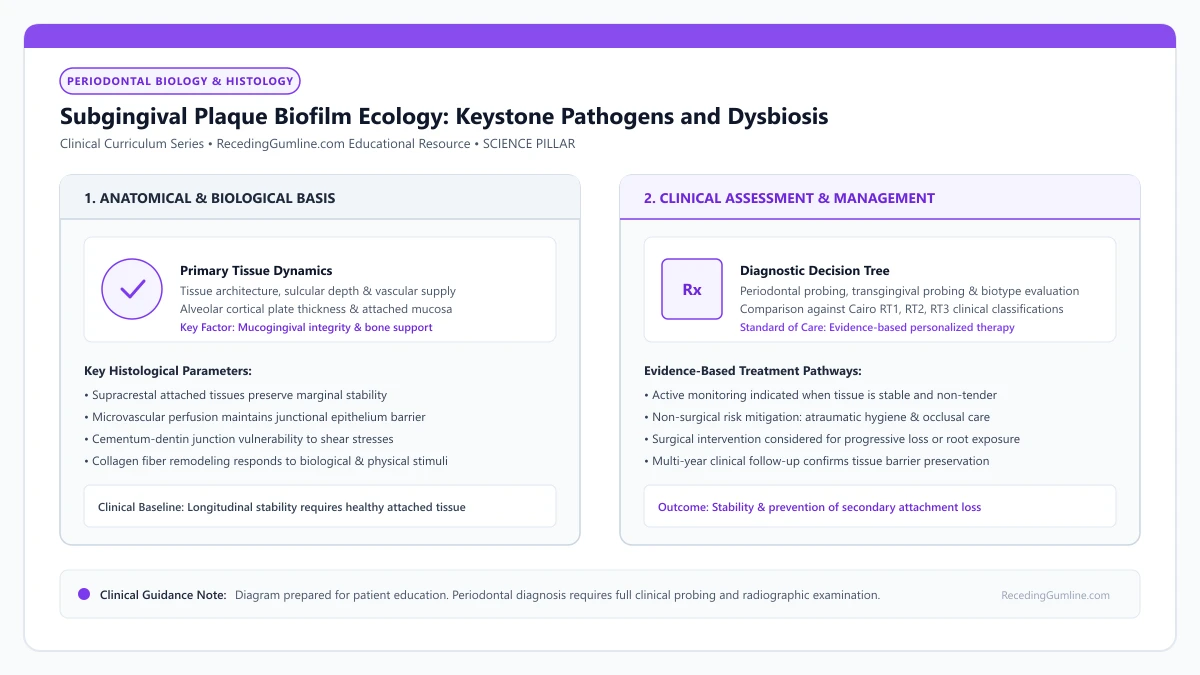
Educational illustration: Subgingival Plaque Biofilm Ecology: Keystone Pathogens and Dysbiosis. Clinical management requires comprehensive periodontal evaluation rather than isolated self-assessment.
Source: RecedingGumline.com Clinical Editorial Team (Proprietary educational diagram for RecedingGumline.com)
Key Clinical Distinctions & Diagnostic Boundaries
- Periodontal disease is not an infection caused by a single exogenous bacterium; it is an ecological dysbiosis of endogenous oral flora.
- Bacteria encased within a subgingival biofilm are up to 1,000 times more resistant to antibiotics and antimicrobial rinses than free-floating (planktonic) bacteria.
- Mechanical debridement (scaling) is mandatory to physically shatter the protective EPS matrix; rinses alone cannot penetrate mature biofilms.
- The Red Complex thrives in anaerobic, blood-rich subgingival pockets; resolving pockets reintroduces oxygen, suppressing these pathogens.
The Biofilm Fortress: The Extracellular Polymeric Substance Matrix
Bacteria in the subgingival pocket do not float as solitary individuals; they construct an intricate, multicellular micro-city known as a biofilm. The bacteria secrete a slime-like extracellular polymeric substance (EPS) matrix made of polysaccharides, extracellular DNA, and proteins.
This EPS matrix acts like armor, shielding the bacteria from the host immune system (white blood cells) and rendering them up to 1,000 times more resistant to systemic antibiotics and antiseptic mouthwashes than planktonic bacteria. Water channels within the matrix circulate nutrients and remove waste, functioning as an internal circulatory system.
Dental plaque is not a random accumulation of bacteria, but a highly structured polymicrobial biofilm embedded within an extracellular polysaccharide matrix. As biofilm matures and migrates subgingivally, the micro-environment transitions from aerobic gram-positive cocci to strictly anaerobic gram-negative motile rods.
Clinical Considerations:
- Bacteria live in structured multicellular biofilms protected by an extracellular polymeric matrix
- Matrix shields pathogens from host antibodies and makes them 1,000x resistant to antibiotics
- Microscopic fluid channels circulate nutrients and chemical signals between bacterial species
Socransky's Microbial Complexes: The Deadly Red Complex
In the late 1990s, Dr. Sigmund Socransky and researchers at the Forsyth Institute organized subgingival bacteria into color-coded microbial complexes based on their association with health or disease. Yellow, green, and purple complexes consist of early colonizers that are generally benign.
However, as pockets deepen, the Orange Complex (including Fusobacterium nucleatum) bridges the gap, allowing the lethal Red Complex to emerge. The Red Complex consists of three obligate anaerobes: Porphyromonas gingivalis, Treponema denticola, and Tannerella forsythia. Their presence is virtually universal in sites undergoing active, destructive bone resorption and clinical attachment loss.
Key periodontal pathogens comprising Socransky’s red complex—Porphyromonas gingivalis, Treponema denticola, and Tannerella forsythia—dominate the deep subgingival pocket niches. These virulent organisms produce toxic proteases, hemolysins, and lipopolysaccharides that trigger severe tissue destruction.
Clinical Considerations:
- Color-coded complexes track ecological succession from early health to late disease
- Orange Complex acts as a biological bridge, facilitating colonizing anaerobes
- Red Complex (P. gingivalis, T. denticola, T. forsythia) drives active tissue destruction
The Keystone Pathogen Theory: P. Gingivalis and Dysbiosis
Modern periodontal microbiology, pioneered by Dr. George Hajishengallis, established the "Keystone Pathogen Hypothesis." Research proved that Porphyromonas gingivalis does not need to be present in massive quantities to destroy tissue; even in tiny numbers, it acts as a master manipulator.
P. gingivalis produces specialized cysteine proteases called gingipains. Gingipains cleave host complement proteins (C5a), paralyzing white blood cells and dismantling the immune response. By subverting host defenses, P. gingivalis allows the entire benign microbial community to overgrow into a hyper-virulent dysbiotic state that triggers massive bone destruction.
The physical architecture of the biofilm shields resident pathogens from systemic antibiotics and host immunological defenses. Effective clinical therapy requires physical mechanical disruption of the biofilm matrix through ultrasonic scaling and curettage, as chemical agents alone cannot penetrate mature biofilm.
Clinical Considerations:
- P. gingivalis acts as a master manipulator, remodeling benign biofilms into pathogens
- Gingipain enzymes disarm white blood cells and disable host immune defenses
- Drives the transition from symbiotic health to destructive periodontal dysbiosis
Microbial Ecology: Socransky's Complexes & Dysbiotic Shift
The subgingival microenvironment exists in a state of dynamic equilibrium between host immune defenses and bacterial biofilms. In 1998, Sigmund Socransky organized subgingival microorganisms into colored complexes based on their association with health or disease.
In healthy sites, yellow, green, and blue complexes (dominated by Streptococcus and Actinomyces species) form a stable, commensal biofilm. However, poor hygiene, mechanical stagnation, or local inflammation induces ecological dysbiosis.
The pioneer species are gradually displaced by the orange complex (Fusobacterium nucleatum, Prevotella intermedia), which creates an anaerobic, nutrient-rich environment that facilitates colonization by the virulent "red complex": Porphyromonas gingivalis, Treponema denticola, and Tannerella forsythia.
Clinical Considerations:
- Healthy subgingival sulci are colonized by commensal yellow, green, and blue bacterial complexes.
- Ecological dysbiosis shifts the microenvironment from aerobic commensals to pathogenic anaerobes.
- The red complex (P. gingivalis, T. denticola, T. forsythia) is the primary driver of destructive periodontitis.
The Extracellular Polymeric Substance (EPS) Matrix & Biofilm Recalcitrance
Subgingival bacteria do not exist as free-floating (planktonic) cells; they are encased within a self-produced Extracellular Polymeric Substance (EPS) matrix composed of exopolysaccharides, extracellular DNA (eDNA), proteins, and lipids.
This gelatinous EPS matrix provides structural stability, coordinates bacterial cell-to-cell communication (quorum sensing), and acts as a physical barrier that restricts the penetration of host antibodies, complement proteins, and systemic antibiotics.
Bacteria embedded within a mature subgingival biofilm can be up to 1,000 times more resistant to antimicrobial agents than their planktonic counterparts. Consequently, effective periodontal therapy mandates mechanical disruption via scaling and root planing; chemical mouthwashes alone cannot penetrate the EPS barrier.
Clinical Considerations:
- The EPS matrix encases subgingival bacteria in a protective mesh of polysaccharides, eDNA, and proteins.
- Biofilms exhibit up to 1,000-fold higher resistance to antimicrobial agents than free-floating bacteria.
- Mechanical instrumentation (scaling and root planing) is essential to physically disrupt the EPS matrix.
Clinical Reality Check
Mouthwashes and antibiotics cannot eradicate periodontitis because they cannot penetrate the dense biofilm matrix; scaling and root planing is required to physically disrupt the biofilm structure.
Questions to Ask Your Periodontist or Dentist
- Do my periodontal probing depths indicate the presence of deep, anaerobic subgingival pockets?
- How does scaling and root planing physically disrupt this subgingival bacterial biofilm?
- What specific daily home hygiene tools (interdental brushes, water flossers) will reach into these microbial areas?
- Why can't I just take a course of antibiotics to kill the gum disease bacteria?
Unsure What Your Gum Changes Mean?
Take our free, evidence-based Gum Recession Assessment — approximately 3 minutes. Identify potential risk factors, evaluate symptoms, and receive personalized discussion questions for your dentist or periodontist.
Non-diagnostic educational triage. Private, secure, completed in your browser.
Related Educational Topics
Clinical Evidence & Claim Traceability (3 Mapped Assertions)
Scientific Literature & Clinical Guidelines
3sources · Hide ▲
- Löe H, Theilade E, Jensen SB (1965).
"Experimental gingivitis in man." The Journal of Periodontology.
Clinical relevance: Classic experimental gingivitis study demonstrating that withdrawal of oral hygiene leads to bacterial plaque accumulation and reversible marginal gingival inflammation within 10 to 21 days, establishing the microbial etiology of gingival inflammation. It serves as foundational evidence for plaque-induced gingivitis, not modern comprehensive models of periodontitis or gingival recession.
- Tonetti MS, Greenwell H, Kornman KS (2018).
"Staging and grading of periodontitis: Framework and proposal of a new classification and case definition." Journal of Clinical Periodontology.
Clinical relevance: Consensus framework establishing the multidimensional staging (severity and extent of periodontal tissue breakdown) and grading (biological rate of disease progression, incorporating smoking and diabetes as grade modifiers) for periodontitis. It addresses periodontitis diagnosis and staging, not the classification of localized gingival recession defects.
- Pihlstrom BL, Michalowicz BS, Johnson NW (2005).
"Periodontal diseases." The Lancet.
Clinical relevance: Peer-reviewed Lancet seminar review synthesizing global periodontal epidemiology, microbial etiology, host immunopathology, and systemic interactions, emphasizing prevention, biofilm disruption, and early risk factor modification.
Important Medical Notice
The contents of RecedingGumline.com, including text, graphics, self-assessment calculators, and other materials, are intended solely for educational and informational purposes. This content is not intended to replace professional dental examination, diagnosis, or treatment. Always seek the advice of a qualified dentist, periodontist, or other licensed oral healthcare provider with any questions you may have regarding a medical or dental condition. Never disregard professional medical advice or delay seeking it because of something you read on this website.