The Host Inflammatory Response & Connective Tissue Breakdown in Gum Recession
In the progression of receding gumline factors, a foundational paradigm of modern periodontal science is that bacteria initiate periodontal disease, but it is the host's own immune-inflammatory response that drives the overwhelming majority of tissue destruction. In response to subgingival dysbiotic biofilms, the host deploys an array of immune cells and biochemical mediators designed to neutralize bacterial invasion. However, when this inflammatory response becomes chronic and uncontained, it unleashes destructive enzymes and osteoclast-activating pathways that degrade collagen fibers, resorb alveolar bone, and cause irreversible gingival recession.
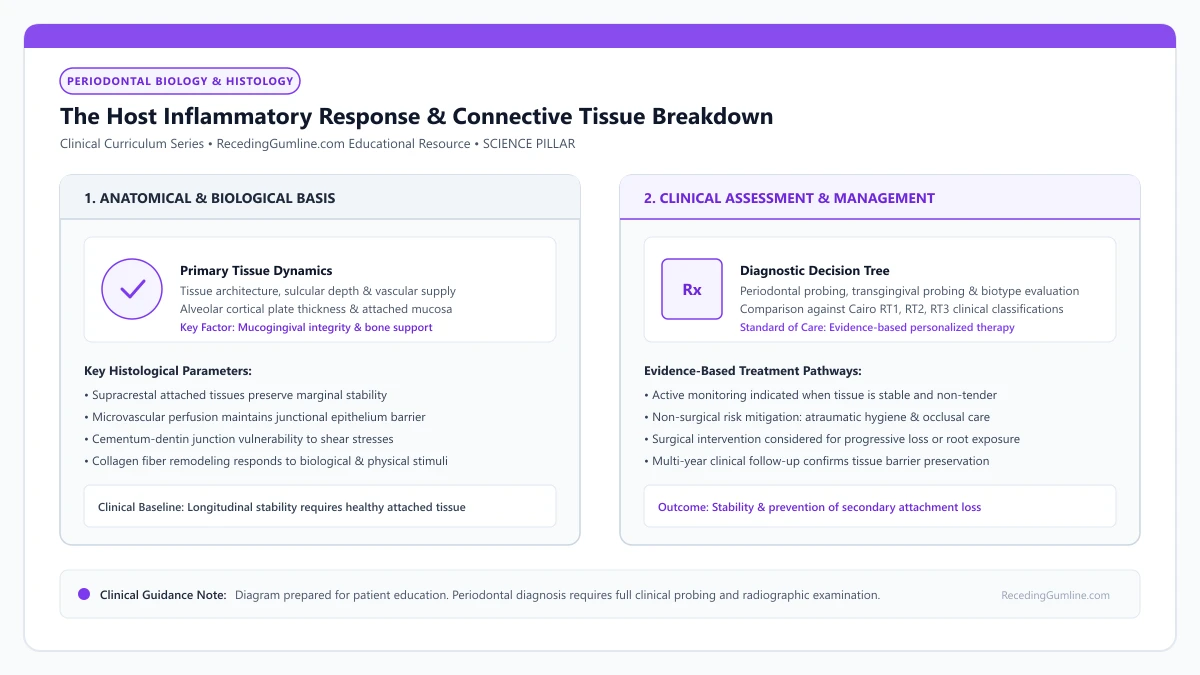
Educational illustration: The Host Inflammatory Response & Connective Tissue Breakdown. Clinical management requires comprehensive periodontal evaluation rather than isolated self-assessment.
Source: RecedingGumline.com Clinical Editorial Team (Proprietary educational diagram for RecedingGumline.com)
The Host-Mediated Destruction Paradigm
For over a century, dental pathology assumed that bacterial enzymes directly digested periodontal tissues. Pioneering immunobiological research has disproven this simplistic view. While bacterial enzymes (such as hyaluronidases and proteases) inflict minor localized damage, the massive loss of connective tissue and alveolar bone observed in periodontitis and recession is host-mediated.
When bacterial antigens (particularly lipopolysaccharides from Gram-negative anaerobes) penetrate the junctional epithelium, they bind to Toll-Like Receptors (TLR-2 and TLR-4) on host macrophages, dendritic cells, and gingival fibroblasts.
This molecular recognition triggers the synthesis and release of potent pro-inflammatory signaling cytokines, including Interleukin-1 beta (IL-1b), Tumor Necrosis Factor-alpha (TNF-a), and Interleukin-6 (IL-6). These cytokines orchestrate a massive immune response, recruiting waves of polymorphonuclear leukocytes (neutrophils) into the sulcular crevice.
[object Object]
Key Scientific Insights
- Host immune-inflammatory pathways inflict over 80% of structural periodontal breakdown.
- Bacterial lipopolysaccharides bind Toll-Like Receptors, activating pro-inflammatory cytokine release.
- Cytokines recruit massive neutrophil infiltrates into the gingival sulcus, setting the stage for tissue destruction.
Matrix Metalloproteinases (MMPs) & Collagen Destruction
The structural integrity of the gingiva and periodontal ligament relies on dense networks of type I and type III collagen fibrils. Human collagen fibrils possess a triple-helix molecular structure that is impervious to ordinary proteolytic enzymes.
To break down this dense matrix during immune cell migration, neutrophils and fibroblasts release specialized zinc-dependent endopeptidases known as Matrix Metalloproteinases (MMPs). Specifically, MMP-8 (neutrophil collagenase) and MMP-9 (gelatinase B) possess the unique capability to cleave the triple helix of type I collagen into fragments.
In chronic periodontal inflammation, massive release of active MMP-8 overwhelms the body's natural inhibitors (Tissue Inhibitors of Metalloproteinases, or TIMPs). The collagen fibers anchoring the gingival margin to the tooth root are fragmented and dissolved. Without structural collagen support, the supracrestal soft tissue collapses and recedes apically.
Key Scientific Insights
- Gingiva and PDL are composed primarily of triple-helix type I collagen fibers.
- MMP-8 (neutrophil collagenase) cleaves type I collagen, fragmenting structural attachment fibers.
- An imbalance between MMPs and TIMPs drives rapid, irreversible soft-tissue degradation and recession.
The RANKL/OPG Pathway & Alveolar Bone Resorption
Concurrent with collagen degradation, the inflammatory cascade triggers the destruction of the underlying alveolar bone crest. Bone remodeling is physiologically regulated by the molecular balance between three proteins: RANK (Receptor Activator of Nuclear Factor-kB), RANKL (RANK Ligand), and OPG (Osteoprotegerin).
In healthy bone, osteoblasts secrete OPG, a decoy receptor that binds to RANKL and prevents it from activating osteoclasts. However, in the presence of elevated IL-1beta and TNF-alpha, T-lymphocytes, B-lymphocytes, and periodontal ligament fibroblasts dramatically upregulate RANKL expression while downregulating OPG.
The surplus RANKL binds to RANK receptors on osteoclast precursor cells, stimulating their proliferation, differentiation, and activation into mature, bone-resorbing osteoclasts. These osteoclasts attach to the alveolar bone crest, secreting hydrochloric acid and cathepsin K to demineralize and digest bone matrix. As the bone crest resorbs apically, the overlying gingival margin loses skeletal foundation and recedes.
Key Scientific Insights
- Alveolar bone resorption is controlled by the balance between RANKL and its decoy receptor OPG.
- Inflammatory cytokines upregulate RANKL, triggering massive osteoclast proliferation and activation.
- Active osteoclasts dissolve alveolar bone crests, stripping the structural support beneath the gumline.
Host Modulation Therapy: Inhibiting Destructive Pathways
Recognizing that host enzymes drive tissue breakdown has led to the development of Host Modulation Therapy (HMT). The premier clinical example is Sub-Antimicrobial Dose Doxycycline (SDD, 20 mg twice daily).
At this sub-antimicrobial concentration, doxycycline does not kill bacteria or induce antibiotic resistance; instead, it directly binds and inhibits active MMP-8 and MMP-9 enzymes while downregulating pro-inflammatory cytokine expression.
When used as an adjunct to mechanical scaling and root planing in patients with aggressive periodontitis, host modulation therapy significantly dampens collagenolytic destruction, arrests progressive attachment loss, and stabilizes fragile gingival margins.
Key Scientific Insights
- Host modulation therapy targets destructive host enzymes rather than killing bacteria.
- Sub-antimicrobial dose doxycycline (20 mg) directly inhibits MMP-8 collagenase activity.
- Dampening host collagenase activity helps stabilize attachment levels in high-risk inflammatory patients.
The Resolution Phase & Specialized Pro-Resolving Mediators (SPMs)
For decades, medical science viewed the resolution of inflammation as a passive process occurring when inflammatory signals simply dissipated. Modern periodontal immunology has discovered that inflammatory resolution is an active, biochemically driven program governed by Specialized Pro-Resolving Mediators (SPMs).
Derived from essential polyunsaturated fatty acids, SPMs—including lipoxins, resolvins, protectins, and maresins—actively halt neutrophil infiltration, stimulate macrophage efferocytosis (the engulfment and clearance of apoptotic cellular debris), and promote tissue regeneration without suppressing systemic immunity.
In chronic periodontitis and progressive gingival recession, the endogenous production of resolvins and lipoxins is deficient, resulting in non-resolving, chronic inflammation. Therapeutic approaches that enhance SPM pathways represent an exciting new frontier in stopping periodontal tissue destruction.
Key Scientific Insights
- Inflammatory resolution is an active biochemical program mediated by Specialized Pro-Resolving Mediators.
- Resolvins and lipoxins stimulate macrophage clearance of cellular debris and promote healing.
- Deficient SPM production results in chronic, non-resolving inflammation that drives progressive recession.
The Host Immune Response in Periodontal Breakdown: Cytokines, MMPs & Bone Resorption
For decades, dental science believed that bacteria directly ate away gum tissue and jawbone. Groundbreaking immunological research in the late 20th century overturned this assumption: while bacterial biofilms trigger the disease, over 80% of tissue destruction is self-inflicted by the host's own hyper-activated immune-inflammatory response. Understanding how cytokines, matrix metalloproteinases, and osteoclasts dismantle the periodontium explains why gums recede.
• Periodontal breakdown is primarily a host-mediated disease driven by an overzealous immune response.
• Pro-inflammatory cytokines (IL-1β, TNF-α, IL-6, PGE2) orchestrate the recruitment of destructive enzymes.
• Matrix metalloproteinases (principally MMP-8) dissolve collagen fibers of the gingiva and periodontal ligament.
• The RANKL-OPG signaling axis controls osteoclast activation, driving irreversible alveolar bone resorption.
The Pro-Inflammatory Signaling Network: IL-1β, TNF-α, and PGE2
When bacterial lipopolysaccharides penetrate the junctional epithelium, they bind to Toll-Like Receptors (TLR-4) on host macrophages, dendritic cells, and fibroblasts. This binding activates the master inflammatory transcription factor NF-κB, triggering the secretion of potent chemical alarm signals called cytokines.
Key among these are Interleukin-1 beta (IL-1β), Tumor Necrosis Factor alpha (TNF-α), and Prostaglandin E2 (PGE2). These molecules cause local blood vessels to dilate, increase vascular permeability, and recruit waves of inflammatory white blood cells into the periodontal connective tissue.
The primary driver of periodontal tissue destruction is not direct bacterial destruction, but an overactive, dysregulated host immune-inflammatory response. In response to subgingival bacterial lipopolysaccharides, host immune cells flood the gingival crevice with pro-inflammatory mediators.
Key Scientific Insights
- Bacterial endotoxins activate Toll-Like Receptors, triggering NF-κB transcription
- Macrophages release pro-inflammatory cytokines: IL-1β, TNF-α, and PGE2
- Recruits millions of immune cells into the delicate gingival connective tissue
Collagen Destruction: Matrix Metalloproteinases (MMP-8)
To allow recruited neutrophils and macrophages to travel through the dense collagen fibers of the gingiva to reach the bacteria, the host cells release proteolytic enzymes called Matrix Metalloproteinases (MMPs). The primary enzyme is MMP-8 (neutrophil collagenase).
MMP-8 is capable of cleaving native, triple-helical Type I and Type III collagen fibers—the structural scaffolding of the gums and periodontal ligament. While intended to clear a path for immune defense, excessive and sustained MMP-8 activity dissolves the connective tissue attachment, causing the gingiva to detach from the tooth root.
Elevated levels of matrix metalloproteinases (specifically MMP-8 and MMP-9) enzymatically cleave interstitial type-I and type-III collagen fibers in the gingiva and periodontal ligament. Concurrently, the upregulation of receptor activator of nuclear factor kappa-B ligand (RANKL) drives relentless osteoclast-mediated bone resorption.
Key Scientific Insights
- MMP-8 (neutrophil collagenase) cleaves native Type I and Type III collagen fibers
- Destroys the structural connective tissue scaffolding supporting the gingival margin
- Allows the junctional epithelium to migrate apically, creating periodontal pockets and recession
Alveolar Bone Loss: The RANKL / Osteoprotegerin Signaling Axis
The ultimate structural catastrophe in periodontal breakdown is the loss of alveolar bone, controlled by the RANKL-OPG signaling axis. Inflammatory cytokines stimulate T-lymphocytes, B-cells, and osteoblasts to express Receptor Activator of Nuclear Factor-κB Ligand (RANKL).
RANKL binds to its receptor (RANK) on pre-osteoclast precursor cells, stimulating them to fuse into mature, multinucleated bone-resorbing osteoclasts. Under healthy conditions, a decoy receptor called Osteoprotegerin (OPG) binds to RANKL and blocks it. In periodontitis, the RANKL-to-OPG ratio spikes, unleashing uninhibited osteoclastic bone resorption. As the alveolar crest melts away, the receded gum margin inevitably follows.
Individual genetic polymorphisms and environmental modifiers like smoking determine the intensity and chronicity of this destructive inflammatory cascade. Modern periodontal therapy increasingly focuses on host-modulation strategies to dampen destructive cytokine production while preserving essential protective immunity.
Key Scientific Insights
- RANKL binds to RANK receptors, activating mature bone-resorbing osteoclasts
- Osteoprotegerin (OPG) functions as a natural biological decoy that normally halts bone loss
- An elevated RANKL/OPG ratio triggers rapid horizontal and vertical alveolar bone destruction
The Innate Defense: Neutrophil Chemotaxis & Frustrated Phagocytosis
The initial host response to subgingival plaque is mediated by polymorphonuclear neutrophils (PMNs). In response to bacterial chemotactic gradients (IL-8, C5a, and fMLP), neutrophils migrate from post-capillary venules across the junctional epithelium into the gingival crevice, forming a cellular "leukocyte wall" over the biofilm.
Under normal conditions, neutrophils phagocytose and destroy invading bacteria. However, when bacterial biofilms are mature, mineralized, or shielded by an EPS matrix, neutrophils cannot engulf them—a pathological state termed "frustrated phagocytosis."
In their failed attempt to eliminate the biofilm, neutrophils degranulate extracellularly, dumping high concentrations of toxic reactive oxygen species (ROS), elastase, and Matrix Metalloproteinases (MMP-8 and MMP-9) directly into the periodontal connective tissue, inadvertently destroying host collagen fibers.
Key Scientific Insights
- Neutrophils form a primary defensive leukocyte wall in the sulcus to contain subgingival biofilms.
- "Frustrated phagocytosis" occurs when mature biofilms resist cellular engulfment.
- Extracellular degranulation releases destructive ROS and MMP enzymes that digest host connective tissue.
Pro-Inflammatory Signaling: Cytokine Cascades & RANKL Activation
As inflammation persists, tissue macrophages and T-helper cells infiltrate the lesion, amplifying the immune cascade by secreting key pro-inflammatory cytokines: Interleukin-1 beta (IL-1β), Interleukin-6 (IL-6), and Tumor Necrosis Factor-alpha (TNF-α).
These cytokines stimulate osteoblasts and periodontal ligament fibroblasts to express Receptor Activator of Nuclear Factor Kappa-B Ligand (RANKL) while downregulating osteoprotegerin (OPG), its natural decoy receptor.
The resulting surge in the RANKL/OPG ratio triggers the recruitment, fusion, and activation of multinucleated osteoclasts along the alveolar bone surface. Osteoclasts secrete hydrochloric acid and cathepsin K, actively dissolving alveolar bone and driving the irreversible loss of tooth support.
Key Scientific Insights
- Macrophages and T-cells secrete pro-inflammatory cytokines (IL-1β, IL-6, TNF-α) in chronic lesions.
- Inflammatory signaling elevates the RANKL/OPG ratio, activating osteoclast differentiation.
- Activated osteoclasts resorb alveolar bone crests, resulting in irreversible clinical attachment loss.
Clinical Reality Check
Systemic inflammation—such as that driven by diabetes, smoking, chronic stress, or cardiovascular disease—amplifies localized periodontal collagen breakdown. Periodontal stability requires addressing both local plaque biofilms and systemic inflammatory co-factors.
Questions to Ask Your Dentist or Periodontist
- Is my gum recession being driven by active host inflammation or purely by mechanical toothbrush wear?
- Would I benefit from host modulation therapy (such as sub-antimicrobial doxycycline) alongside deep cleaning?
- Are my cytokine levels or inflammatory markers (such as high-sensitivity CRP) elevated?
- How does my systemic health (such as blood sugar or autoimmune conditions) influence my periodontal inflammation?
- What anti-inflammatory homecare protocols do you recommend to protect my remaining bone support?
- Is my gum recession caused by an aggressive host immune response to bacterial plaque?
- Would host modulation therapy (like low-dose doxycycline) help inhibit collagen-destroying enzymes in my mouth?
- Are there genetic or systemic risk factors (such as diabetes) that might be amplifying my cytokine response?
- How does professional deep cleaning turn off this destructive inflammatory signaling cascade?
Unsure What Your Gum Changes Mean?
Take our free, evidence-based Gum Recession Assessment — approximately 3 minutes. Identify potential risk factors, evaluate symptoms, and receive personalized discussion questions for your dentist or periodontist.
Non-diagnostic educational triage. Private, secure, completed in your browser.
Related Educational Topics
Scientific Literature & Clinical Guidelines
4sources · Hide ▲
- Tonetti MS, Greenwell H, Kornman KS (2018).
"Staging and grading of periodontitis: Framework and proposal of a new classification and case definition." Journal of Clinical Periodontology.
Clinical relevance: Consensus framework establishing the multidimensional staging (severity and extent of periodontal tissue breakdown) and grading (biological rate of disease progression, incorporating smoking and diabetes as grade modifiers) for periodontitis. It addresses periodontitis diagnosis and staging, not the classification of localized gingival recession defects.
- Chapple ILC, Mealey BL, Van Dyke TE, Bartold PM, Dommisch H, Eickholz P, et al. (2018).
"Periodontal health and gingival diseases and conditions on an intact and a reduced periodontium: Consensus report of workgroup 1 of the 2017 World Workshop on the Classification of Periodontal and Peri-Implant Diseases and Conditions." Journal of Clinical Periodontology.
Clinical relevance: Consensus report establishing diagnostic criteria for periodontal health and gingivitis across intact and reduced periodontia, defining clinical gingival health as <10% bleeding on probing without attachment loss and strictly differentiating gingivitis from periodontitis.
- Pihlstrom BL, Michalowicz BS, Johnson NW (2005).
"Periodontal diseases." The Lancet.
Clinical relevance: Peer-reviewed Lancet seminar review synthesizing global periodontal epidemiology, microbial etiology, host immunopathology, and systemic interactions, emphasizing prevention, biofilm disruption, and early risk factor modification.
- Sculean A, Nikolidakis D, Schwarz F (2008).
"Regeneration of periodontal tissues: combinations of barrier membranes and grafting materials - biological foundation and preclinical evidence: a systematic review." Journal of Clinical Periodontology.
Clinical relevance: Comprehensive systematic review analyzing clinical and histological outcomes of biomaterials in periodontal regeneration; confirmed that enamel matrix derivative (EMD) and barrier membranes for guided tissue regeneration achieve histological evidence of true regeneration (new cementum, periodontal ligament, and bone).
Important Medical Notice
The contents of RecedingGumline.com, including text, graphics, self-assessment calculators, and other materials, are intended solely for educational and informational purposes. This content is not intended to replace professional dental examination, diagnosis, or treatment. Always seek the advice of a qualified dentist, periodontist, or other licensed oral healthcare provider with any questions you may have regarding a medical or dental condition. Never disregard professional medical advice or delay seeking it because of something you read on this website.