Scaling & Root Planing vs. Routine Cleaning for Gum Recession
What is the clinical difference between a regular dental cleaning and scaling and root planing?
In understanding periodontal recession guide and periodontal infection, many patients are confused when told that a standard six-month cleaning is no longer sufficient and that they require scaling and root planing. Understanding the clear anatomical, diagnostic, and procedural distinctions between preventive hygiene and therapeutic deep cleaning clarifies why this non-surgical therapy is vital for arresting tissue breakdown.
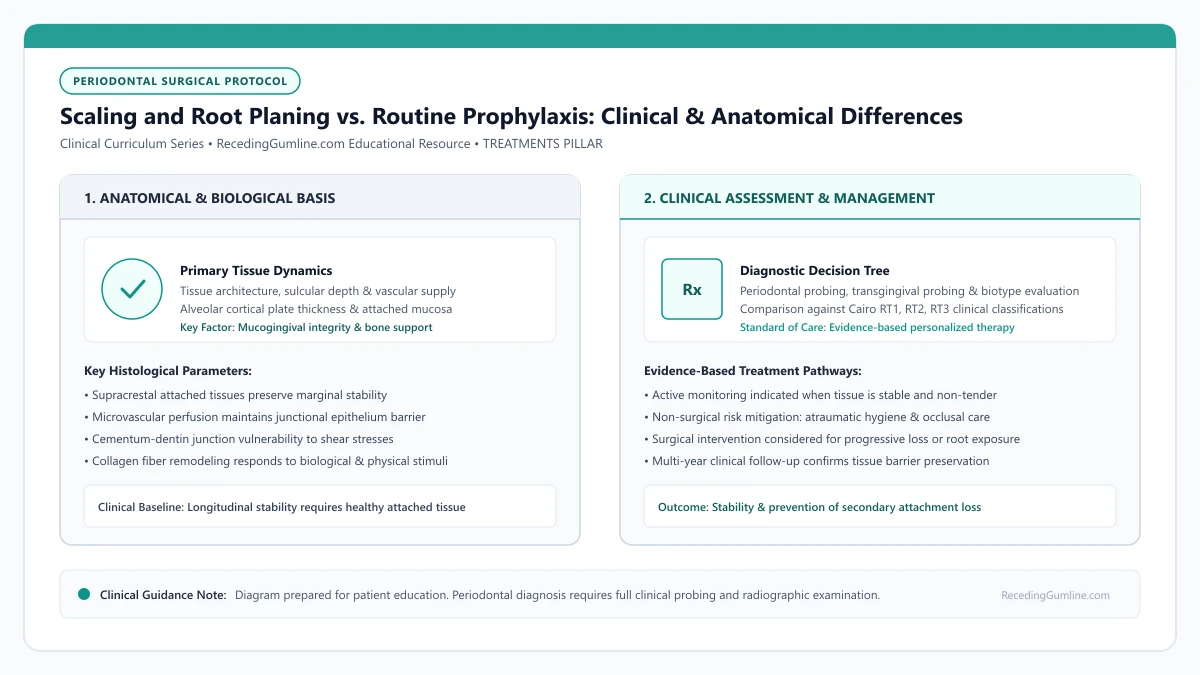
Educational illustration: Scaling and Root Planing vs. Routine Prophylaxis: Clinical & Anatomical Differences. Clinical management requires comprehensive periodontal evaluation rather than isolated self-assessment.
Source: RecedingGumline.com Clinical Editorial Team (Proprietary educational diagram for RecedingGumline.com)
Key Clinical Distinctions & Diagnostic Boundaries
- Prophylaxis is performed on coronal enamel surfaces above the gumline, whereas SRP instruments root surfaces below the gumline within diseased pockets.
- Local anesthesia is rarely needed for standard prophylaxis but is routinely administered for comfortable, thorough root planing.
- Deep cleaning smooths contaminated root cementum, allowing the junctional epithelium to form a long, protective repair seal.
- Following SRP, patients transition permanently into periodontal maintenance recall rather than returning to standard bi-annual prophylaxis.
Routine Prophylaxis (D1110): Scope and Clinical Indications
A standard dental cleaning, known clinically as dental prophylaxis (ADA code D1110), is purely preventive. It is indicated for patients who exhibit clinically healthy gingival tissues or mild gingivitis without any radiographic bone loss or clinical attachment loss.
During prophylaxis, the hygienist uses ultrasonic scalers and hand instruments to polish the crowns of the teeth and remove supragingival plaque and tartar. The instrumentation stops at or just slightly below the healthy marginal gingival collar (within normal 1 to 3 mm sulci).
Routine dental prophylaxis focuses on supra-gingival polishing and superficial calculus removal for patients with intact periodontal attachment and minimal inflammation. In contrast, scaling and root planing treats diseased cementum within pathological subgingival pockets.
Modern ultrasonic scaling tips operate with specialized linear micro-vibrations, flushing subgingival crevices with cooled antimicrobial irrigants while gently removing deep calculus deposits without damaging the underlying sound dentin matrix.
Clinical Considerations:
- Intended exclusively for patients with intact periodontium or mild gingivitis
- Removes plaque and tartar from coronal enamel surfaces above the gumline
- Does not address subgingival pathogens or debride root surfaces in pockets ≥ 4 mm
Scaling and Root Planing (D4341/D4342): Therapeutic Debridement
Scaling and root planing (SRP), colloquially termed "deep cleaning," is a specialized therapeutic procedure. It is prescribed when diagnostic charting reveals periodontal pocket depths of 4 mm or deeper accompanied by bleeding and radiographic bone loss.
SRP involves two clinical actions: scaling removes tenacious hard calculus deposits from the root surface, and root planing meticulously shaves away microscopic layers of necrotic cementum impregnated with bacterial lipopolysaccharide endotoxins, creating a biocompatible surface for tissue re-adaptation.
Thorough ultrasonic instrumentation combined with sharp curettes disrupts complex anaerobic bacterial biofilms residing within deep pocket niches. Removing endotoxin-impregnated necrotic cementum provides a biocompatible biological surface for junctional epithelial reattachment.
Clinical Considerations:
- Prescribed for active periodontitis with pocketing ≥ 4 mm and bone loss
- Removes subgingival calculus and bacterial endotoxins embedded in root cementum
- Performed under local anesthesia to ensure thorough debridement without discomfort
Healing Responses and the Transition to Periodontal Maintenance
Following scaling and root planing, inflamed, swollen pocket tissues undergo dramatic biological resolution. Over 4 to 8 weeks, edema subsides, collagen fibers reorganize, and a long junctional epithelium forms against the cleaned root surface, reducing pocket depths by 1 to 2 millimeters.
Because periodontal pathogens repopulate subgingival pockets within 90 to 120 days, patients who complete SRP cannot return to standard twice-yearly prophylaxis. They transition into ongoing Periodontal Maintenance (CDT D4910) at 3- to 4-month intervals to maintain clinical stability.
A formal periodontal re-evaluation examination is conducted four to six weeks following scaling and root planing. This appointment measures pocket reduction, resolves residual bleeding on probing, and determines whether localized periodontal surgery or ongoing maintenance is required.
Clinical Considerations:
- Tissues shrink as inflammation subsides, which may increase visual root exposure
- Long junctional epithelium seals against the planed root to reduce pocket depths
- Requires 3- to 4-month periodontal maintenance recalls to prevent bacterial repopulation
Therapeutic Endpoints: Biofilm Detoxification vs. Over-Instrumentation
Scaling and Root Planing (SRP) differs fundamentally from a routine prophylaxis in its therapeutic intent and anatomical scope. While a standard cleaning removes supragingival plaque and calculus from crown enamel, SRP is a therapeutic intervention performed within deep periodontal pockets along diseased root cementum.
Historical periodontal concepts emphasized aggressive root planing until the root felt glass-smooth, inadvertently stripping away healthy cementum and exposing sensitive dentinal tubules. Modern clinical protocols prioritize biofilm detoxification and selective calculus removal using ultrasonic micro-inserts with light overlapping strokes.
The primary endpoint is biological compatibility: removing endotoxins embedded in superficial cementum while preserving as much healthy cementum and native collagen fibers as possible to facilitate cellular reattachment.
Clinical Considerations:
- Prophylaxis is preventive and supragingival; SRP is therapeutic and subgingival.
- Modern SRP emphasizes biofilm detoxification rather than aggressive cementum removal.
- Preserving sound root cementum minimizes post-treatment root sensitivity and pulp irritation.
The Six-Week Periodontal Re-Evaluation: Measuring Clinical Endpoints
The success of Scaling and Root Planing is formally assessed at a mandatory four- to six-week re-evaluation visit. This interval allows adequate biological time for junctional epithelial re-attachment, connective tissue fiber remodeling, and resolution of inflammatory edema.
During this examination, the clinician repeats complete full-mouth periodontal probing to evaluate primary clinical endpoints: reduction in pocket probing depths, elimination of bleeding on probing (BOP), and gain of clinical attachment.
Pocket depth reductions of 1 to 2 millimeters are typical as swollen marginal tissues shrink and a long junctional epithelium forms. Persistent deep pockets (≥ 5 mm) with active bleeding indicate refractory disease or complex root anatomy, warranting referral for advanced periodontal surgery.
Clinical Considerations:
- Mandatory re-evaluation occurs 4-6 weeks post-SRP to assess biological tissue response.
- Primary success metrics include pocket depth reduction and elimination of bleeding on probing.
- Residual bleeding pockets ≥ 5 mm require advanced surgical periodontal therapy.
Clinical Reality Check
Deep cleaning does not regrow receded gum tissue; in fact, as chronic inflammation and swelling resolve, gums often tighten, which may make receded roots slightly more visible while restoring biological health.
Questions to Ask Your Periodontist or Dentist
- What pocket depths and bone loss measurements specifically indicate that I need scaling and root planing?
- Will my treatment be completed in a single visit or divided into two quadrant appointments with local anesthesia?
- How long after deep cleaning will you perform a re-evaluation probing examination?
- What should I expect regarding root sensitivity and gum appearance as my tissues heal?
Unsure What Your Gum Changes Mean?
Take our free, evidence-based Gum Recession Assessment — approximately 3 minutes. Identify potential risk factors, evaluate symptoms, and receive personalized discussion questions for your dentist or periodontist.
Non-diagnostic educational triage. Private, secure, completed in your browser.
Related Educational Topics
Clinical Evidence & Claim Traceability (3 Mapped Assertions)
Scientific Literature & Clinical Guidelines
3sources · Hide ▲
- Heitz-Mayfield LJ, Trombelli L, Heitz F, Needleman I, Moles D (2002).
"A systematic review of the effect of surgical debridement vs non-surgical debridement for the treatment of chronic periodontitis." Journal of Clinical Periodontology.
Clinical relevance: Systematic review comparing surgical versus non-surgical debridement; concluded that both modalities effectively reduce probing pocket depths and bleeding on probing, with non-surgical scaling and root planing providing the foundation of periodontal therapy and surgical debridement offering greater probing depth reduction in deep pockets (>6 mm).
- Sanz M, Herrera D, Kebschull M, Chapple ILC, Jepsen S, Beglundh T, et al. (2020).
"Treatment of stage I-III periodontitis—The EFP S3 level clinical practice guideline." Journal of Clinical Periodontology.
Clinical relevance: Evidence-based clinical practice guideline establishing the 4-step therapeutic pathway for periodontal management: Step 1 (behavioral and supragingival hygiene), Step 2 (subgingival instrumentation), Step 3 (surgical therapy where indicated), and Step 4 (supportive periodontal care at 3- to 4-month intervals).
- American Dental Association (2026).
"Code on Dental Procedures and Nomenclature (CDT)." American Dental Association.Coding Standard Official Publication
Clinical relevance: Standardized dental procedure nomenclature maintained and updated annually by the American Dental Association (ADA, currently referencing CDT 2026/2027) for administrative classification and billing (including codes D4273, D4275, D4277, D4341, D4910). The site references CDT procedure numbers for high-level educational and administrative context and does not reproduce proprietary CDT descriptors or substantial CDT text. Commercial use/licensing requirements should be reviewed separately with the ADA or qualified counsel. Procedure codes facilitate administrative reporting and do not dictate clinical necessity or insurance benefit coverage.
Important Medical Notice
The contents of RecedingGumline.com, including text, graphics, self-assessment calculators, and other materials, are intended solely for educational and informational purposes. This content is not intended to replace professional dental examination, diagnosis, or treatment. Always seek the advice of a qualified dentist, periodontist, or other licensed oral healthcare provider with any questions you may have regarding a medical or dental condition. Never disregard professional medical advice or delay seeking it because of something you read on this website.