Allograft vs. Autograft Gum Graft Costs & Factors
How much more does donor tissue (allograft) cost compared to using your own palate tissue (autograft)?
When planning receding gums overview surgery, one of the most important decisions is selecting the source of the graft tissue. Patients can use their own tissue harvested from the palate (autograft) or opt for processed, medically sterilized human donor tissue (allograft, such as AlloDerm). While both techniques achieve excellent clinical outcomes, their financial structures, material fees, and recovery dynamics differ significantly.
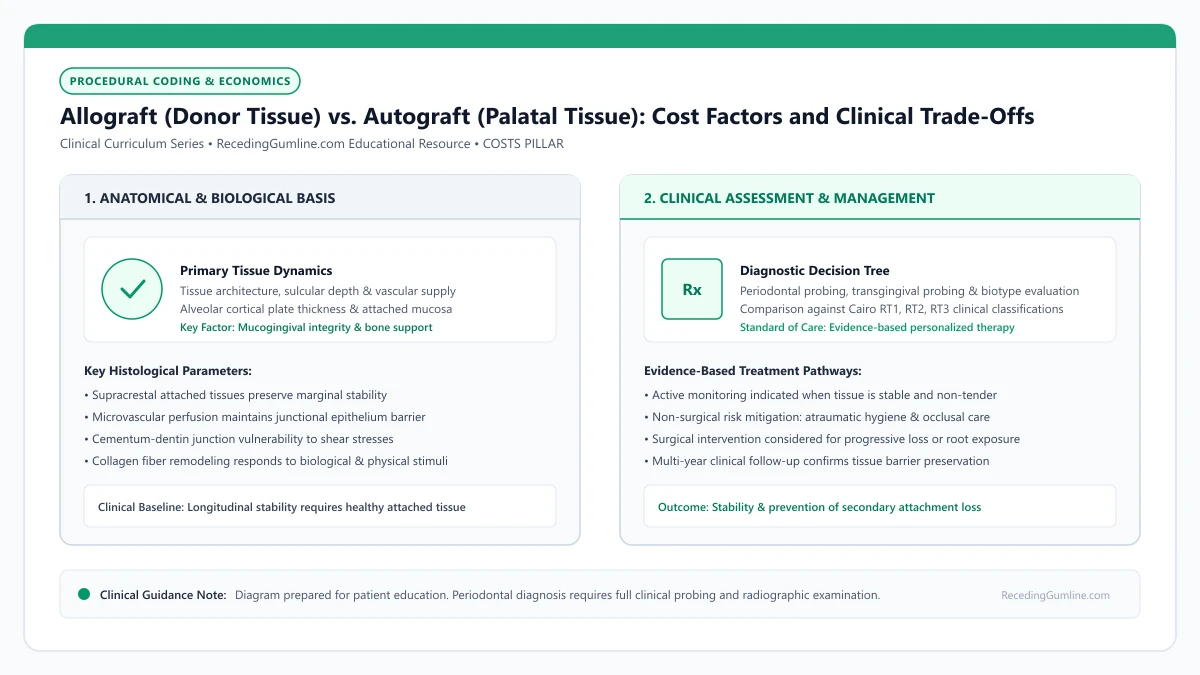
Educational illustration: Allograft (Donor Tissue) vs. Autograft (Palatal Tissue): Cost Factors and Clinical Trade-Offs. Clinical management requires comprehensive periodontal evaluation rather than isolated self-assessment.
Source: RecedingGumline.com Clinical Editorial Team (Proprietary educational diagram for RecedingGumline.com)
Key Clinical Distinctions & Diagnostic Boundaries
- An autograft requires no external tissue purchase, but operative time is longer because two surgical sites (palate and gums) are operated on.
- An allograft incurs a raw biomaterial purchase invoice ($300 to $800 per package) passed on to the patient or built into the fee.
- Autogenous connective tissue remains the primary clinical benchmark with slightly higher rates of 100% complete root coverage in advanced defects.
- Allograft surgery involves zero palatal pain, reducing post-operative downtime and medication expenses.
The Financial Structure: Material Surcharge vs. Operative Time
The pricing difference between an autograft and an allograft comes down to material costs versus surgical labor. In an autograft procedure (CDT D4273), there is zero biomaterial product fee because the tissue is harvested from your own palate. However, the surgeon must perform two separate surgeries in one session, requiring more operative time and sutures.
In an allograft procedure (CDT D4275), the surgeon orders a sterile package of processed human acellular dermal matrix (ADM, such as AlloDerm) or porcine collagen matrix. This high-tech biomaterial costs the surgical practice $300 to $800 per unit, which is either billed as a separate materials charge or incorporated into a slightly higher procedural fee.
Autogenous connective tissue grafting (harvested from the patient’s own palate) eliminates material purchase fees but increases surgical operating time and requires donor site management. In contrast, donor tissue allografts (such as acellular human dermis) eliminate palatal donor pain but introduce bio-material laboratory costs of $300 to $700 per package.
Clinical Considerations:
- Autograft has zero tissue purchase fee, but requires longer surgical operating time
- Allograft incurs a $300 to $800 biomaterial cost per tissue packet
- Overall out-of-pocket costs are often remarkably similar ($1,000–$1,800 per site)
The Morbidity Trade-Off: Pain, Time Off Work & Medication Costs
When evaluating costs, patients must also consider the "hidden costs" of recovery. In an autograft, the palatal donor site behaves like a severe burn on the roof of your mouth, often requiring a custom palatal stent ($100–$250), prescription painkillers, and 2 to 4 days of reduced work productivity.
With an allograft, there is zero palatal wound. The patient leaves surgery with only the gumline treated, experiencing virtually no acute post-surgical pain. For busy professionals, eliminating palatal discomfort and avoiding missed work days often easily offsets the material fee of the allograft.
When treating multiple adjacent teeth or extensive generalized recession defects across three or four teeth, allografts offer substantial cost and comfort advantages. Harvesting sufficient autogenous tissue from the palate for multiple teeth is anatomically limited and dramatically increases post-operative patient morbidity.
Clinical Considerations:
- Autograft palatal wound requires analgesics, protective stents, and more downtime
- Allograft produces minimal postoperative pain and virtually zero speech impairment
- Eliminating missed work days frequently compensates for the allograft material cost
Multi-Tooth Economics: When Allografts Become Cheaper
Where allografts truly shine financially is in multi-tooth or full-quadrant cases. The human palate has a strictly limited amount of harvestable donor tissue—usually enough to treat only two or three teeth at one time. If a patient needs six receded teeth grafted, an autograft approach requires two or three separate surgical dates months apart.
With allografts, tissue supply is virtually unlimited. A surgeon can use a large sheet of acellular dermal matrix to treat five or six teeth in a single surgical session, saving the patient thousands of dollars in facility fees, surgical setups, and multiple recovery periods.
Total out-of-pocket costs for autografts versus allografts frequently equalize when factoring in operating room time, suturing complexity, and specialized hemostatic dressings. Discussing financial and recovery trade-offs during the consultation helps patients choose the grafting approach aligned with their clinical needs and budget.
Clinical Considerations:
- Palate has limited tissue, restricting autografts to 2 or 3 teeth per surgery
- Allografts allow 4 to 8 teeth to be treated in a single surgical appointment
- Eliminates duplicate facility and anesthesia charges, reducing overall multi-tooth costs
Biomaterial Economics: Acellular Dermal Matrix (ADM) Procurement Costs
When comparing the financial aspects of autogenous grafting (harvesting palatal tissue) versus allografting (using processed human donor tissue), the primary direct cost differentiator is biomaterial procurement.
Acellular Dermal Matrix (ADM, such as Alloderm) requires extensive processing: donor screening, viral inactivation, decellularization, and sterile packaging in certified tissue banks. Consequently, periodontal practices must purchase ADM biomaterials at wholesale costs ranging from $300 to $800+ per sterile package.
Dental practices bill allografts under CDT code D4275 (Non-autogenous connective tissue graft). While the insurance reimbursement rate for D4275 is often slightly lower than autograft code D4273, practices must factor in the non-reimbursable wholesale cost of the biomaterial.
Clinical Considerations:
- Acellular Dermal Matrix (ADM) incurs wholesale procurement costs of $300 to $800+ per package.
- Allografts are billed under CDT code D4275, carrying distinct insurance reimbursement rates.
- Practices must balance biomaterial procurement overhead against surgical operative efficiency.
Chair-Time Efficiency vs. Material Costs: The Economic Trade-Off
Despite the wholesale material expense of allografts, the total patient fee for allograft and autograft surgery is often remarkably similar. This economic parity results from the significant savings in operative surgical chair time.
An autogenous graft requires two simultaneous surgical sites: harvesting from the palate and preparing the recipient bed. This dual-site surgery demands 60 to 90 minutes of surgeon chair time, complex suturing, and fabrication of a palatal stent. Conversely, an allograft eliminates the palatal donor site, reducing operative time by 30 to 45 minutes.
For multi-tooth procedures spanning four or more teeth, allografts offer unmatched scalability: the surgeon can treat multiple teeth without being constrained by limited palatal donor tissue volume or causing extensive patient donor site morbidity.
Clinical Considerations:
- Allografts eliminate palatal harvesting, reducing surgical chair time by 30 to 45 minutes.
- Reduced surgeon labor offsets the procurement cost of the donor biomaterial.
- Allografts provide unlimited tissue volume, making multi-tooth cases economically and clinically viable.
Clinical Reality Check
If your palate is anatomically shallow or exceptionally thin, an allograft is not just an aesthetic choice; it is medically safer to avoid injuring the greater palatine artery.
Questions to Ask Your Periodontist or Dentist
- What is the total fee difference in your office between an autograft (palate) and allograft (donor tissue)?
- What specific allograft brand (such as AlloDerm or Mucoderm) do you use, and is it billed under code D4275?
- Given the thickness and depth of my gum recession, is an autograft significantly more predictable for my case?
- If I choose an allograft, will my insurance cover it at the same coinsurance percentage as an autograft?
Unsure What Your Gum Changes Mean?
Take our free, evidence-based Gum Recession Assessment — approximately 3 minutes. Identify potential risk factors, evaluate symptoms, and receive personalized discussion questions for your dentist or periodontist.
Non-diagnostic educational triage. Private, secure, completed in your browser.
Related Educational Topics
Clinical Evidence & Claim Traceability (2 Mapped Assertions)
Scientific Literature & Clinical Guidelines
2sources · Hide ▲
- Chambrone L, Salinas Ortega MA, Sukekava F, Rotundo R, Kalemaj Z, Buti J, Pini Prato GP (2018).
"Root coverage procedures for treating localised and multiple recession-type defects." Cochrane Database of Systematic Reviews.
Clinical relevance: Cochrane systematic review evaluating root-coverage procedures for localized and multiple recession-type defects. While subepithelial connective tissue grafts (SCTG) combined with coronally advanced flaps demonstrated higher rates of complete root coverage and keratinized tissue gain compared to flap advancement alone, evidence quality varied across outcomes and clinical decisions must balance donor site morbidity and patient-reported outcomes.
- American Dental Association (2026).
"Code on Dental Procedures and Nomenclature (CDT)." American Dental Association.Coding Standard Official Publication
Clinical relevance: Standardized dental procedure nomenclature maintained and updated annually by the American Dental Association (ADA, currently referencing CDT 2026/2027) for administrative classification and billing (including codes D4273, D4275, D4277, D4341, D4910). The site references CDT procedure numbers for high-level educational and administrative context and does not reproduce proprietary CDT descriptors or substantial CDT text. Commercial use/licensing requirements should be reviewed separately with the ADA or qualified counsel. Procedure codes facilitate administrative reporting and do not dictate clinical necessity or insurance benefit coverage.
Important Medical Notice
The contents of RecedingGumline.com, including text, graphics, self-assessment calculators, and other materials, are intended solely for educational and informational purposes. This content is not intended to replace professional dental examination, diagnosis, or treatment. Always seek the advice of a qualified dentist, periodontist, or other licensed oral healthcare provider with any questions you may have regarding a medical or dental condition. Never disregard professional medical advice or delay seeking it because of something you read on this website.