Gum Graft Cost Per Tooth vs. Multi-Tooth Quadrant Pricing
How much does a gum graft cost per tooth, and is it more affordable to treat multiple teeth at the same time?
When facing soft-tissue grafting surgery, one of the most common questions patients ask is: "Why does treating two or three teeth at once cost less than treating them separately?" When treating a receding gumline, procedural billing reflects surgical economies of scale. Understanding how ADA coding structures primary and contiguous surgical sites clarifies the pricing differences between single-tooth and quadrant procedures.
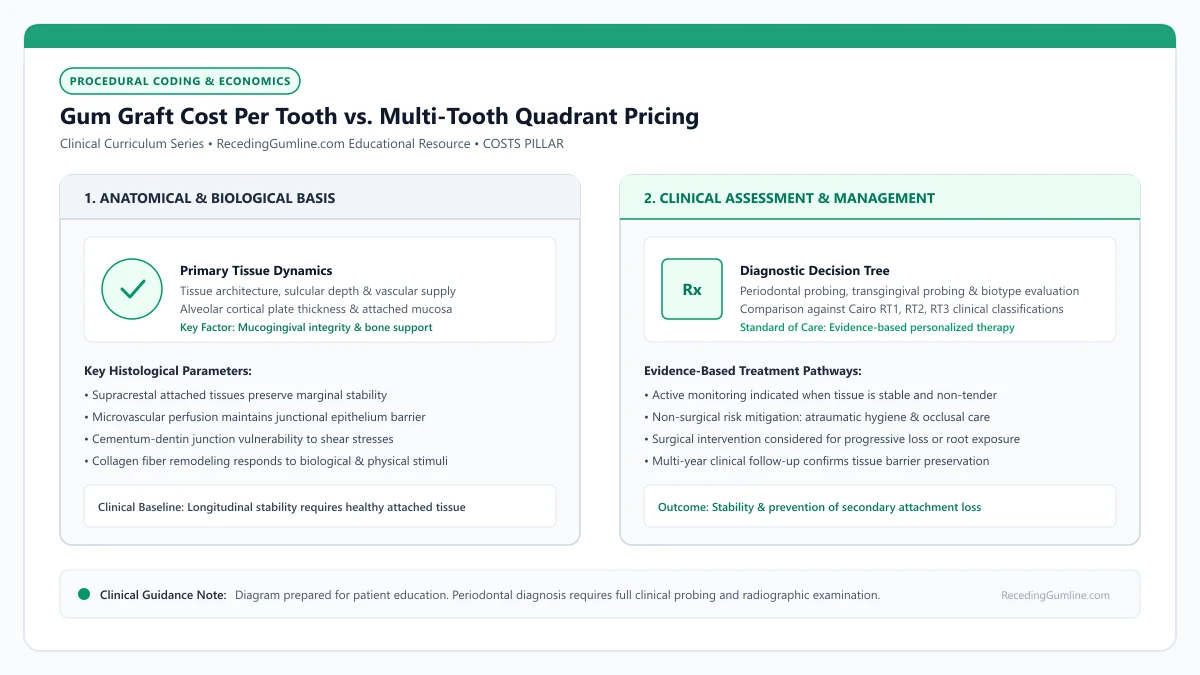
Educational illustration: Gum Graft Cost Per Tooth vs. Multi-Tooth Quadrant Pricing. Clinical management requires comprehensive periodontal evaluation rather than isolated self-assessment.
Source: RecedingGumline.com Clinical Editorial Team (Proprietary educational diagram for RecedingGumline.com)
Key Clinical Distinctions & Diagnostic Boundaries
- The first tooth in a surgical quadrant is billed as the primary graft site (e.g., D4273); subsequent adjacent teeth in the same quadrant are billed under lower additional-site fees.
- Autografts (palatal tissue) carry different surgical overhead than allografts (donor tissue) where material purchase costs are factored in.
- Treating multiple teeth in one appointment requires only one surgical recovery and one palatal donor wound.
- If multi-tooth surgery exceeds your annual dental insurance maximum, splitting surgery across December and January can access two years of benefits.
Single-Tooth Surgery: Overhead and Initial Site Billing
If you undergo gum graft surgery on a single isolated tooth, the national average out-of-pocket cost typically ranges from $800 to $1,800. This single-tooth fee must absorb all fixed surgical overhead costs: sterile surgical room setup, micro-surgical instrumentation, local anesthesia administration, and surgeon operative time.
Under standard dental coding, an autogenous connective tissue graft on the first tooth is billed as ADA code D4273 (Autogenous connective tissue graft procedure, first tooth). If donor tissue is used, it is billed under D4275. This primary code reflects the complete surgical preparation of both the donor harvest bed and the recipient flap.
The standard surgical fee for soft-tissue grafting typically ranges from $800 to $2,000 per tooth depending on anatomical complexity and surgical technique. When multiple adjacent teeth are treated within the same quadrant, periodontists frequently apply reduced multi-tooth bundle fees that lower per-tooth costs.
Clinical Considerations:
- Single-tooth graft averages $800 to $1,800 depending on geography and provider tier
- Primary site code (D4273 or D4275) absorbs all fixed surgical room and anesthesia overhead
- Requires full post-operative recovery protocol regardless of treating one tooth or three
Multi-Tooth Quadrant Pricing: The Additional Contiguous Tooth Discount
When multiple adjacent teeth in the same quadrant have receding gums, treating them simultaneously is substantially more cost-effective. In 2014, the ADA introduced specific "additional site" codes: CDT D4283 (Autogenous connective tissue graft, each additional contiguous tooth) and D4285 (Non-autogenous graft, each additional tooth).
Because the surgeon has already anesthetized the area and reflected the flap, the fee for each additional contiguous tooth is typically 40% to 60% lower than the primary site fee (averaging $400 to $700 per additional tooth). Treating three teeth together might cost $2,200, compared to $3,600 if performed across three separate appointments.
Autogenous connective tissue harvesting from the palate carries separate procedural fees compared to acellular dermal matrix allografts or xenogeneic collagen matrices. Utilizing donor allografts eliminates the second surgical donor site but adds material procurement expenses of $300 to $600 per surgical site.
Clinical Considerations:
- Additional adjacent teeth are billed under lower codes (D4283 or D4285)
- Fees for additional teeth are 40% to 60% lower than the first primary site
- Patients endure a single surgical recovery and single palatal donor site instead of multiple surgeries
Navigating Insurance Maximums: The Calendar Year Splitting Strategy
A major obstacle when treating multiple teeth is that most dental insurance plans have annual maximum benefit caps of $1,000 to $2,000. A multi-tooth surgical estimate of $2,500 will quickly exhaust your entire annual benefit, leaving remaining costs out-of-pocket.
To maximize insurance reimbursement, many patients and periodontists utilize a "calendar-year split." If surgery is needed across two quadrants, quadrant one is performed in November or December (exhausting the current year's maximum), and quadrant two is scheduled in January, accessing a fresh annual benefit maximum.
Anesthesia fees, post-operative antibiotic prescriptions, and surgical re-evaluation visits may be billed separately or bundled into an inclusive global surgical package. Clarifying whether post-operative suture removal and three-month surgical healing evaluations are covered avoids unexpected auxiliary expenses.
Clinical Considerations:
- Annual insurance maximums ($1,000–$2,000) are easily exhausted by multi-tooth surgery
- Calendar-year splitting schedules one quadrant in late fall and the next in January
- Accesses two consecutive annual benefit maximums, doubling insurance reimbursement
CDT Fee Mechanics: Primary Graft (D4273) vs. Additional Contiguous Site (D4276)
When budgeting for multiple-tooth gum graft surgery, patients should understand the significant fee difference between primary and secondary surgical sites under the ADA CDT coding system.
The first tooth treated in a given quadrant is billed under code D4273 (Autogenous connective tissue graft, first tooth in surgical site), which carries the full procedural fee (typically $1,000 to $1,800). This base fee covers flap design, palatal harvest, and initial site preparation.
However, each additional adjacent tooth treated within the same continuous surgical site is billed under code D4276 (combined connective tissue graft, each additional contiguous tooth). Because the donor harvest is already completed and the flap is continuous, the fee for D4276 is discounted by 30% to 50% (typically $600 to $1,100 per tooth).
Clinical Considerations:
- The initial tooth is billed under full-rate primary code D4273 ($1,000-$1,800).
- Contiguous adjacent teeth in the same site are billed under discounted secondary code D4276 ($600-$1,100).
- Secondary contiguous codes reflect 30% to 50% savings due to shared flap and harvest efficiency.
Quadrant Consolidation: Maximizing Surgical & Financial Efficiency
Treating receded teeth across multiple isolated appointments dramatically inflates total patient expenses. Each separate surgical appointment incurs independent facility setup fees, local anesthetic supplies, disposable microsurgical blades, and postoperative prescription costs.
Consolidating care by treating entire quadrants or sextants in a single operative session captures maximum economies of scale. For instance, grafting three contiguous mandibular incisors in one visit requires only one surgical setup, one palatal stent, and one recovery cycle.
This staging strategy minimizes total out-of-pocket costs, shortens cumulative healing time, and allows patients to maximize single-calendar-year insurance benefits.
Clinical Considerations:
- Multiple isolated surgeries multiply facility, anesthetic, and prescription expenses.
- Consolidating contiguous teeth into quadrant sessions captures substantial economies of scale.
- Single-session quadrant care minimizes recovery time and maximizes insurance deductible usage.
Clinical Reality Check
Always ask your surgical coordinator for a fee comparison between treating teeth individually versus together; doing adjacent teeth in one surgery saves hundreds of dollars and spares you multiple healing phases.
Questions to Ask Your Periodontist or Dentist
- What is your fee for the first tooth versus each additional contiguous tooth in the same quadrant?
- Which specific CDT codes (D4273, D4283, D4275, D4285) will you be submitting to my insurance plan?
- If I have multiple teeth needing grafts in different quadrants, should we split them across calendar years to maximize my insurance?
- Are postoperative suture removals and follow-up visits included in this surgical fee?
Unsure What Your Gum Changes Mean?
Take our free, evidence-based Gum Recession Assessment — approximately 3 minutes. Identify potential risk factors, evaluate symptoms, and receive personalized discussion questions for your dentist or periodontist.
Non-diagnostic educational triage. Private, secure, completed in your browser.
Related Educational Topics
Clinical Evidence & Claim Traceability (2 Mapped Assertions)
Scientific Literature & Clinical Guidelines
2sources · Hide ▲
- American Dental Association (2026).
"Code on Dental Procedures and Nomenclature (CDT)." American Dental Association.Coding Standard Official Publication
Clinical relevance: Standardized dental procedure nomenclature maintained and updated annually by the American Dental Association (ADA, currently referencing CDT 2026/2027) for administrative classification and billing (including codes D4273, D4275, D4277, D4341, D4910). The site references CDT procedure numbers for high-level educational and administrative context and does not reproduce proprietary CDT descriptors or substantial CDT text. Commercial use/licensing requirements should be reviewed separately with the ADA or qualified counsel. Procedure codes facilitate administrative reporting and do not dictate clinical necessity or insurance benefit coverage.
- Chambrone L, Salinas Ortega MA, Sukekava F, Rotundo R, Kalemaj Z, Buti J, Pini Prato GP (2018).
"Root coverage procedures for treating localised and multiple recession-type defects." Cochrane Database of Systematic Reviews.
Clinical relevance: Cochrane systematic review evaluating root-coverage procedures for localized and multiple recession-type defects. While subepithelial connective tissue grafts (SCTG) combined with coronally advanced flaps demonstrated higher rates of complete root coverage and keratinized tissue gain compared to flap advancement alone, evidence quality varied across outcomes and clinical decisions must balance donor site morbidity and patient-reported outcomes.
Important Medical Notice
The contents of RecedingGumline.com, including text, graphics, self-assessment calculators, and other materials, are intended solely for educational and informational purposes. This content is not intended to replace professional dental examination, diagnosis, or treatment. Always seek the advice of a qualified dentist, periodontist, or other licensed oral healthcare provider with any questions you may have regarding a medical or dental condition. Never disregard professional medical advice or delay seeking it because of something you read on this website.