Navigating the Annual Maximum on Dental Insurance for Periodontal Surgery
What happens when gum graft surgery costs more than your dental insurance annual maximum?
Dental insurance is fundamentally different from medical insurance (see our receding gumline factors). While medical insurance protects against catastrophic expenses after meeting an out-of-pocket maximum, dental insurance enforces a hard annual maximum cap—typically between $1,000 and $2,000 per benefit year. When facing periodontal surgery that easily costs $2,000 to $5,000, understanding how to navigate this annual ceiling is essential to avoid crushing out-of-pocket bills.
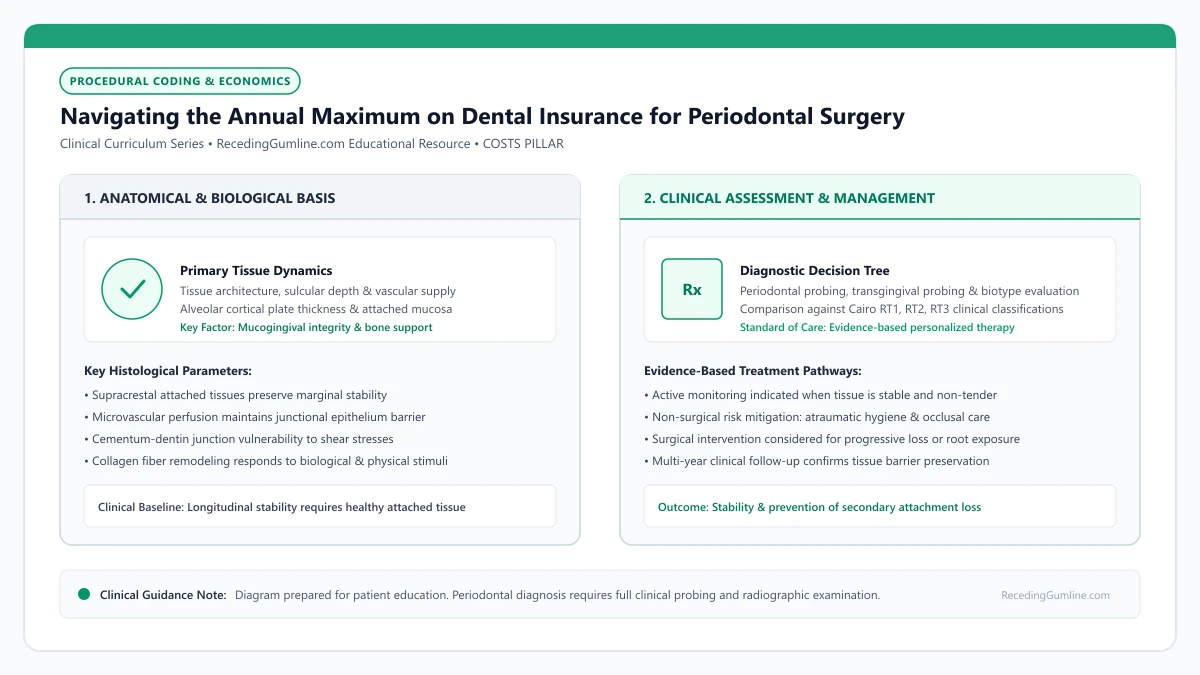
Educational illustration: Navigating the Annual Maximum on Dental Insurance for Periodontal Surgery. Clinical management requires comprehensive periodontal evaluation rather than isolated self-assessment.
Source: RecedingGumline.com Clinical Editorial Team (Proprietary educational diagram for RecedingGumline.com)
Key Clinical Distinctions & Diagnostic Boundaries
- An annual maximum is not a guarantee of money in your pocket; it is the absolute ceiling on what the insurance company will pay out across 12 months.
- Every dollar paid toward routine cleanings, x-rays, or fillings earlier in the year reduces the remaining maximum available for gum surgery.
- Unused annual maximum funds do NOT roll over to the next year; they disappear on December 31 ("use it or lose it").
- Medical insurance rarely covers gum surgery unless the recession resulted from major facial trauma, oral cancer resection, or severe congenital defects.
The Insurance Ceiling: A 1970s Relic in the Modern Era
In the 1970s, when dental insurance first became a widespread employee benefit, the typical annual maximum was set at $1,000 per year. Today, more than fifty years later, most employer dental plans still maintain that exact same $1,000 to $1,500 maximum.
If adjusted for inflation, an annual maximum from 1972 would exceed $7,000 today. Because the cap has remained stagnant while procedural costs have risen, dental insurance behaves more like a limited discount coupon rather than true catastrophic insurance, covering only a portion of major periodontal therapy.
Most commercial dental insurance plans cap their annual benefit payouts between $1,000 and $2,000 per calendar year, figures that have remained largely unchanged for decades. Because a single gum grafting surgery can exceed $1,500, a single procedure frequently exhausts the entire annual policy maximum.
Clinical Considerations:
- Most annual maximums are capped at $1,000 to $1,500 per calendar year
- Caps have not kept pace with fifty years of healthcare inflation
- A single surgical gum graft easily exhausts the entire annual insurance allowance
The Year-End Split: Accessing Two Annual Maximums
The single most powerful financial strategy for major gum surgery is the "calendar-year split." If your periodontal treatment plan calls for grafting in multiple quadrants (totaling $3,000 or more), scheduling the procedures across the year-end transition doubles your insurance reimbursement.
For example, schedule your first quadrant in late November or December. Your insurer pays up to your remaining $1,500 cap for the current year. Then, schedule your second quadrant in January. On January 1, your benefit plan resets, providing a brand-new $1,500 maximum, effectively yielding $3,000 in insurance support for your overall care.
Once the annual maximum is reached, all remaining periodontal treatment expenses become the sole 100% financial responsibility of the patient. Understanding this financial ceiling is crucial when planning multi-phase periodontal therapy involving scaling, grafting, and maintenance.
Clinical Considerations:
- Schedule the first surgical phase in November/December to exhaust current-year funds
- Schedule the second surgical phase in January to access a fresh annual maximum
- Doubles total insurance reimbursement from $1,500 to $3,000 for multi-quadrant care
Bridging the Gap: HSAs, FSAs, and Healthcare Financing
Even with smart insurance timing, patients often face remaining out-of-pocket balances. Health Savings Accounts (HSA) and Flexible Spending Accounts (FSA) allow you to pay these balances using pre-tax dollars, immediately saving 20% to 35% based on your income tax bracket.
For amounts not covered by cash or savings, most periodontal offices partner with healthcare financing lenders (such as CareCredit or Proceed Finance). These companies offer 6- to 24-month zero-percent interest promotional financing plans, allowing you to pay for your surgery in predictable monthly installments without interest charges.
Periodontists routinely split multi-quadrant surgeries across two distinct plan years (e.g., treating two quadrants in November and two in January) to access two separate annual maximum benefit pools. This clinical phasing strategy significantly reduces out-of-pocket expenses for patients requiring extensive full-mouth reconstruction.
Clinical Considerations:
- HSAs and FSAs allow pre-tax payment, saving 20% to 35% in effective out-of-pocket costs
- 0% interest promotional medical financing (CareCredit) spreads payments over 6 to 24 months
- Dental savings discount plans can be utilized after insurance maximums are exhausted
The Annual Maximum Stagnation: 1970s Caps ($1,000-$1,500) vs. Modern Surgical Fees
The annual maximum is the total dollar ceiling a dental insurance company will pay for covered dental care within a single plan year. Remarkably, the standard dental annual maximum has remained virtually unchanged at $1,000 to $1,500 since dental insurance was introduced in the early 1970s.
Had insurance maximums kept pace with medical inflation over the past 50 years, the typical annual maximum would exceed $7,500 today. Because multi-tooth periodontal surgery or extensive scaling and root planing easily exceeds $2,000 to $4,000, insurance benefits are exhausted rapidly.
Once the annual maximum is reached, the insurance company pays $0 toward subsequent claims, leaving the patient responsible for 100% of all remaining procedural costs for the balance of the calendar year.
Clinical Considerations:
- Standard insurance annual maximums ($1,000-$1,500) have remained stagnant since the 1970s.
- Comprehensive periodontal surgical treatment quickly exceeds annual benefit ceilings.
- Patients are 100% responsible for all procedural costs once the annual cap is exhausted.
Split-Year Staging Strategies: Double-Benefit Calendar Optimization
To overcome the financial barrier imposed by stagnant annual maximums, periodontists frequently implement "split-year treatment staging" for non-emergency surgical cases.
In this protocol, a patient requiring bilateral or four-quadrant periodontal therapy schedules the first half of treatment in November or December, utilizing the current year's $1,500 benefit maximum. The second half of treatment is scheduled in January or February of the following year, tapping into the freshly renewed $1,500 maximum.
By bridging the calendar year turnover, the patient successfully secures $3,000 in insurance contributions within a 60- to 90-day treatment window, cutting their out-of-pocket financial burden in half.
Clinical Considerations:
- Split-year staging schedules the first surgical phase in late autumn and the second in early winter.
- Allows the patient to access two consecutive $1,500 benefit allowances within a 60-90 day period.
- Effectively doubles insurance reimbursement for extensive multi-quadrant surgical cases.
Clinical Reality Check
Check your benefit plan's reset date; while over 90% of plans reset on January 1, some corporate or school district plans operate on a fiscal year resetting on July 1 or October 1.
Questions to Ask Your Periodontist or Dentist
- How much of my annual insurance maximum is currently remaining for this year?
- Can we phase my gum surgeries across two benefit years to maximize my insurance reimbursement?
- Does your office accept HSA or FSA debit cards for my surgical copayments?
- What zero-percent interest medical financing options (such as CareCredit) do you offer?
Unsure What Your Gum Changes Mean?
Take our free, evidence-based Gum Recession Assessment — approximately 3 minutes. Identify potential risk factors, evaluate symptoms, and receive personalized discussion questions for your dentist or periodontist.
Non-diagnostic educational triage. Private, secure, completed in your browser.
Related Educational Topics
Clinical Evidence & Claim Traceability (1 Mapped Assertions)
Scientific Literature & Clinical Guidelines
1source · Hide ▲
- American Dental Association (2026).
"Code on Dental Procedures and Nomenclature (CDT)." American Dental Association.Coding Standard Official Publication
Clinical relevance: Standardized dental procedure nomenclature maintained and updated annually by the American Dental Association (ADA, currently referencing CDT 2026/2027) for administrative classification and billing (including codes D4273, D4275, D4277, D4341, D4910). The site references CDT procedure numbers for high-level educational and administrative context and does not reproduce proprietary CDT descriptors or substantial CDT text. Commercial use/licensing requirements should be reviewed separately with the ADA or qualified counsel. Procedure codes facilitate administrative reporting and do not dictate clinical necessity or insurance benefit coverage.
Important Medical Notice
The contents of RecedingGumline.com, including text, graphics, self-assessment calculators, and other materials, are intended solely for educational and informational purposes. This content is not intended to replace professional dental examination, diagnosis, or treatment. Always seek the advice of a qualified dentist, periodontist, or other licensed oral healthcare provider with any questions you may have regarding a medical or dental condition. Never disregard professional medical advice or delay seeking it because of something you read on this website.