Dental Insurance Coverage for Gum Recession & Periodontal Care
Navigating dental insurance reimbursement for periodontal recession guide therapy is one of the most frustrating aspects of healthcare for American dental patients. Because dental insurance operates as a defined-dollar benefit rather than comprehensive medical indemnity, coverage for gum recession procedures is tightly constrained by outdated annual benefit caps, restrictive waiting periods, and stringent pre-authorization criteria. Understanding the specific American Dental Association (ADA) Code on Dental Procedures and Nomenclature (CDT) codes enables patients to maximize their legitimate policy benefits.
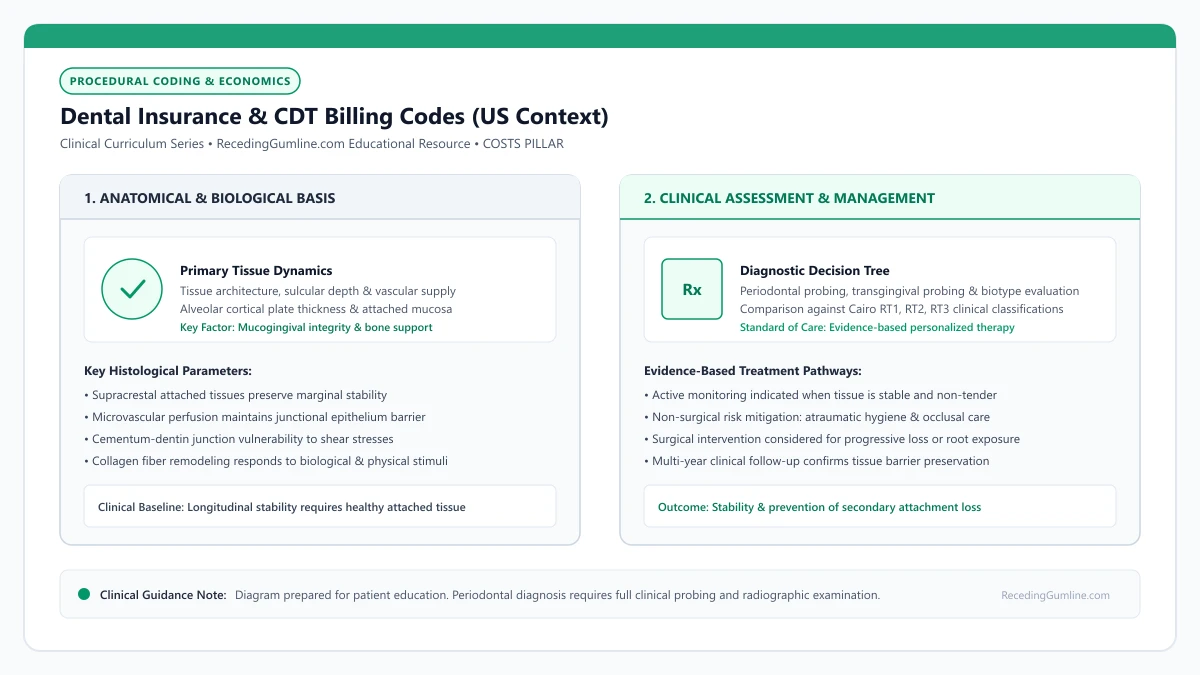
Educational illustration: Dental Insurance & CDT Billing Codes (US Context). Clinical management requires comprehensive periodontal evaluation rather than isolated self-assessment.
Source: RecedingGumline.com Clinical Editorial Team (Proprietary educational diagram for RecedingGumline.com)
ADA CDT Procedural Codes for Periodontal Grafting
Dental insurance claims must be submitted using standardized nomenclature established by the American Dental Association in the Current Dental Terminology (CDT) manual. For gum recession and soft-tissue grafting, four primary procedural codes govern coverage.
Code D4273 designates "autogenous connective tissue graft procedure (including donor and recipient site surgery of first tooth, implant, or edentulous tooth position in graft)." This code is utilized when subepithelial tissue is harvested from the patient's palate to treat the primary tooth defect.
Code D4275 designates "non-autogenous connective tissue graft (including recipient site and donor material) by report." This code is billed when the surgeon utilizes processed human donor allograft (such as Acellular Dermal Matrix) or xenogeneic collagen matrices, completely omitting palatal donor surgery.
When multiple adjacent teeth are treated in the same continuous operative flap, secondary teeth cannot be billed under D4273. Instead, they must be coded as D4276: "combined connective tissue and double pedicle graft, each additional contiguous tooth, implant or edentulous tooth position in same graft site," which insurance plans reimburse at a significantly reduced allowable fee.
[object Object]
Key Cost Insights
- D4273 represents autogenous connective tissue grafting from the patient's palate for the first tooth.
- D4275 represents non-autogenous allograft donor tissue placed on the primary tooth defect.
- D4276 designates each additional adjacent tooth treated in the same continuous surgical flap.
The Annual Maximum Benefit Bottleneck
The single greatest obstacle to comprehensive periodontal insurance reimbursement is the annual maximum benefit cap. When commercial dental insurance was first introduced in the early 1970s, typical annual maximums were established between 1,000 dollars and 1,500 dollars per calendar year.
Astonishingly, despite five decades of general inflation that would elevate that 1972 maximum to over 8,000 dollars today, the overwhelming majority of commercial dental policies still cap total annual coverage at 1,000 dollars to 1,500 dollars per year. Once a patient receives a professional deep cleaning or has a single tooth grafted, their annual benefit is frequently exhausted.
Because soft-tissue grafting costs 1,500 dollars to 3,000 dollars+ per tooth, a patient with a 1,500 dollars annual cap can expect insurance to cover only a modest fraction of a multi-tooth treatment plan. Patients must recognize that dental insurance operates as a supplementary discount coupon rather than comprehensive medical insurance.
Key Cost Insights
- Most dental insurance policies maintain annual maximum benefit caps of 1,000 dollars to 1,500 dollars.
- Annual caps have remained virtually unchanged for 50 years despite severe medical inflation.
- A single surgical gum graft procedure frequently exhausts the patient's entire annual benefit allowance.
Appealing Denials & Strategic Calendar-Year Staging
If a legitimate periodontal claim is denied, patients and clinicians have the legal right to submit a formal appeal. Denials frequently stem from clerical omissions (such as a missing x-ray) or automated computerized rejections. An effective appeal includes a detailed clinical rebuttal letter signed by the periodontist, referencing landmark periodontal literature (such as Lang & Löe 1972 on keratinized tissue requirements).
A highly effective financial strategy for extensive multi-tooth recession is Strategic Calendar-Year Staging (the "split-year" approach). For patients requiring surgery on multiple quadrants, the first quadrant is scheduled in November or December, utilizing the current year's 1,500 dollars maximum benefit.
The second quadrant is scheduled in January or February of the new calendar year, immediately tapping into the refreshed 1,500 dollars annual maximum. This simple calendar coordination doubles the total insurance payout, saving the patient thousands of dollars in out-of-pocket costs.
Key Cost Insights
- Denials should be aggressively appealed with clinical rebuttal letters citing periodontal literature.
- Strategic calendar-year staging splits surgeries between December and January to double benefit payouts.
- Coordinating surgery across renewal dates maximizes allowable insurance contributions for extensive cases.
Dental Insurance Coverage Rules for Gum Grafts: Medical Necessity Criteria & Exclusions
As highlighted in our receding gums overview, dental insurance coverage for gum graft surgery is not automatic. Many patients are stunned when an insurance claim for a gum graft is denied with the explanation: "Procedure deemed not medically necessary or cosmetic in nature." Understanding how insurance claim adjudicators evaluate medical necessity—and what clinical records your periodontist must submit—ensures your claim is approved and reimbursed.
• Dental insurance covers gum grafting only when documented as medically necessary to prevent tooth loss.
• Claims submitted purely for aesthetic improvement (smile enhancement) are universally excluded as cosmetic.
• Mandatory documentation includes full-mouth probing charts, diagnostic radiographs, and clear intraoral photographs.
• Evidence of active attachment loss, lack of attached gingiva (< 1 mm), or progressive recession establishes medical necessity.
The Battleground: Functional Medical Necessity vs. Cosmetic Denial
Virtually all dental benefit contracts contain an explicit exclusion clause stating: "Procedures performed primarily for cosmetic reasons or to alter appearance are not covered." When a claim for a gum graft is submitted, insurance claim adjusters immediately scrutinize it to determine if it can be labeled cosmetic.
To qualify as medically necessary, the surgical record must prove that the graft is required to preserve the tooth, halt active disease, or restore lost functional architecture. If the clinician writes "patient unhappy with appearance of long tooth," the claim will be rejected instantly.
Dental insurers evaluate soft-tissue grafting claims (CDT codes D4270, D4273, D4275) based on strict biological criteria of medical and structural necessity. Coverage approval requires objective clinical evidence, including pre-operative photographs showing severe mucogingival defects and documented clinical attachment loss.
Key Cost Insights
- Insurers universally exclude procedures performed primarily for cosmetic appearance
- Clinical documentation must prove functional necessity to prevent tooth mortality
- Surgeon notes must focus on lack of attached tissue, progressive attachment loss, and hygiene access
The Four Evidence Requirements: What Insurers Demand
Insurance claim adjusters do not accept a dentist's word alone; they require objective, quantifiable physical evidence. To secure approval, your periodontist must submit four specific records:
1. Periodontal Probing Chart: Documenting probing depths, recession depth in millimeters, and bleeding on probing. 2. Diagnostic Radiographs: Showing bone crest height and rule out hopeless prognosis. 3. Intraoral Photographs: Clearly showing root exposure and lack of keratinized tissue. 4. Narrative of Medical Necessity: Explaining that less than 1 mm of attached gingiva remains, that the muscle pull threatens margin stability, or that documented recession progression has occurred.
Insurers routinely classify gum grafting as a major periodontal service, providing reimbursement at 50% of the carrier’s usual, customary, and reasonable (UCR) fee schedule. A waiting period of 6 to 12 months for major periodontal services commonly applies to new dental insurance policyholders.
Key Cost Insights
- Full-mouth probing chart with documented recession measurements in millimeters
- Diagnostic periapical radiographs demonstrating bone crest support
- Color intraoral photographs proving root exposure and absence of attached gingiva
- Clinical narrative detailing functional impairment and progression risk
What to Do If Denied: The Clinical Appeal Protocol
If your gum graft claim is initially denied, do not panic. Initial denials are frequently generated by automated computer algorithms or non-clinical reviewers looking for missing attachments. Over 50% of denied periodontal claims are successfully overturned on appeal.
Have your periodontist submit a formal "First-Level Appeal" requesting a peer-to-peer review with a licensed dental consultant. The appeal should include enlarged, annotated photographs and citations to peer-reviewed periodontal literature proving that lack of attached gingiva leads to progressive attachment loss.
Submitting a detailed pre-treatment estimate along with calibrated periodontal probing charts and high-resolution diagnostic intraoral photographs minimizes administrative claim denials. If a claim is denied as cosmetic, the periodontist can submit a clinical appeal emphasizing tooth retention and functional stability.
Key Cost Insights
- Initial claim denials are frequently automated and can be overturned on appeal
- Request a formal peer-to-peer review with an insurance dental consultant
- Submit annotated color photos and peer-reviewed clinical citations to prove necessity
Insurance Approval Standards: Documenting Clinical Attachment Loss (CAL)
Dental insurance carriers routinely scrutinize gum graft claims to determine whether the procedure is "medically necessary" or purely "cosmetic." Most insurance policies have explicit exclusion clauses denying benefits for cosmetic gumline corrections.
To establish medical necessity and secure reimbursement, the periodontist must submit comprehensive objective clinical documentation. This includes a full-mouth periodontal charting showing probing depths, millimeters of gingival recession, and calculated clinical attachment loss.
Crucially, insurance guidelines require documented absence or deficiency of attached keratinized tissue (< 1.0 mm), accompanied by high-resolution clinical photographs demonstrating visible root exposure, active bleeding on probing, or tissue blanching under muscle pull.
Key Cost Insights
- Insurance carriers strictly exclude cosmetic procedures; medical necessity must be proven.
- Claims require full-mouth periodontal charting with probing depths and calibrated recession measurements.
- Documenting < 1 mm attached gingiva and high-resolution clinical photos is essential for approval.
Pre-Determination Filings & Clinical Narrative Defense Strategies
Because periodontal surgery fees often exceed procedural fee rangessubmitting a formal Pre-Determination of Benefits (pre-estimate) prior to surgery is strongly recommended. The dental office submits CDT codes, radiographs, and intraoral photographs to the insurer for advance adjudication.
If a claim is initially denied as cosmetic, the periodontist submits an appeal with a written clinical narrative. The narrative cites peer-reviewed clinical guidelines, emphasizing that untreated progressive recession threatens tooth retention due to cervical root decay, hypersensitivity, and impending cortical bone dehiscence.
Citing the 2017 AAP/EFP consensus definitions on mucogingival conditions provides authoritative documentation that frequently overturns initial claim denials.
Key Cost Insights
- A formal pre-determination confirms insurance allowances and out-of-pocket shares in advance.
- Written specialist narratives defend medical necessity against automated insurance denials.
- Appeals referencing AAP/EFP consensus guidelines successfully overturn cosmetic exclusion claims.
How Dental Deductibles and Annual Maximums Apply to Periodontal Procedures
Navigating dental insurance can be bewildering. When dealing with periodontal therapy—such as deep cleanings, maintenance visits, or soft-tissue grafting—patients are confronted with insurance jargon: annual deductibles, coinsurance tiers, and maximum allowable charges. Understanding how these financial mechanisms interact determines exactly what you owe at the dental front desk.
• Standard dental PPO deductibles typically range from procedural fee ranges per person per benefit year.
• Deductibles are usually waived for preventive cleanings (D1110) but apply to all periodontal procedures (D4341, D4910, D4273).
• Coinsurance splits for periodontal surgery typically require patients to pay 20% to 50% of the allowable charge out-of-pocket.
• Meeting your deductible early in the benefit year lowers out-of-pocket costs for subsequent periodontal maintenance appointments.
The Deductible Surprise: Why Periodontal Care Triggers a Deductible
Most patients are accustomed to their routine six-month checkups and cleanings being "100% free" with zero copay. This is because dental plans classify routine prophylaxis (CDT D1110) and exams as Class I Preventive services, routinely waiving the annual deductible.
However, once you are diagnosed with receding gums or periodontitis, your care transitions out of Class I. Scaling and root planing (D4341) and periodontal maintenance (D4910) are classified as Class II Basic services, while gum grafting (D4273) is classified as Class III Major surgery. All Class II and Class III services require you to pay your full annual deductible first.
Annual dental insurance deductibles typically range from procedural fee ranges for individual policies and up to procedural fee rangesfor family plans. Before insurance benefits contribute toward periodontal scaling or gum grafting, the patient must fully satisfy this deductible amount out of pocket.
Key Cost Insights
- Routine cleanings bypass the deductible; periodontal therapies do not
- Periodontal maintenance (D4910) triggers your annual deductible (procedural fee ranges–procedural fee ranges)
- Deep cleanings and gum grafts fall into Class II and Class III benefit tiers
Coinsurance Calculations: 80/20 vs. 50/50 Coverage Splits
Once your deductible is satisfied, your dental insurance covers a specified percentage of the allowable procedure cost, and you are responsible for the remainder—known as your coinsurance.
For Class II Basic periodontal services (such as scaling and root planing), insurance typically pays 80%, leaving you with a 20% copay. For Class III Major surgical services (such as soft-tissue grafting and bone grafts), insurance typically pays only 50%, leaving you responsible for 50% of the total surgical fee.
Deductibles reset at the beginning of each calendar year or policy anniversary, requiring strategic scheduling when multiple periodontal procedures are planned. While diagnostic preventive exams may be exempt from the deductible, all basic and major periodontal surgical treatments are subject to it.
Key Cost Insights
- Class II Basic (Scaling and Root Planing): Insurer pays 80%, patient pays 20%
- Class III Major (Gum Graft Surgery): Insurer pays 50%, patient pays 50%
- Percentages apply strictly to the insurer's contracted allowable fee schedule
In-Network Savings: Maximum Allowable Charges
A decisive factor governing your deductible and coinsurance is whether your periodontist is an in-network participating provider. In-network clinicians sign contracts agreeing to Maximum Allowable Charges (MAC) that discount procedures by 25% to 45% off standard cash fees.
If an out-of-network surgeon charges procedural fee rangesfor a graft and your plan's allowable fee is procedural fee rangesyour 50% insurance will pay procedural fee rangesbut the out-of-network surgeon can "balance-bill" you for the remaining procedural fee ranges. An in-network surgeon is legally prohibited from balance-billing, saving you hundreds of dollars.
Patients facing extensive multi-quadrant grafting can benefit from coordinating treatment across the end of one calendar year and the beginning of the next. This phasing strategy maximizes annual maximum reimbursements while satisfying the deductible efficiently across consecutive benefit periods.
Key Cost Insights
- In-network periodontists discount fees by 25% to 45% based on contracted fee schedules
- In-network providers are legally barred from balance-billing beyond allowable fees
- Out-of-network providers can balance-bill the difference between their cash fee and insurance allowance
Deductible Mechanics: Individual vs. Family Accumulation in Periodontics
A dental insurance deductible is the fixed dollar amount a patient must pay out-of-pocket each calendar year before the insurance plan begins contributing toward covered services. For individual plans, annual deductibles typically range from procedural fee ranges; for family plans, deductibles are capped at procedural fee ranges.
While preventive services (such as routine cleanings and exams) often waive the deductible, periodontal therapy (scaling and root planing, gum grafting, and osseous surgery) is categorized as a Basic or Major service, meaning the annual deductible is strictly applied to the first surgical claim.
In family plans, expenses incurred by family members across preventive and basic dental treatments count toward satisfying the overall family deductible, reducing the remaining out-of-pocket deductible for surgical care.
Key Cost Insights
- Annual dental deductibles typically range from procedural fee ranges per individual.
- Preventive cleanings often waive deductibles, but periodontal surgery strictly requires deductible payment.
- Family deductibles aggregate family dental expenses to satisfy the threshold early in the plan year.
Strategic Timing: Plan Year Renewals & Benefit Reset Optimization
Most dental insurance policies operate on a standard calendar year (January 1 through December 31), resetting all deductibles and annual benefit maximums to zero on January 1. Understanding this renewal schedule allows patients to optimize out-of-pocket expenses.
If a patient has already met their annual deductible through routine cleanings or basic fillings earlier in the year, scheduling gum graft surgery in October or November ensures that 100% of insurance contributions go directly toward surgical fees without deductible deductions.
Conversely, if comprehensive treatment spans multiple quadrants, completing the first phase in December and the second phase in January applies benefits across two consecutive plan years, tapping into two annual maximums.
Key Cost Insights
- Most dental plans reset deductibles and benefit caps on January 1.
- Scheduling surgery late in the year leverages previously satisfied deductibles.
- Splitting multi-quadrant care between December and January utilizes two consecutive benefit maximums.
Clinical Reality Check
Never allow an insurance denial to dictate your healthcare decisions. Insurance benefits reflect an employer's purchased policy contract, not your biological clinical needs. Delaying necessary grafting because insurance refuses coverage allows bone loss to progress, leading to vastly more expensive tooth loss.
Questions to Ask Your Dentist or Periodontist
- Will your office submit a detailed pre-authorization with clinical photos and x-rays before we schedule surgery?
- What are the exact ADA CDT codes you plan to submit for my recommended treatment?
- Can we strategically stage my surgery across December and January to utilize two annual maximums?
- If my insurance denies coverage on the grounds of "cosmetic procedure," how does your office handle appeals?
- What will my estimated out-of-pocket balance be after my annual maximum benefit is completely applied?
- Will your office submit a predetermination of benefits to my dental insurer before we schedule surgery?
- Does my chart document that I have less than 1 mm of attached tissue to satisfy insurance guidelines?
- Will you be including color intraoral photographs and diagnostic x-rays with the insurance claim?
- What is your office's protocol for filing a clinical appeal if the insurer initially denies coverage?
- Has my annual dental insurance deductible already been met for this benefit year?
- Does your office participate as an in-network provider with my specific dental plan?
- What is my exact coinsurance percentage (20% or 50%) for the recommended procedure?
- What is the contracted maximum allowable fee for each code on my treatment plan?
Unsure What Your Gum Changes Mean?
Take our free, evidence-based Gum Recession Assessment — approximately 3 minutes. Identify potential risk factors, evaluate symptoms, and receive personalized discussion questions for your dentist or periodontist.
Non-diagnostic educational triage. Private, secure, completed in your browser.
Related Educational Topics
Scientific Literature & Clinical Guidelines
5sources · Hide ▲
- American Dental Association (2026).
"Code on Dental Procedures and Nomenclature (CDT)." American Dental Association.Coding Standard Official Publication
Clinical relevance: Standardized dental procedure nomenclature maintained and updated annually by the American Dental Association (ADA, currently referencing CDT 2026/2027) for administrative classification and billing (including codes D4273, D4275, D4277, D4341, D4910). The site references CDT procedure numbers for high-level educational and administrative context and does not reproduce proprietary CDT descriptors or substantial CDT text. Commercial use/licensing requirements should be reviewed separately with the ADA or qualified counsel. Procedure codes facilitate administrative reporting and do not dictate clinical necessity or insurance benefit coverage.
- Tonetti MS, Greenwell H, Kornman KS (2018).
"Staging and grading of periodontitis: Framework and proposal of a new classification and case definition." Journal of Clinical Periodontology.
Clinical relevance: Consensus framework establishing the multidimensional staging (severity and extent of periodontal tissue breakdown) and grading (biological rate of disease progression, incorporating smoking and diabetes as grade modifiers) for periodontitis. It addresses periodontitis diagnosis and staging, not the classification of localized gingival recession defects.
- Lang NP, Löe H (1972).
"The relationship between the width of keratinized gingiva and gingival health." Journal of Periodontology.
Clinical relevance: Landmark clinical investigation observing that gingival sites with less than 2 mm of keratinized gingiva (corresponding to less than 1 mm of attached gingiva) frequently exhibited clinical signs of persistent marginal inflammation despite plaque control, historically establishing the 2 mm keratinized tissue reference point.
- Cairo F, Nieri M, Cincinelli S, Mervelt J, Pagliaro U (2011).
"The interproximal clinical attachment level to classify gingival recessions and predict root coverage outcomes: an explorative and reliability study." Journal of Clinical Periodontology.
Clinical relevance: Exploratory and reliability study establishing the Cairo classification based on interdental clinical attachment level (CAL): RT1 (no interproximal attachment loss; complete root coverage is clinically predictable), RT2 (interproximal attachment loss <= buccal loss; partial coverage predictable), and RT3 (interproximal loss exceeds buccal recession; complete coverage not predictable).
- Jepsen S, Caton JG, Albandar JM, Bissada NF, Bouchard P, Cortellini P, et al. (2018).
"Periodontal manifestations of systemic diseases and developmental and acquired conditions: Consensus report of workgroup 3 of the 2017 World Workshop on the Classification of Periodontal and Peri-Implant Diseases and Conditions." Journal of Periodontology.
Clinical relevance: Consensus report defining mucogingival conditions, gingival phenotype (replacing biotype), non-carious cervical lesions, and the multifactorial etiology of gingival recession; emphasizes that recession can occur without periodontitis and classifies recession by interdental clinical attachment loss.
Important Medical Notice
The contents of RecedingGumline.com, including text, graphics, self-assessment calculators, and other materials, are intended solely for educational and informational purposes. This content is not intended to replace professional dental examination, diagnosis, or treatment. Always seek the advice of a qualified dentist, periodontist, or other licensed oral healthcare provider with any questions you may have regarding a medical or dental condition. Never disregard professional medical advice or delay seeking it because of something you read on this website.