Gum Graft Surgery Costs: Procedural Drivers & Planning
Alongside our gum recession clinical overview, understanding the financial investment required for gingival graft surgery is an essential part of treatment planning. In the United States, soft-tissue grafting fees generally range from 1,000 dollars to 3,000 dollars or more per tooth, depending on a complex combination of clinical variables: the surgical technique utilized, whether donor tissue is harvested from the patient's palate or sourced from allograft biomaterials, the number of adjacent teeth treated, and the use of intravenous conscious sedation. Navigating these procedural drivers enables patients to plan care effectively.
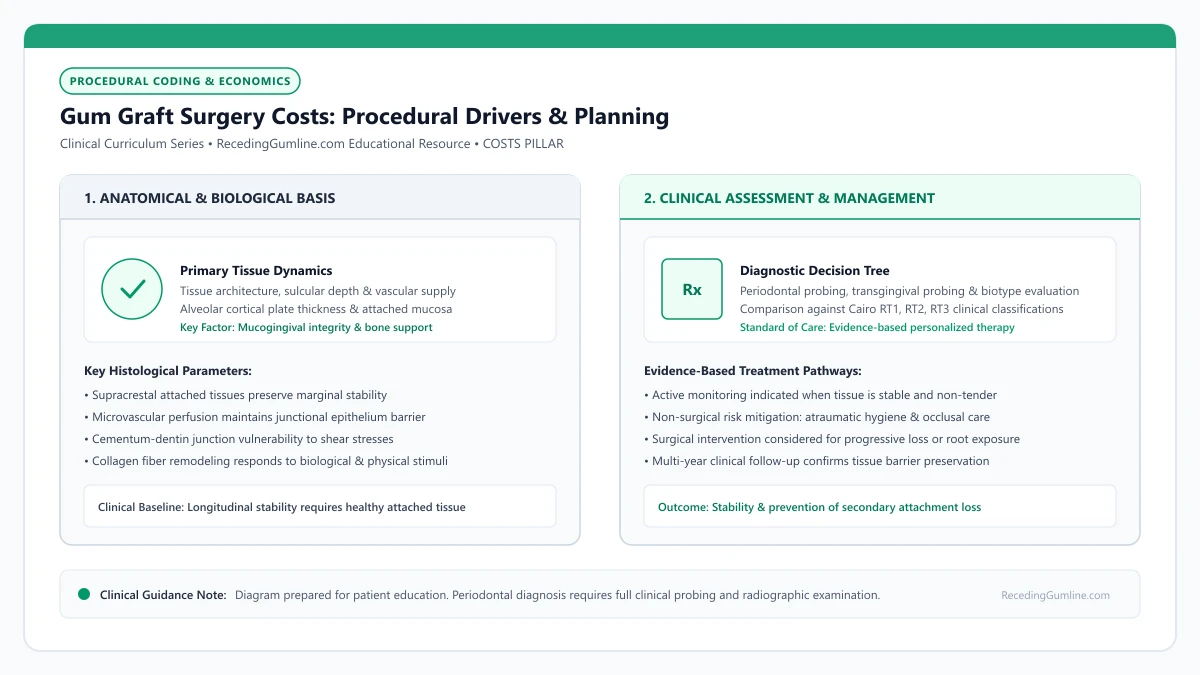
Educational illustration: Gum Graft Surgery Costs: Procedural Drivers & Planning. Clinical management requires comprehensive periodontal evaluation rather than isolated self-assessment.
Source: RecedingGumline.com Clinical Editorial Team (Proprietary educational diagram for RecedingGumline.com)
Core Clinical Cost Drivers in Periodontal Grafting
The total financial investment for gingival graft surgery is governed by four primary clinical drivers: surgical modality, graft material selection, anatomical defect complexity, and provider specialty. A simple free gingival graft placed to widen keratinized tissue in a non-aesthetic mandibular site carries a different fee structure than a complex microsurgical connective tissue graft requiring papilla-sparing tunneling across three maxillary incisors.
Surgeon expertise is a critical determinant. Board-certified periodontists complete three additional years of hospital-based surgical residency following dental school, specializing exclusively in soft-tissue biology and microsurgical flap design. While specialist fees are often 15% to 30% higher than general dentists, specialist outcomes demonstrate higher rates of complete root coverage and lower incidence of graft failure.
Furthermore, operating facility costs vary. Procedures performed in modern periodontal surgical suites equipped with surgical operating microscopes, high-magnification loupes, and piezoelectric bone-cutting devices reflect the advanced overhead necessary to deliver microsurgical precision.
Key Cost Insights
- Surgical technique and anatomical complexity directly dictate procedural fees.
- Board-certified periodontists possess specialized microsurgical training, reflected in fee schedules.
- Advanced surgical suites with operating microscopes provide enhanced clinical outcomes with corresponding overhead.
Material Economics: Autogenous Palatal Grafts vs. Donor Allografts
The choice between harvesting the patient's own palatal tissue (autograft) and using processed donor biomaterials (allograft or xenograft) introduces distinct economic trade-offs. Autogenous subepithelial connective tissue grafting (ADA CDT code D4273) involves two concurrent surgical sites: the recipient root surface and the palatal donor site.
Because autogenous harvesting requires specialized microsurgical flap creation, anatomical artery identification, and complex suturing, the procedure demands 60 to 90 minutes of surgical time. However, there are zero direct biomaterial procurement costs.
Conversely, using Acellular Dermal Matrix (ADM, ADA CDT code D4275) or collagen xenografts eliminates the palatal donor wound, reducing chair time by 30 to 45 minutes. However, the surgeon must purchase sterile, tissue-bank-processed biomaterials, which range from 300 dollars to 800 dollars+ per package. In many practices, the total patient fee for allograft and autograft procedures ends up remarkably similar, balancing surgeon labor against biomaterial costs.
Key Cost Insights
- Autogenous grafting (D4273) involves higher surgeon time and dual surgical sites with zero material fees.
- Allograft procedures (D4275) eliminate palatal donor pain but introduce 300 dollars-800 dollars+ biomaterial procurement costs.
- Total patient costs for autograft vs allograft often balance out due to labor versus material offsets.
Multi-Tooth Economies of Scale & Staging Strategies
When patients require grafting across multiple teeth, treating adjacent teeth in a single operative session offers substantial financial efficiencies. Periodontal fee schedules recognize this through primary versus additional site coding.
For example, the first tooth in a quadrant is billed under code D4273 (first tooth in surgical site), carrying the full primary fee. Each subsequent adjacent tooth treated in the same continuous surgical flap is billed under code D4276 (combined connective tissue graft, each additional contiguous tooth), which is typically discounted by 30% to 50% compared to the primary fee.
In contrast, treating three separate teeth in three distinct surgical appointments requires triple the setup, anesthesia, post-op visits, and facility overhead, maximizing out-of-pocket costs. Planning multi-tooth quadrant procedures maximizes both clinical healing efficiency and insurance benefit utilization.
Key Cost Insights
- Adjacent teeth in the same surgical site are billed under discounted secondary codes (D4276).
- Treating multiple teeth simultaneously saves 30% to 50% on secondary tooth fees.
- Consolidating care into quadrant sessions avoids repeated anesthesia, facility, and setup costs.
Ancillary Expenses: Sedation, Imaging & Recovery Supplies
When budgeting for gum graft surgery, patients must account for ancillary fees that accompany the primary surgical code. Pre-operative diagnostics frequently include high-resolution periapical radiographs (30 dollars to 60 dollars per film) or Cone-Beam Computed Tomography (CBCT, 250 dollars to 450 dollars) to evaluate 3D bone plate thickness.
Anesthesia options also influence the final invoice. While local anesthesia is included in the base surgical fee, patients with dental anxiety often opt for oral conscious sedation (150 dollars to 300 dollars) or intravenous (IV) deep conscious sedation administered by a certified anesthesiologist (500 dollars to 1,000 dollars+ per hour).
Finally, postoperative supplies contribute to out-of-pocket expenses: custom-fabricated vacuum-formed palatal stents (150 dollars to 250 dollars) to protect the donor wound, prescription 0.12% chlorhexidine digluconate antimicrobial mouthwash (20 dollars to 40 dollars), and analgesics or antibiotics (30 dollars to 75 dollars).
Key Cost Insights
- Pre-operative CBCT 3D imaging adds 250 dollars to 450 dollars when detailed bone mapping is required.
- Intravenous (IV) conscious sedation adds 500 dollars to 1,000 dollars+ to the total surgical invoice.
- Palatal stents, prescription antimicrobial rinses, and medications contribute 200 dollars to 350 dollars in ancillary costs.
The Economic Cost of Delayed Treatment vs. Early Intervention
A vital economic calculation that patients must weigh is the financial cost of delaying treatment. While soft-tissue grafting requires an upfront capital investment of 1,500 dollars to 3,000, dollars postponing care allows recession and bone loss to advance unhindered.
When an isolated recession defect progresses from a highly predictable Cairo RT1 to an advanced RT2 or RT3 defect with interproximal bone loss, simple root coverage is no longer achievable. The tooth may eventually become hypermobile and require extraction.
Replacing a lost tooth with a dental implant, bone graft, and ceramic crown routinely costs 4,500 dollars to 7,000 dollars+ per tooth—more than triple the cost of a preventive gum graft. Early periodontal soft-tissue stabilization represents an exceptionally sound biological and financial investment that preserves natural dentition.
Key Cost Insights
- Delaying treatment allows simple Cairo RT1 defects to progress into complex, less predictable bone loss.
- Tooth replacement via dental implants and crowns costs 4,500 dollars to 7,000 dollars+, far exceeding grafting costs.
- Early soft-tissue stabilization protects the natural tooth root, avoiding expensive restorative cascades.
Gum Graft Cost Per Tooth vs. Multi-Tooth Quadrant Pricing
When facing soft-tissue grafting surgery, one of the most common questions patients ask is: "Why does treating two or three teeth at once cost less than treating them separately?" When treating a receding gumline, procedural billing reflects surgical economies of scale. Understanding how ADA coding structures primary and contiguous surgical sites clarifies the pricing differences between single-tooth and quadrant procedures.
• Single-tooth gum graft surgery typically costs between procedural fee rangesand procedural fee rangesdepending on graft material and regional fees.
• Treating adjacent teeth in the same surgical session utilizes "additional tooth" billing codes (CDT D4273 / D4275), significantly reducing the per-tooth cost.
• Multi-tooth procedures share facility, surgical drape, and local anesthesia overhead, creating substantial financial savings.
• Dental insurance annual maximums (procedural fee ranges) often cap reimbursement, making surgical timing across calendar years a strategic consideration.
Single-Tooth Surgery: Overhead and Initial Site Billing
If you undergo gum graft surgery on a single isolated tooth, the national average out-of-pocket cost typically ranges from procedural fee ranges. This single-tooth fee must absorb all fixed surgical overhead costs: sterile surgical room setup, micro-surgical instrumentation, local anesthesia administration, and surgeon operative time.
Under standard dental coding, an autogenous connective tissue graft on the first tooth is billed as ADA code D4273 (Autogenous connective tissue graft procedure, first tooth). If donor tissue is used, it is billed under D4275. This primary code reflects the complete surgical preparation of both the donor harvest bed and the recipient flap.
The standard surgical fee for soft-tissue grafting typically ranges from procedural fee ranges per tooth depending on anatomical complexity and surgical technique. When multiple adjacent teeth are treated within the same quadrant, periodontists frequently apply reduced multi-tooth bundle fees that lower per-tooth costs.
Key Cost Insights
- Single-tooth graft averages procedural fee ranges depending on geography and provider tier
- Primary site code (D4273 or D4275) absorbs all fixed surgical room and anesthesia overhead
- Requires full post-operative recovery protocol regardless of treating one tooth or three
Multi-Tooth Quadrant Pricing: The Additional Contiguous Tooth Discount
When multiple adjacent teeth in the same quadrant have receding gums, treating them simultaneously is substantially more cost-effective. In 2014, the ADA introduced specific "additional site" codes: CDT D4283 (Autogenous connective tissue graft, each additional contiguous tooth) and D4285 (Non-autogenous graft, each additional tooth).
Because the surgeon has already anesthetized the area and reflected the flap, the fee for each additional contiguous tooth is typically 40% to 60% lower than the primary site fee (averaging procedural fee ranges per additional tooth). Treating three teeth together might cost procedural fee rangescompared to procedural fee rangesif performed across three separate appointments.
Autogenous connective tissue harvesting from the palate carries separate procedural fees compared to acellular dermal matrix allografts or xenogeneic collagen matrices. Utilizing donor allografts eliminates the second surgical donor site but adds material procurement expenses of procedural fee ranges per surgical site.
Key Cost Insights
- Additional adjacent teeth are billed under lower codes (D4283 or D4285)
- Fees for additional teeth are 40% to 60% lower than the first primary site
- Patients endure a single surgical recovery and single palatal donor site instead of multiple surgeries
Navigating Insurance Maximums: The Calendar Year Splitting Strategy
A major obstacle when treating multiple teeth is that most dental insurance plans have annual maximum benefit caps of procedural fee ranges. A multi-tooth surgical estimate of procedural fee rangeswill quickly exhaust your entire annual benefit, leaving remaining costs out-of-pocket.
To maximize insurance reimbursement, many patients and periodontists utilize a "calendar-year split." If surgery is needed across two quadrants, quadrant one is performed in November or December (exhausting the current year's maximum), and quadrant two is scheduled in January, accessing a fresh annual benefit maximum.
Anesthesia fees, post-operative antibiotic prescriptions, and surgical re-evaluation visits may be billed separately or bundled into an inclusive global surgical package. Clarifying whether post-operative suture removal and three-month surgical healing evaluations are covered avoids unexpected auxiliary expenses.
Key Cost Insights
- Annual insurance maximums (procedural fee ranges–procedural fee ranges) are easily exhausted by multi-tooth surgery
- Calendar-year splitting schedules one quadrant in late fall and the next in January
- Accesses two consecutive annual benefit maximums, doubling insurance reimbursement
CDT Fee Mechanics: Primary Graft (D4273) vs. Additional Contiguous Site (D4276)
When budgeting for multiple-tooth gum graft surgery, patients should understand the significant fee difference between primary and secondary surgical sites under the ADA CDT coding system.
The first tooth treated in a given quadrant is billed under code D4273 (Autogenous connective tissue graft, first tooth in surgical site), which carries the full procedural fee (typically procedural fee ranges). This base fee covers flap design, palatal harvest, and initial site preparation.
However, each additional adjacent tooth treated within the same continuous surgical site is billed under code D4276 (combined connective tissue graft, each additional contiguous tooth). Because the donor harvest is already completed and the flap is continuous, the fee for D4276 is discounted by 30% to 50% (typically procedural fee ranges per tooth).
Key Cost Insights
- The initial tooth is billed under full-rate primary code D4273 (procedural fee ranges).
- Contiguous adjacent teeth in the same site are billed under discounted secondary code D4276 (procedural fee ranges).
- Secondary contiguous codes reflect 30% to 50% savings due to shared flap and harvest efficiency.
Quadrant Consolidation: Maximizing Surgical & Financial Efficiency
Treating receded teeth across multiple isolated appointments dramatically inflates total patient expenses. Each separate surgical appointment incurs independent facility setup fees, local anesthetic supplies, disposable microsurgical blades, and postoperative prescription costs.
Consolidating care by treating entire quadrants or sextants in a single operative session captures maximum economies of scale. For instance, grafting three contiguous mandibular incisors in one visit requires only one surgical setup, one palatal stent, and one recovery cycle.
This staging strategy minimizes total out-of-pocket costs, shortens cumulative healing time, and allows patients to maximize single-calendar-year insurance benefits.
Key Cost Insights
- Multiple isolated surgeries multiply facility, anesthetic, and prescription expenses.
- Consolidating contiguous teeth into quadrant sessions captures substantial economies of scale.
- Single-session quadrant care minimizes recovery time and maximizes insurance deductible usage.
Dental Insurance Frequency Limitations on Deep Cleanings and Gum Grafts
One of the most frustrating reasons for insurance claim denials in periodontics is the "frequency limitation." Even when your periodontist proves that you urgently need a deep cleaning or a gum graft, your insurance company may refuse payment simply because not enough months or years have passed since you last had a similar procedure. Understanding these contractual time locks prevents costly surprises.
• Insurers enforce strict contractual frequency limitations on periodontal procedures regardless of clinical necessity.
• Scaling and root planing (CDT D4341) is typically limited to once every 24 to 36 months per quadrant.
• Periodontal maintenance (CDT D4910) is frequently restricted to two visits per benefit year, despite the clinical need for quarterly care.
• Soft-tissue grafting is often limited to once per tooth per lifetime or once every 36 to 60 months.
Deep Cleaning Limits: The 24- to 36-Month Lockout
Under most dental insurance policies, scaling and root planing (CDT D4341 or D4342) is restricted by a strict frequency clause: covered only once per quadrant every 24 to 36 months (and in some restrictive policies, once every 5 years).
If you had deep cleaning performed 18 months ago, but active periodontitis has flared up again with 6 mm bleeding pockets, your periodontist cannot bill insurance for a new deep cleaning. The insurer will automatically deny the claim based on the calendar restriction, leaving you responsible for the full fee.
Dental benefit plans impose rigid frequency limitations on periodontal procedures, such as covering scaling and root planing (D4341) only once every 24 to 36 months per quadrant. Soft-tissue grafting procedures often face strict limits permitting coverage only once every 3 to 5 years per tooth site.
Key Cost Insights
- Scaling and root planing is typically covered only once every 24 to 36 months per quadrant
- Applies strictly to the calendar date of previous treatment, even if performed by a different dentist
- Disease flare-ups within the lockout window must be managed out-of-pocket or via maintenance
The Maintenance Conflict: 2 Visits vs. 4 Needed per Year
The most widespread frequency conflict in periodontics involves periodontal maintenance (CDT D4910). Peer-reviewed medical science proves that bacteria repopulate pockets every 90 days, requiring 4 maintenance visits per year to prevent bone loss.
However, many low-cost dental plans have a contractual clause stating: "Periodontal maintenance limited to two visits in any 12-month period, combined with routine prophylaxis." Under this rule, insurance pays for visits 1 and 3, while you must pay 100% out-of-pocket for visits 2 and 4.
Periodontal maintenance visits (CDT code D4910) are frequently capped at two visits per calendar year under standard employer policies, despite clinical guidelines mandating three-month intervals. When patients attend the clinically necessary third and fourth annual maintenance visits, insurers often deny coverage or reclassify visits as routine cleanings.
Key Cost Insights
- Science dictates 4 maintenance cleanings per year; many plans pay for only 2
- Insurers frequently combine prophylaxis and maintenance into a shared 2-visit cap
- Paying out-of-pocket for the alternating 2 visits is vital to prevent tooth loss
Gum Grafting Limitations: Lifetime and Multi-Year Restrictions
Soft-tissue grafting procedures (CDT D4273 and D4275) also face stringent frequency caps. Many dental policies enforce a "once per tooth per lifetime" rule. If a tooth received a gum graft five years ago and now exhibits recurrent recession, insurance will reject any subsequent graft on that specific tooth.
Other policies enforce a 36- to 60-month waiting period before a graft can be repeated on the same tooth. If surgery is required before the lockout window expires, patients must rely on HSA/FSA funds, medical savings plans, or practice payment arrangements.
To navigate frequency restrictions, dental billing coordinators can submit letters of medical necessity documenting active bleeding on probing and refractory pocketing. When insurance refuses additional maintenance coverage, paying out of pocket for the extra visits protects the thousands of dollars invested in initial periodontal stabilization.
Key Cost Insights
- Many policies enforce a "once per tooth per lifetime" restriction on gum grafts
- Other plans impose a 36- to 60-month waiting period between repeat grafting procedures
- Prior claims submitted under the same tooth number trigger automated rejection
Site-Specific Exclusions: The 24-to-36 Month Re-Grafting Frequency Clause
Dental insurance contracts contain strict frequency limitations that restrict how often specific procedure codes can be billed on the same anatomical tooth site. For soft-tissue grafting (CDT codes D4273, D4275, D4276), policies commonly enforce a 24- to 36-month frequency limitation.
If a patient develops recurrent recession on a previously grafted tooth within two to three years of the initial surgery, the insurance carrier will automatically deny reimbursement for a revision graft, categorizing it as an excluded repeat service.
Similarly, Scaling and Root Planing (D4341/D4342) enforces strict 24-month limitations per quadrant. Billing SRP on the same quadrant sooner than 24 months triggers immediate claim rejection unless documented by severe refractory disease.
Key Cost Insights
- Insurance policies enforce 24- to 36-month frequency limitations on soft-tissue grafting per tooth site.
- Revision surgery within the exclusion window is automatically denied regardless of medical need.
- Scaling and root planing enforces strict 24-month quadrant frequency restrictions.
Overcoming Frequency Denials: Documenting Secondary Disease & Refractory Progression
When clinical necessity requires performing surgery or deep cleaning within an active frequency limitation window, the periodontist can submit an evidence-based appeal with formal narrative justification.
To successfully overturn a frequency denial, the provider must demonstrate that the current procedure addresses a new, separate clinical condition rather than a failure of previous treatment. For example, if recession developed on an adjacent root surface or if systemic changes (uncontrolled diabetes, new medications) precipitated rapid secondary breakdown, this must be documented.
Submitting calibrated before-and-after periodontal charts, intraoral photographs, and a narrative from the treating specialist can prompt an insurance medical review director to grant a frequency exception.
Key Cost Insights
- Appealing frequency denials requires proving new or refractory periodontal pathology.
- Distinguishing between initial procedural failure and new secondary disease is crucial.
- Comparative periodontal probing charts and clinical photographs support successful appeals.
Allograft vs. Autograft Gum Graft Costs & Clinical Trade-Offs
When planning gum graft surgery, one of the most important decisions is selecting the source of the graft tissue. Patients can use their own tissue harvested from the palate (autograft) or opt for processed, medically sterilized human donor tissue (allograft, such as AlloDerm). While both techniques achieve excellent clinical outcomes, their financial structures, material fees, and recovery dynamics differ significantly.
• Autografts harvest tissue from your own palate, eliminating biomaterial purchase costs but requiring a second surgical wound.
• Allografts utilize processed acellular dermal matrix (ADM), avoiding a palatal wound but incurring an added material fee of procedural fee ranges.
• Insurance reimbursement codes differ: CDT D4273 for autografts vs. D4275 for non-autogenous allografts.
• For multi-tooth procedures across four or more teeth, allografts become highly cost- and time-effective by eliminating donor site harvesting limits.
The Financial Structure: Material Surcharge vs. Operative Time
The pricing difference between an autograft and an allograft comes down to material costs versus surgical labor. In an autograft procedure (CDT D4273), there is zero biomaterial product fee because the tissue is harvested from your own palate. However, the surgeon must perform two separate surgeries in one session, requiring more operative time and sutures.
In an allograft procedure (CDT D4275), the surgeon orders a sterile package of processed human acellular dermal matrix (ADM, such as AlloDerm) or porcine collagen matrix. This high-tech biomaterial costs the surgical practice procedural fee ranges per unit, which is either billed as a separate materials charge or incorporated into a slightly higher procedural fee.
Autogenous connective tissue grafting (harvested from the patient’s own palate) eliminates material purchase fees but increases surgical operating time and requires donor site management. In contrast, donor tissue allografts (such as acellular human dermis) eliminate palatal donor pain but introduce bio-material laboratory costs of procedural fee ranges per package.
Key Cost Insights
- Autograft has zero tissue purchase fee, but requires longer surgical operating time
- Allograft incurs a procedural fee ranges biomaterial cost per tissue packet
- Overall out-of-pocket costs are often remarkably similar (procedural fee ranges–procedural fee rangesper site)
The Morbidity Trade-Off: Pain, Time Off Work & Medication Costs
When evaluating costs, patients must also consider the "hidden costs" of recovery. In an autograft, the palatal donor site behaves like a severe burn on the roof of your mouth, often requiring a custom palatal stent (procedural fee ranges–procedural fee ranges), prescription painkillers, and 2 to 4 days of reduced work productivity.
With an allograft, there is zero palatal wound. The patient leaves surgery with only the gumline treated, experiencing virtually no acute post-surgical pain. For busy professionals, eliminating palatal discomfort and avoiding missed work days often easily offsets the material fee of the allograft.
When treating multiple adjacent teeth or extensive generalized recession defects across three or four teeth, allografts offer substantial cost and comfort advantages. Harvesting sufficient autogenous tissue from the palate for multiple teeth is anatomically limited and dramatically increases post-operative patient morbidity.
Key Cost Insights
- Autograft palatal wound requires analgesics, protective stents, and more downtime
- Allograft produces minimal postoperative pain and virtually zero speech impairment
- Eliminating missed work days frequently compensates for the allograft material cost
Multi-Tooth Economics: When Allografts Become Cheaper
Where allografts truly shine financially is in multi-tooth or full-quadrant cases. The human palate has a strictly limited amount of harvestable donor tissue—usually enough to treat only two or three teeth at one time. If a patient needs six receded teeth grafted, an autograft approach requires two or three separate surgical dates months apart.
With allografts, tissue supply is virtually unlimited. A surgeon can use a large sheet of acellular dermal matrix to treat five or six teeth in a single surgical session, saving the patient thousands of dollars in facility fees, surgical setups, and multiple recovery periods.
Total out-of-pocket costs for autografts versus allografts frequently equalize when factoring in operating room time, suturing complexity, and specialized hemostatic dressings. Discussing financial and recovery trade-offs during the consultation helps patients choose the grafting approach aligned with their clinical needs and budget.
Key Cost Insights
- Palate has limited tissue, restricting autografts to 2 or 3 teeth per surgery
- Allografts allow 4 to 8 teeth to be treated in a single surgical appointment
- Eliminates duplicate facility and anesthesia charges, reducing overall multi-tooth costs
Biomaterial Economics: Acellular Dermal Matrix (ADM) Procurement Costs
When comparing the financial aspects of autogenous grafting (harvesting palatal tissue) versus allografting (using processed human donor tissue), the primary direct cost differentiator is biomaterial procurement.
Acellular Dermal Matrix (ADM, such as Alloderm) requires extensive processing: donor screening, viral inactivation, decellularization, and sterile packaging in certified tissue banks. Consequently, periodontal practices must purchase ADM biomaterials at wholesale costs ranging from procedural fee ranges+ per sterile package.
Dental practices bill allografts under CDT code D4275 (Non-autogenous connective tissue graft). While the insurance reimbursement rate for D4275 is often slightly lower than autograft code D4273, practices must factor in the non-reimbursable wholesale cost of the biomaterial.
Key Cost Insights
- Acellular Dermal Matrix (ADM) incurs wholesale procurement costs of procedural fee ranges+ per package.
- Allografts are billed under CDT code D4275, carrying distinct insurance reimbursement rates.
- Practices must balance biomaterial procurement overhead against surgical operative efficiency.
Chair-Time Efficiency vs. Material Costs: The Economic Trade-Off
Despite the wholesale material expense of allografts, the total patient fee for allograft and autograft surgery is often remarkably similar. This economic parity results from the significant savings in operative surgical chair time.
An autogenous graft requires two simultaneous surgical sites: harvesting from the palate and preparing the recipient bed. This dual-site surgery demands 60 to 90 minutes of surgeon chair time, complex suturing, and fabrication of a palatal stent. Conversely, an allograft eliminates the palatal donor site, reducing operative time by 30 to 45 minutes.
For multi-tooth procedures spanning four or more teeth, allografts offer unmatched scalability: the surgeon can treat multiple teeth without being constrained by limited palatal donor tissue volume or causing extensive patient donor site morbidity.
Key Cost Insights
- Allografts eliminate palatal harvesting, reducing surgical chair time by 30 to 45 minutes.
- Reduced surgeon labor offsets the procurement cost of the donor biomaterial.
- Allografts provide unlimited tissue volume, making multi-tooth cases economically and clinically viable.
Cost Comparison: Periodontal Maintenance (D4910) vs. Prophylaxis (D1110)
A common point of financial confusion for dental patients occurs after completing scaling and root planing: their cleanings are suddenly billed under ADA code D4910 (Periodontal Maintenance) rather than code D1110 (Prophylaxis), resulting in higher fees and unexpected copayments. Understanding the clinical, operational, and insurance differences between these two cleaning types explains the fee structure.
• A routine prophylaxis (CDT D1110) averages procedural fee ranges and is typically 100% covered twice a year by dental insurance.
• Periodontal maintenance (CDT D4910) averages procedural fee ranges per visit, reflecting advanced clinical time and subgingival instrumentation.
• Maintenance is subject to annual deductibles and 20% to 50% coinsurance under most dental PPO plans.
• Over a full year (four quarterly visits), periodontal maintenance costs approximately procedural fee ranges total.
Why Maintenance Costs More: Clinical Time and Site Debridement
The primary reason periodontal maintenance (CDT D4910) costs more than a standard cleaning (CDT D1110) is the clinical scope and time required. A standard cleaning takes 30 to 45 minutes and focuses on polishing enamel and scraping away superficial tartar above the gumline.
In contrast, a periodontal maintenance visit requires 50 to 60 minutes of intensive specialist care. The hygienist performs full-mouth 6-point probing at 168 sites, compares millimeter numbers against past checkups, and provides targeted subgingival debridement with ultrasonic scalers and hand curettes into 4 mm and 5 mm pockets to prevent bacterial repopulation.
A routine dental prophylaxis (CDT code D1110) typically costs between procedural fee rangesand procedural fee rangeswhereas specialized periodontal maintenance (CDT code D4910) ranges from procedural fee ranges per visit. Periodontal maintenance requires higher clinician expertise, subgingival instrumentation of deep pockets, and individualized antimicrobial therapy.
Key Cost Insights
- Prophylaxis (D1110) averages procedural fee ranges for 30–45 minutes of supragingival cleaning
- Periodontal Maintenance (D4910) averages procedural fee ranges for 50–60 minutes of deep care
- Involves full-mouth probing documentation and targeted subgingival pocket instrumentation
Insurance Mechanics: Class I Preventive vs. Class II Basic
The second shock for patients is insurance coverage. Most dental plans cover standard prophylaxis at 100% with no deductible because it is classified as Class I Preventive.
However, the moment your code changes to D4910, insurers categorize it as Class II Basic care. This means your annual deductible (procedural fee ranges–procedural fee ranges) applies, and you are charged a 20% coinsurance fee. Furthermore, many plans contractually limit cleanings to two per year, meaning you may have to pay 100% cash for the alternating two quarterly maintenance visits.
Insurance policies often reimburse routine prophy cleanings at 100% under preventive benefits, but classify periodontal maintenance as basic periodontal care reimbursed at 80% or subject to deductibles. This difference in insurance classification can create an unexpected procedural fee ranges copayment per maintenance appointment.
Key Cost Insights
- D1110 (Prophy) is Class I: 100% covered with zero deductible
- D4910 (Maintenance) is Class II: Subject to annual deductible and 20% coinsurance
- Many plans cap coverage at 2 visits per year, leaving 2 visits fully out-of-pocket
Annual Cost Comparison: Maintenance as Financial Insurance
Over a 12-month period, a patient with healthy gums receiving two standard cleanings pays approximately procedural fee rangesout-of-pocket with insurance (or procedural fee ranges–procedural fee rangeswithout insurance). A periodontal patient receiving four maintenance visits will typically pay procedural fee ranges out-of-pocket with insurance (or procedural fee ranges–procedural fee rangeswithout insurance).
While this extra expense can feel burdensome, periodontists view maintenance as essential financial protection. Spending procedural fee rangesa year on maintenance prevents recurrent periodontitis that requires a procedural fee rangesrepeat deep cleaning, procedural fee rangesin gum grafts, or a procedural fee rangesdental implant to replace a lost tooth.
Downgrading from periodontal maintenance back to routine prophylaxis to save money is clinically hazardous for patients with a history of periodontitis. Discontinuing subgingival debridement allows anaerobic pathogens to recolonize deep pockets within 12 weeks, reversing previous surgical gains and triggering secondary bone loss.
Key Cost Insights
- Annual out-of-pocket cost with insurance: Prophy ~procedural fee rangesvs. Maintenance ~procedural fee ranges–procedural fee ranges
- Annual cost without insurance: Prophy ~procedural fee rangesvs. Maintenance ~procedural fee ranges–procedural fee ranges
- Investing in quarterly maintenance prevents thousands in future surgical and implant costs
Billing Taxonomy: Routine Prophylaxis (D1110) vs. Periodontal Maintenance (D4910)
A frequent source of patient confusion is the cost and billing transition from a routine dental cleaning to periodontal maintenance. A routine dental cleaning is billed under CDT code D1110 (Prophylaxis - adult), typically costing procedural fee ranges and covered at 100% by dental insurance twice per year.
However, once a patient has been diagnosed with periodontitis and treated with scaling and root planing or surgical grafting, they can never legally or clinically return to code D1110. Ongoing care must be billed under CDT code D4910 (Periodontal Maintenance), which carries a higher fee (procedural fee ranges per visit).
Code D4910 involves specialized site-specific subgingival scaling, antimicrobial pocket irrigation, and full-mouth calibrated periodontal probing, reflecting the therapeutic expertise needed to maintain disease remission.
Key Cost Insights
- Routine cleanings (D1110, procedural fee ranges) are preventive; periodontal maintenance (D4910, procedural fee ranges) is therapeutic.
- Patients treated for periodontitis or recession can never be billed under routine prophylaxis D1110.
- D4910 reflects comprehensive subgingival debridement, pocket irrigation, and continuous probing surveillance.
Managing Insurance Downgrades & Alternate Benefit Clauses
Insurance coverage for Periodontal Maintenance (D4910) is fraught with policy restrictions. While preventive D1110 cleanings are covered at 100%, insurance plans frequently classify D4910 under "Basic Periodontal Services," reimbursing only 70% to 80% and subjecting the claim to the annual deductible.
Furthermore, many policies restrict D4910 coverage to only two visits per year, despite clinical guidelines mandating 3-month (four visits per year) recall intervals. Some carriers enforce an "Alternate Benefit Clause," automatically downgrading the D4910 claim and paying only the lower D1110 fee.
Dental offices provide patients with detailed financial estimates illustrating these downgrades, enabling patients to budget for the out-of-pocket share required to maintain tissue stability.
Key Cost Insights
- Insurance plans often cover D4910 at 70-80% as a Basic service subject to deductibles.
- Policies frequently limit coverage to 2 visits annually, conflicting with the 3-month clinical standard.
- Alternate Benefit Clauses downgrade D4910 to lower D1110 payment rates, increasing out-of-pocket costs.
Clinical Reality Check
Always request a comprehensive, itemized written treatment plan before surgery that clearly delineates the primary surgical codes (D4273/D4275), secondary contiguous codes (D4276), sedation, and imaging to prevent unexpected surprise billing.
Questions to Ask Your Dentist or Periodontist
- What is the itemized fee breakdown for my recommended gum graft procedure?
- How much will I save per tooth if we treat all adjacent receded teeth in the same quadrant together?
- Are the costs of the palatal protective stent, follow-up suture removals, and medications included?
- Does your office submit pre-authorization claims to my dental insurance with clinical intraoral photos?
- What healthcare financing plans (such as CareCredit) or in-house payment options do you accept?
- What is your fee for the first tooth versus each additional contiguous tooth in the same quadrant?
- Which specific CDT codes (D4273, D4283, D4275, D4285) will you be submitting to my insurance plan?
- If I have multiple teeth needing grafts in different quadrants, should we split them across calendar years to maximize my insurance?
- Are postoperative suture removals and follow-up visits included in this surgical fee?
- What are the exact frequency limitations on deep cleanings (D4341) and maintenance (D4910) under my plan?
- Does my plan cover 2 or 4 periodontal maintenance cleanings per calendar year?
- If insurance denies my 3-month cleaning, what is your out-of-pocket cash fee for that maintenance visit?
- Has this specific receded tooth ever had a previous gum graft billed to my insurance policy?
- What is the total fee difference in your office between an autograft (palate) and allograft (donor tissue)?
- What specific allograft brand (such as AlloDerm or Mucoderm) do you use, and is it billed under code D4275?
- Given the thickness and depth of my gum recession, is an autograft significantly more predictable for my case?
- If I choose an allograft, will my insurance cover it at the same coinsurance percentage as an autograft?
- What is the exact cash fee difference between code D1110 and D4910 in your practice?
- How many D4910 maintenance visits does my specific dental insurance policy reimburse each year?
- Can your office provide an annual cost estimate for my four recommended maintenance visits?
- Will my periodontal maintenance visit include full-mouth probing depth charting at every appointment?
Unsure What Your Gum Changes Mean?
Take our free, evidence-based Gum Recession Assessment — approximately 3 minutes. Identify potential risk factors, evaluate symptoms, and receive personalized discussion questions for your dentist or periodontist.
Non-diagnostic educational triage. Private, secure, completed in your browser.
Related Educational Topics
Scientific Literature & Clinical Guidelines
5sources · Hide ▲
- American Dental Association (2026).
"Code on Dental Procedures and Nomenclature (CDT)." American Dental Association.Coding Standard Official Publication
Clinical relevance: Standardized dental procedure nomenclature maintained and updated annually by the American Dental Association (ADA, currently referencing CDT 2026/2027) for administrative classification and billing (including codes D4273, D4275, D4277, D4341, D4910). The site references CDT procedure numbers for high-level educational and administrative context and does not reproduce proprietary CDT descriptors or substantial CDT text. Commercial use/licensing requirements should be reviewed separately with the ADA or qualified counsel. Procedure codes facilitate administrative reporting and do not dictate clinical necessity or insurance benefit coverage.
- Cairo F, Nieri M, Cincinelli S, Mervelt J, Pagliaro U (2011).
"The interproximal clinical attachment level to classify gingival recessions and predict root coverage outcomes: an explorative and reliability study." Journal of Clinical Periodontology.
Clinical relevance: Exploratory and reliability study establishing the Cairo classification based on interdental clinical attachment level (CAL): RT1 (no interproximal attachment loss; complete root coverage is clinically predictable), RT2 (interproximal attachment loss <= buccal loss; partial coverage predictable), and RT3 (interproximal loss exceeds buccal recession; complete coverage not predictable).
- Chambrone L, Salinas Ortega MA, Sukekava F, Rotundo R, Kalemaj Z, Buti J, Pini Prato GP (2018).
"Root coverage procedures for treating localised and multiple recession-type defects." Cochrane Database of Systematic Reviews.
Clinical relevance: Cochrane systematic review evaluating root-coverage procedures for localized and multiple recession-type defects. While subepithelial connective tissue grafts (SCTG) combined with coronally advanced flaps demonstrated higher rates of complete root coverage and keratinized tissue gain compared to flap advancement alone, evidence quality varied across outcomes and clinical decisions must balance donor site morbidity and patient-reported outcomes.
- Tonetti MS, Greenwell H, Kornman KS (2018).
"Staging and grading of periodontitis: Framework and proposal of a new classification and case definition." Journal of Clinical Periodontology.
Clinical relevance: Consensus framework establishing the multidimensional staging (severity and extent of periodontal tissue breakdown) and grading (biological rate of disease progression, incorporating smoking and diabetes as grade modifiers) for periodontitis. It addresses periodontitis diagnosis and staging, not the classification of localized gingival recession defects.
- Ramfjord SP, Caffesse RG, Morrison EC, Burgett FG, Nissle RR, Shick RA (1987).
"4 modalities of periodontal treatment compared over 5 years." Journal of Clinical Periodontology.
Clinical relevance: Longitudinal clinical trial comparing four periodontal treatment modalities over 5 years; established that rigorous professional maintenance at 3-month intervals successfully maintains clinical attachment levels and prevents further periodontal tissue breakdown regardless of the initial surgical or non-surgical modality used.
Important Medical Notice
The contents of RecedingGumline.com, including text, graphics, self-assessment calculators, and other materials, are intended solely for educational and informational purposes. This content is not intended to replace professional dental examination, diagnosis, or treatment. Always seek the advice of a qualified dentist, periodontist, or other licensed oral healthcare provider with any questions you may have regarding a medical or dental condition. Never disregard professional medical advice or delay seeking it because of something you read on this website.