Specialist vs General Practice Fees in Periodontal Care
When treating a receding gumline etiology or advanced periodontal disease, patients frequently encounter a noticeable price differential between general dentists and board-certified periodontists. On average, specialist fees are 15% to 35% higher for surgical procedures such as connective tissue grafting, bone regeneration, and osseous surgery. Understanding the advanced surgical residency training, microsurgical technology, and clinical outcome predictability that underpin this fee differential enables patients to make informed healthcare choices.
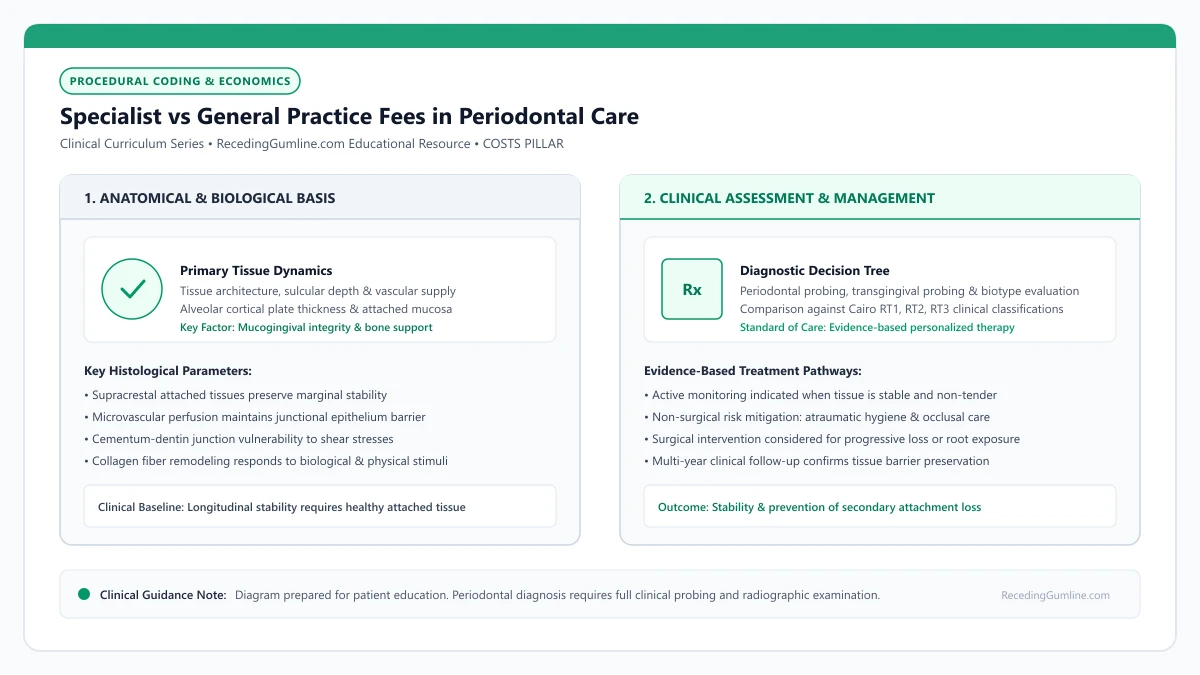
Educational illustration: Specialist vs General Practice Fees in Periodontal Care. Clinical management requires comprehensive periodontal evaluation rather than isolated self-assessment.
Source: RecedingGumline.com Clinical Editorial Team (Proprietary educational diagram for RecedingGumline.com)
Education & Residency: The Making of a Periodontist
All dentists graduate with a Doctor of Dental Surgery (DDS) or Doctor of Dental Medicine (DMD) degree, having completed four years of comprehensive general dental education covering fillings, crowns, extractions, root canals, and basic periodontal cleanings. General dentists are legally permitted to perform any dental procedure they deem within their clinical competency.
A Periodontist, however, is a dental specialist recognized by the American Dental Association who has completed a rigorous, full-time 3-year postgraduate residency program accredited by the Commission on Dental Accreditation (CODA). During these 36 months, periodontal residents perform thousands of hours of advanced soft-tissue plastic surgery, bone grafting, dental implant placement, and IV conscious sedation management.
Furthermore, board certification through the American Board of Periodontology (ABP) requires passing comprehensive written and rigorous oral defense examinations evaluating real surgical case outcomes. This advanced credential represents the pinnacle of surgical excellence in periodontal care.
Key Cost Insights
- Periodontists complete 3 years of rigorous full-time surgical residency beyond dental school.
- Training focuses exclusively on soft-tissue plastic surgery, bone regeneration, and micro-vascular biology.
- Board certification from the American Board of Periodontology verifies proven surgical excellence.
Specialized Surgical Infrastructure & Technology Investments
The higher fee structure observed in periodontal specialty practices is directly tied to the advanced surgical infrastructure maintained within the clinic. Periodontists routinely equip their surgical operatories with operating microscopes and high-power Galilean or prismatic loupes that cost 15,000 dollars to 40,000 dollars+ per unit.
These magnification systems allow the surgeon to work under 4x to 10x magnification, utilizing micro-scalpels and ultra-fine sutures (6-0 to 8-0) that minimize surgical trauma to the delicate vascular supply of the marginal gingiva. In contrast, general dental operatories are rarely outfitted for dedicated microsurgery.
In addition, specialty practices invest in in-house 3D Cone-Beam CT (CBCT) scanners, centrifuge units for Platelet-Rich Fibrin (PRF) preparation, and specialized emergency monitoring equipment for IV conscious sedation, establishing an environment designed specifically for complex surgical safety.
Key Cost Insights
- Specialty operatories feature surgical operating microscopes and microsurgical micro-instruments.
- Ultra-fine 6-0 to 8-0 sutures and micro-scalpels preserve the delicate supraperiosteal vascular network.
- In-house CBCT 3D imaging and PRF centrifuges support advanced regenerative protocols.
Clinical Outcomes: Complete Root Coverage Predictability
The ultimate justification for consulting a specialist lies in clinical outcome predictability. While many general dentists perform simple soft-tissue grafting, extensive systematic reviews in periodontal literature reveal a clear correlation between surgical volume, microsurgical technique, and root coverage success.
Periodontal plastic surgery is intensely technique-sensitive: minor surgical errors—such as placing excessive tension on the flap, tearing the delicate interdental papilla, or failing to properly prepare the avascular root surface—routinely result in partial or complete graft necrosis and recurrent recession.
On challenging Cairo RT1 and RT2 defects, particularly across multiple adjacent teeth or in the high-visibility aesthetic smile zone, board-certified periodontists consistently achieve complete root coverage rates exceeding 80% to 90%, with refined tissue color blending and harmonious gingival zeniths.
Key Cost Insights
- Periodontal plastic surgery is highly technique-sensitive, where minor errors cause graft failure.
- Specialists achieve significantly higher percentages of complete root coverage (CRC) in aesthetic zones.
- Re-treating a failed gum graft is technically challenging and carries far lower predictability than primary surgery.
Patient Decision Framework: When to See a Specialist
Navigating provider selection requires evaluating the specific clinical presentation and personal treatment goals. General dentists are exceptionally well-suited for early-stage conservative care: diagnosing initial recession, managing toothbrush abrasion, and performing non-surgical scaling and root planing.
However, patients should seek a consultation with a board-certified periodontist if any of the following clinical indicators exist: recession involving anterior teeth within the smile zone, multiple adjacent receded teeth, severe root hypersensitivity, a thin periodontal biotype with total absence of attached keratinized tissue, or recession accompanied by interproximal bone loss (Cairo RT2 or RT3).
Furthermore, patients requiring intravenous (IV) conscious sedation for surgical anxiety or those who have experienced a previous failed gum graft should always be managed by a periodontal specialist.
Key Cost Insights
- General dentists excel at diagnosing early recession and performing initial non-surgical deep cleanings.
- Specialist referral is strongly indicated for aesthetic zone defects, multiple teeth, or thin biotypes.
- Complex bone defects, failed previous grafts, and IV sedation require board-certified periodontal care.
Specialized Operatory Technology: Surgical Operating Microscopes & Loupes
The fee difference between specialist periodontal care and general practice also directly reflects significant institutional investments in advanced microsurgical technology and clinical infrastructure. Board-certified periodontists routinely perform soft-tissue grafting and regenerative therapy under high-power surgical operating microscopes (providing 8x to 20x magnification) or custom high-resolution prismatic loupes with coaxial LED illumination.
Operating at this level of optical precision requires specialized ophthalmic-grade micro-instrumentation, micro-scalpels (such as ophthalmic blade size 67 or 69), and ultra-fine monofilament micro-sutures (6-0 to 8-0 caliber, thinner than a human hair). These specialized tools allow the surgeon to handle delicate graft tissues atraumatically, dissect partial-thickness flaps without tearing micro-vessels, and achieve primary wound closure with zero tension.
Extensive clinical literature demonstrates that periodontal microsurgery performed under high magnification yields significantly higher rates of complete root coverage, reduced postoperative swelling and hematoma formation, and refined aesthetic tissue blending compared to macrosurgical techniques.
Key Cost Insights
- Periodontal fee schedules support surgical operating microscopes providing up to 20x optical magnification.
- Ophthalmic-grade micro-instruments and 7-0/8-0 micro-sutures minimize tissue trauma and preserve vascularity.
- Microsurgical precision achieves higher complete root coverage rates and faster patient recovery.
Periodontal Consultation Cost Breakdown: Exam, Comprehensive Charting & Radiographs
When scheduling a specialized receding gumline assessment with a periodontist, patients are frequently uncertain about what the initial visit will cost and how it differs from a routine general dental exam. A periodontal consultation is an extensive diagnostic evaluation involving full-mouth millimeter probing, clinical attachment level mapping, and radiographic bone analysis. Understanding these diagnostic components demystifies out-of-pocket expenses.
• A comprehensive periodontal evaluation is billed under ADA CDT code D0180, distinct from a routine periodic exam (D0120).
• Diagnostic periapical radiographs or full-mouth series (D0210) evaluate underlying alveolar bone crest height.
• Average out-of-pocket costs for an initial specialist consultation range from procedural fee ranges depending on geographic region and required x-rays.
• Dental insurance typically covers diagnostic evaluations at 80% to 100% of allowable fees, subject to annual maximums and deductibles.
Itemized Breakdown: What You Pay For During the Initial Visit
When you receive an itemized billing statement for an initial periodontal consultation, it typically consists of two to three specific procedure codes. The central charge is ADA code D0180: Comprehensive Periodontal Evaluation—New or Established Patient.
National average fees for code D0180 range from procedural fee ranges. Unlike a quick 5-minute visual checkup, this evaluation involves a specialized clinician measuring 168 individual probing depth sites, recording recession millimeters, grading tooth mobility, and checking for root furcation involvement.
A comprehensive periodontal examination (CDT code D0180) typically ranges from procedural fee ranges depending on geographic location and specialist training. This diagnostic visit incorporates full-mouth six-point periodontal probing, mucogingival defect charting, and occlusal analysis to determine the biological etiology of recession.
Key Cost Insights
- ADA Code D0180: Comprehensive Periodontal Evaluation averages procedural fee ranges
- Involves measuring 168 individual probing sites and full-mouth attachment charting
- Assesses gingival phenotype, tissue thickness, and mucogingival defects
Diagnostic Imaging Fees: How to Avoid Duplicate X-Ray Charges
Accurate evaluation of gum recession requires high-resolution radiographs to assess the bone between your teeth. If current radiographs are needed, the periodontist may bill code D0210 (Full Mouth Series, procedural fee ranges–procedural fee ranges) or individual periapical films (D0220/D0230, procedural fee ranges–procedural fee rangesper image).
A major cost-saving tip is having your general dental office email your recent digital x-rays to the periodontist prior to your consultation. If the images were taken within the past 6 to 12 months and clearly display the bone crest, you can avoid paying for duplicate diagnostic films.
Intraoral radiographic series (such as a full-mouth series D0210 or panoramic radiograph D0330) add between procedural fee rangesand procedural fee rangesif recent films from a referring general dentist are unavailable. In complex surgical cases involving bone fenestrations, cone-beam volumetric imaging (CBCT) may be billed separately under specialized dental codes.
Key Cost Insights
- Full-mouth series (CDT D0210) averages procedural fee ranges when full skeletal baseline is needed
- Individual periapical films (CDT D0220/D0230) cost procedural fee ranges per exposed site
- Transferring recent digital x-rays from your general dentist avoids duplicate charges
Insurance Reimbursement: Diagnostic Deductibles and Maximums
Most standard PPO dental benefit plans classify diagnostic evaluations under Class I (Preventive & Diagnostic) services. Plans typically reimburse between 80% and 100% of the insurer's "allowable fee," often waiving the annual deductible.
However, many policies enforce strict frequency limitations—such as covering only one comprehensive exam (D0180 or D0150) every 36 months, or limiting exams to two per benefit year across all providers. If you have already used your exam benefit at your general dentist, your consultation may be applied directly to your deductible or billed out-of-pocket.
Many private dental insurance plans cover diagnostic periodontal evaluations under preventive or basic categories at 80% to 100% of allowable fees. Patients without insurance should request an itemized fee estimate prior to the appointment to clarify out-of-pocket diagnostic commitments.
Key Cost Insights
- PPO plans typically cover diagnostic evaluations at 80% to 100% of allowable fees
- Frequency limitations (e.g., one comprehensive exam per 36 months) can limit coverage
- Always request a formal pre-treatment estimate before scheduling subsequent surgical therapy
Diagnostic Fee Coding: Comprehensive Periodontal Exam (D0180) vs. D0150
Billing for a specialist periodontal consultation differs from a standard dental checkup. While a general dentist bills a routine new-patient exam under ADA CDT code D0150, a board-certified periodontist utilizes code D0180 (Comprehensive Periodontal Evaluation).
Code D0180 reflects a specialized diagnostic service that records six-point circumferential probing depths across all present teeth, clinical attachment levels, gingival recession measurements, tooth mobility grades, furcation involvement classifications, and mucogingival defect tracking.
Consultation fees generally range between procedural fee rangesand procedural fee rangesdepending on geographic metropolitan region and whether comprehensive periapical radiographs (D0210, procedural fee ranges) or cross-sectional CBCT scans (D0367, procedural fee ranges) are required to assess bone morphology.
Key Cost Insights
- Periodontists bill specialized evaluations under CDT code D0180 rather than general D0150.
- Includes detailed 6-point probing, recession tracking, furcation staging, and mobility grading.
- Initial examination fees range from procedural fee ranges with ancillary 3D imaging billed separately.
Specialist Surgical Facility Overhead & Advanced Diagnostic Technology
The cost structure of a periodontal consultation reflects substantial investments in specialized microsurgical equipment and clinical infrastructure. Periodontal operatories are equipped with surgical operating microscopes, high-magnification loupes with coaxial fiber-optic illumination, and intraoral digital scanners.
Digital scanners allow real-time 3D optical mapping of the patient's soft-tissue contours, providing volumetric baseline measurements that can be tracked across future visits. High-resolution intraoral cameras document tissue color, vascular patterns, and frenal attachments for insurance narrative submission.
Understanding that consultation fees cover this rigorous, multi-point diagnostic workup reassures patients that their treatment plan is engineered with microsurgical precision rather than superficial estimation.
Key Cost Insights
- Periodontal consultation fees support specialized microsurgical and optical imaging technologies.
- Intraoral 3D scans create precise digital volumetric baselines for tracking margin movement.
- Comprehensive photographic and clinical documentation facilitates insurance claim approval.
Clinical Reality Check
Choosing the lowest-cost provider for gum grafting can prove economically counterproductive. If a graft fails due to inexperienced handling, the patient loses both their initial financial investment and irreplaceable palatal donor tissue, making secondary revision surgery far more complex and costly.
Questions to Ask Your Dentist or Periodontist
- How many soft-tissue gum graft procedures do you perform personally each month?
- Do you perform autogenous connective tissue grafting and tunneling microsurgery in this office?
- Given my anatomical biotype and recession location, would I benefit from a consultation with a periodontist?
- What are the specific fee differences between having this procedure performed here versus at a periodontal practice?
- Do you work in coordination with a specific board-certified periodontist for surgical referrals?
- What specific ADA codes will be billed for my consultation visit today?
- Did my general dentist's transferred x-rays provide adequate diagnostic clarity, or are new films needed?
- Is your office an in-network contracted provider with my specific dental PPO plan?
- Will I receive a printed, itemized treatment plan with out-of-pocket estimates before leaving today?
Unsure What Your Gum Changes Mean?
Take our free, evidence-based Gum Recession Assessment — approximately 3 minutes. Identify potential risk factors, evaluate symptoms, and receive personalized discussion questions for your dentist or periodontist.
Non-diagnostic educational triage. Private, secure, completed in your browser.
Related Educational Topics
Scientific Literature & Clinical Guidelines
4sources · Hide ▲
- Tonetti MS, Greenwell H, Kornman KS (2018).
"Staging and grading of periodontitis: Framework and proposal of a new classification and case definition." Journal of Clinical Periodontology.
Clinical relevance: Consensus framework establishing the multidimensional staging (severity and extent of periodontal tissue breakdown) and grading (biological rate of disease progression, incorporating smoking and diabetes as grade modifiers) for periodontitis. It addresses periodontitis diagnosis and staging, not the classification of localized gingival recession defects.
- Cairo F, Nieri M, Cincinelli S, Mervelt J, Pagliaro U (2011).
"The interproximal clinical attachment level to classify gingival recessions and predict root coverage outcomes: an explorative and reliability study." Journal of Clinical Periodontology.
Clinical relevance: Exploratory and reliability study establishing the Cairo classification based on interdental clinical attachment level (CAL): RT1 (no interproximal attachment loss; complete root coverage is clinically predictable), RT2 (interproximal attachment loss <= buccal loss; partial coverage predictable), and RT3 (interproximal loss exceeds buccal recession; complete coverage not predictable).
- Chambrone L, Salinas Ortega MA, Sukekava F, Rotundo R, Kalemaj Z, Buti J, Pini Prato GP (2018).
"Root coverage procedures for treating localised and multiple recession-type defects." Cochrane Database of Systematic Reviews.
Clinical relevance: Cochrane systematic review evaluating root-coverage procedures for localized and multiple recession-type defects. While subepithelial connective tissue grafts (SCTG) combined with coronally advanced flaps demonstrated higher rates of complete root coverage and keratinized tissue gain compared to flap advancement alone, evidence quality varied across outcomes and clinical decisions must balance donor site morbidity and patient-reported outcomes.
- American Dental Association (2026).
"Code on Dental Procedures and Nomenclature (CDT)." American Dental Association.Coding Standard Official Publication
Clinical relevance: Standardized dental procedure nomenclature maintained and updated annually by the American Dental Association (ADA, currently referencing CDT 2026/2027) for administrative classification and billing (including codes D4273, D4275, D4277, D4341, D4910). The site references CDT procedure numbers for high-level educational and administrative context and does not reproduce proprietary CDT descriptors or substantial CDT text. Commercial use/licensing requirements should be reviewed separately with the ADA or qualified counsel. Procedure codes facilitate administrative reporting and do not dictate clinical necessity or insurance benefit coverage.
Important Medical Notice
The contents of RecedingGumline.com, including text, graphics, self-assessment calculators, and other materials, are intended solely for educational and informational purposes. This content is not intended to replace professional dental examination, diagnosis, or treatment. Always seek the advice of a qualified dentist, periodontist, or other licensed oral healthcare provider with any questions you may have regarding a medical or dental condition. Never disregard professional medical advice or delay seeking it because of something you read on this website.