Financing Gum Surgery & Periodontal Treatment Options
As outlined in our receding gums guide, because periodontal surgery frequently requires significant out-of-pocket investment that exceeds standard dental insurance maximums, understanding how to strategically finance and fund treatment is essential. Patients can dramatically reduce their effective financial burden by leveraging pre-tax medical accounts—specifically Health Savings Accounts (HSA) and Flexible Spending Accounts (FSA)—under IRS Section 213(d). Combined with third-party healthcare financing and phased clinical staging, comprehensive gum recession care becomes accessible and manageable.
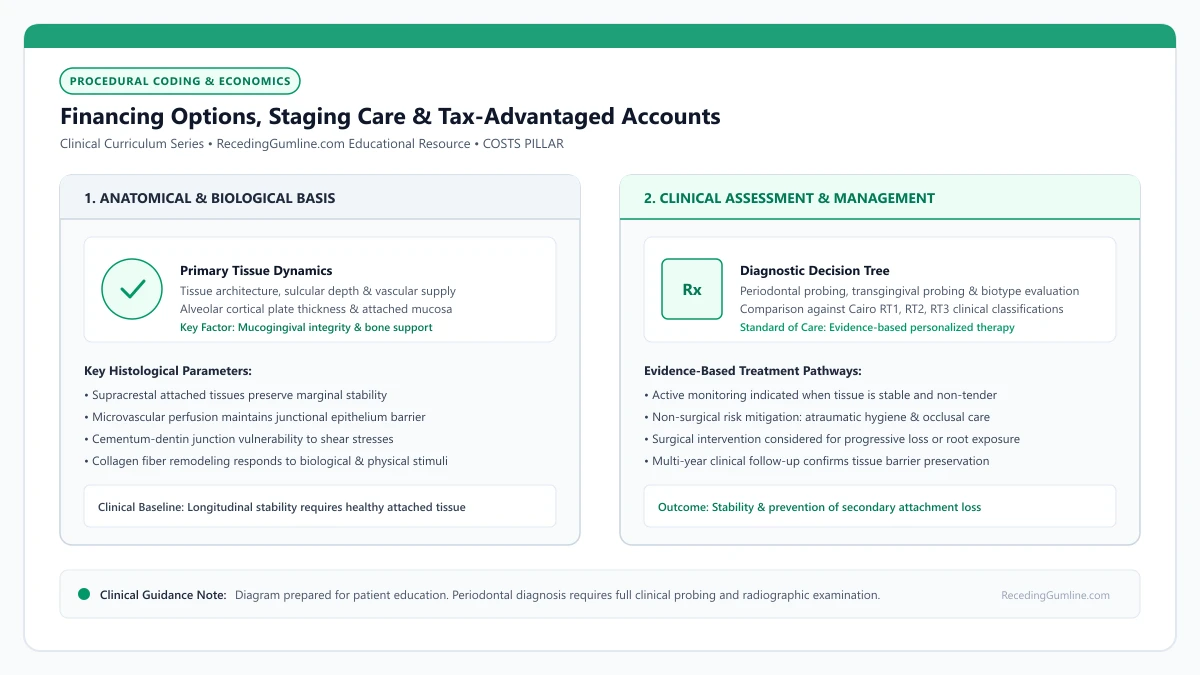
Educational illustration: Financing Options, Staging Care & Tax-Advantaged Accounts. Clinical management requires comprehensive periodontal evaluation rather than isolated self-assessment.
Source: RecedingGumline.com Clinical Editorial Team (Proprietary educational diagram for RecedingGumline.com)
Tax-Advantaged Accounts: The Power of HSA and FSA Dollars
One of the most underutilized financial tools for dental surgery is paying with pre-tax dollars through a Health Savings Account (HSA) or Flexible Spending Account (FSA). Under United States Internal Revenue Code Section 213(d), medical care expenses—including procedures to diagnose, treat, mitigate, or manage periodontal conditions—are fully eligible expenses.
Because contributions to HSAs and FSAs are deducted from payroll before federal income tax, state income tax, and FICA (Medicare and Social Security) taxes are calculated, using these accounts provides an immediate financial discount. For an individual in a combined 30% tax bracket, paying a 2,500 dollars gum graft fee using an HSA effectively costs only 1,750 dollars in post-tax earnings—a direct savings of 750 dollars.
Purely cosmetic procedures (such as tooth whitening) are legally excluded from HSA/FSA eligibility. However, because gingival grafting treats pathological attachment loss, eliminates root hypersensitivity, and prevents tooth loss, it easily satisfies the IRS medical necessity standard.
Key Cost Insights
- Periodontal grafting and deep cleaning qualify as eligible medical expenses under IRS Section 213(d).
- Paying with pre-tax HSA/FSA funds delivers an effective cash savings of 20% to 35% based on tax bracket.
- Procedures that treat disease, sensitivity, or tissue deficiency easily meet IRS medical necessity criteria.
The FSA "Uniform Coverage Rule" for Immediate Funding
A powerful feature unique to healthcare Flexible Spending Accounts (FSAs) is the federal "Uniform Coverage Rule." Under this regulation, an employee's entire elected annual FSA contribution is legally available on the very first day of the plan year (typically January 1), even though payroll deductions are spread evenly over the entire year.
For example, if a patient elects the maximum statutory FSA contribution (typically around 3,200 dollars), that entire 3,200 dollars balance is accessible immediately in January. The patient can undergo complete periodontal surgery, pay the provider in full using their FSA debit card, and reimburse the account through modest payroll deductions over the remaining 12 months with zero interest.
Unlike FSAs (which have "use-it-or-lose-it" annual expiration rules), Health Savings Accounts (HSAs) roll over indefinitely year after year. Patients with High-Deductible Health Plans (HDHPs) can intentionally accumulate funds over several years to build a dedicated surgical fund.
Key Cost Insights
- The Uniform Coverage Rule makes the full annual FSA balance available immediately on Day 1 of the plan year.
- Patients can pay for surgery upfront in January and reimburse the account interest-free through annual payroll.
- HSAs roll over indefinitely, allowing patients to build a dedicated pre-tax surgical savings cushion.
Third-Party Healthcare Financing & 0% Promotional Terms
When insurance and HSA/FSA funds do not fully cover treatment costs, specialized third-party healthcare financing companies—such as CareCredit, LendingPoint, and Proceed Finance—bridge the remaining gap. Unlike traditional credit cards with high variable interest rates (often 22% to 28%), healthcare lenders offer promotional financing terms specifically for dental procedures.
The most popular option is 0% APR promotional financing over 6, 12, 18, or 24 months for purchases exceeding minimum thresholds (200 dollars to 1,000 dollars+). If the patient pays off the full balance within the promotional period, zero interest is charged, functioning as an interest-free payment plan.
However, patients must be acutely aware of deferred interest clauses: if the entire balance is not completely paid off by the final day of the promotional window, retroactive interest (often calculated at 26.99% to 29.99% from the original purchase date) is added to the account. Patients must set up automatic monthly payments to guarantee complete payoff before the deadline.
Key Cost Insights
- Specialized healthcare lenders offer 0% APR promotional financing for 6 to 24 months.
- Paying off the balance within the promotional window provides a completely interest-free payment schedule.
- Failing to pay the full balance before promotional expiration triggers costly retroactive interest penalties.
Phased Clinical Staging: Dividing Care Across Time
For patients facing extensive full-mouth recession across three or four quadrants, attempting to complete all surgical procedures at once can be financially and physically overwhelming. In such cases, the periodontist can design a Phased Clinical Staging plan.
Phased care organizes treatment into prioritized chronological blocks. Phase 1 focuses on initial disease stabilization: full-mouth scaling and root planing, oral hygiene re-instruction, and nightguard fabrication to halt ongoing damage.
Phase 2 addresses the most critical surgical site: the quadrant exhibiting progressive attachment loss, severe hypersensitivity, or aesthetic aesthetic concern. Phase 3 (treating the remaining stable quadrants) is scheduled 6 to 12 months later. This phased approach spreads out-of-pocket expenses across multiple billing cycles and calendar years while ensuring that urgent sites receive immediate care.
Key Cost Insights
- Phased clinical staging organizes treatment into prioritized chronological blocks.
- Phase 1 stabilizes inflammation through deep cleaning, halting active disease progression.
- Surgical grafting is prioritized for critical sites, spreading financial investment across manageable intervals.
Navigating the Annual Maximum on Dental Insurance for Periodontal Surgery
Dental insurance is fundamentally different from medical insurance. While medical insurance protects against catastrophic expenses after meeting an out-of-pocket maximum, dental insurance enforces a hard annual maximum cap—typically between procedural fee rangesand procedural fee rangesper benefit year. When facing periodontal surgery that easily costs procedural fee ranges understanding how to navigate this annual ceiling is essential to avoid crushing out-of-pocket bills.
• The typical dental insurance annual maximum has remained virtually unchanged (procedural fee ranges–procedural fee ranges) since the 1970s.
• Once your dental plan pays out your annual maximum, it pays 0% for all remaining procedures until the plan year resets.
• Strategic scheduling across calendar years (e.g., December and January) allows access to two consecutive annual caps.
• Combining dental insurance with secondary dental plans or HSA/FSA funds covers the gap created by annual maximums.
The Insurance Ceiling: A 1970s Relic in the Modern Era
In the 1970s, when dental insurance first became a widespread employee benefit, the typical annual maximum was set at procedural fee rangesper year. Today, more than fifty years later, most employer dental plans still maintain that exact same procedural fee ranges maximum.
If adjusted for inflation, an annual maximum from 1972 would exceed procedural fee rangesday. Because the cap has remained stagnant while procedural costs have risen, dental insurance behaves more like a limited discount coupon rather than true catastrophic insurance, covering only a portion of major periodontal therapy.
Most commercial dental insurance plans cap their annual benefit payouts between procedural fee rangesand procedural fee rangesper calendar year, figures that have remained largely unchanged for decades. Because a single gum grafting surgery can exceed procedural fee rangesa single procedure frequently exhausts the entire annual policy maximum.
Key Cost Insights
- Most annual maximums are capped at procedural fee ranges per calendar year
- Caps have not kept pace with fifty years of healthcare inflation
- A single surgical gum graft easily exhausts the entire annual insurance allowance
The Year-End Split: Accessing Two Annual Maximums
The single most powerful financial strategy for major gum surgery is the "calendar-year split." If your periodontal treatment plan calls for grafting in multiple quadrants (totaling procedural fee rangesor more), scheduling the procedures across the year-end transition doubles your insurance reimbursement.
For example, schedule your first quadrant in late November or December. Your insurer pays up to your remaining procedural fee rangescap for the current year. Then, schedule your second quadrant in January. On January 1, your benefit plan resets, providing a brand-new procedural fee rangesmaximum, effectively yielding procedural fee rangesin insurance support for your overall care.
Once the annual maximum is reached, all remaining periodontal treatment expenses become the sole 100% financial responsibility of the patient. Understanding this financial ceiling is crucial when planning multi-phase periodontal therapy involving scaling, grafting, and maintenance.
Key Cost Insights
- Schedule the first surgical phase in November/December to exhaust current-year funds
- Schedule the second surgical phase in January to access a fresh annual maximum
- Doubles total insurance reimbursement from procedural fee ranges for multi-quadrant care
Bridging the Gap: HSAs, FSAs, and Healthcare Financing
Even with smart insurance timing, patients often face remaining out-of-pocket balances. Health Savings Accounts (HSA) and Flexible Spending Accounts (FSA) allow you to pay these balances using pre-tax dollars, immediately saving 20% to 35% based on your income tax bracket.
For amounts not covered by cash or savings, most periodontal offices partner with healthcare financing lenders (such as CareCredit or Proceed Finance). These companies offer 6- to 24-month zero-percent interest promotional financing plans, allowing you to pay for your surgery in predictable monthly installments without interest charges.
Periodontists routinely split multi-quadrant surgeries across two distinct plan years (e.g., treating two quadrants in November and two in January) to access two separate annual maximum benefit pools. This clinical phasing strategy significantly reduces out-of-pocket expenses for patients requiring extensive full-mouth reconstruction.
Key Cost Insights
- HSAs and FSAs allow pre-tax payment, saving 20% to 35% in effective out-of-pocket costs
- 0% interest promotional medical financing (CareCredit) spreads payments over 6 to 24 months
- Dental savings discount plans can be utilized after insurance maximums are exhausted
The Annual Maximum Stagnation: 1970s Caps (procedural fee ranges) vs. Modern Surgical Fees
The annual maximum is the total dollar ceiling a dental insurance company will pay for covered dental care within a single plan year. Remarkably, the standard dental annual maximum has remained virtually unchanged at procedural fee ranges since dental insurance was introduced in the early 1970s.
Had insurance maximums kept pace with medical inflation over the past 50 years, the typical annual maximum would exceed procedural fee rangesday. Because multi-tooth periodontal surgery or extensive scaling and root planing easily exceeds procedural fee ranges insurance benefits are exhausted rapidly.
Once the annual maximum is reached, the insurance company pays procedural fee rangesward subsequent claims, leaving the patient responsible for 100% of all remaining procedural costs for the balance of the calendar year.
Key Cost Insights
- Standard insurance annual maximums (procedural fee ranges) have remained stagnant since the 1970s.
- Comprehensive periodontal surgical treatment quickly exceeds annual benefit ceilings.
- Patients are 100% responsible for all procedural costs once the annual cap is exhausted.
Split-Year Staging Strategies: Double-Benefit Calendar Optimization
To overcome the financial barrier imposed by stagnant annual maximums, periodontists frequently implement "split-year treatment staging" for non-emergency surgical cases.
In this protocol, a patient requiring bilateral or four-quadrant periodontal therapy schedules the first half of treatment in November or December, utilizing the current year's procedural fee rangesbenefit maximum. The second half of treatment is scheduled in January or February of the following year, tapping into the freshly renewed procedural fee rangesmaximum.
By bridging the calendar year turnover, the patient successfully secures procedural fee rangesin insurance contributions within a 60- to 90-day treatment window, cutting their out-of-pocket financial burden in half.
Key Cost Insights
- Split-year staging schedules the first surgical phase in late autumn and the second in early winter.
- Allows the patient to access two consecutive procedural fee rangesbenefit allowances within a 60-90 day period.
- Effectively doubles insurance reimbursement for extensive multi-quadrant surgical cases.
Using HSA and FSA Accounts for Periodontal Care: Eligible Treatments and Documentation
Paying for specialized periodontal treatment—such as gum grafting, scaling and root planing, or quarterly maintenance—can put serious strain on personal finances. Fortunately, the vast majority of periodontal treatments qualify as eligible medical expenses under IRS tax regulations. Utilizing pre-tax funds from Health Savings Accounts (HSA) or Flexible Spending Accounts (FSA) effectively discounts treatment costs by 20% to 35%.
• All diagnostic, non-surgical, and surgical periodontal procedures are 100% IRS-eligible HSA/FSA expenses.
• Paying with pre-tax dollars saves between 20% and 35% on out-of-pocket costs based on your income tax bracket.
• FSA funds operate under a strict "use-it-or-lose-it" annual deadline, making year-end gum surgery an ideal way to utilize expiring funds.
• Over-the-counter daily hygiene items (toothpaste, manual brushes) are generally ineligible unless accompanied by a Letter of Medical Necessity.
IRS Rule 213(d): What Periodontal Procedures Are Eligible?
Under Internal Revenue Code Section 213(d), medical care expenses are defined as amounts paid "for the diagnosis, remediation, mitigation, treatment, or prevention of disease." Because periodontitis and gingival recession are documented oral diseases, all therapeutic interventions qualify 100%.
Eligible periodontal expenses include: specialist periodontal consultations (D0180), full-mouth x-rays (D0210), scaling and root planing deep cleanings (D4341), ongoing periodontal maintenance visits (D4910), soft-tissue gum grafts (D4273/D4275), bone grafting, and custom occlusal nightguards for bruxism.
Health Savings Accounts (HSA) and Flexible Spending Accounts (FSA) allow patients to pay for qualified out-of-pocket dental expenses using pre-tax dollars. The Internal Revenue Service (IRS Publication 502) explicitly classifies periodontal surgery, scaling, root planing, and diagnostic radiographs as qualified medical expenses.
Key Cost Insights
- 100% of diagnostic, preventive, and surgical periodontal procedures qualify
- Deep cleanings, gum grafts, bone grafts, and maintenance are fully eligible
- Custom hard nightguards to prevent clenching and recession are eligible medical expenses
The Math: How Pre-Tax Dollars Create a 30% Discount
When you contribute money to an HSA or FSA, the funds are deducted directly from your gross paycheck before federal income taxes, state taxes, and FICA (Social Security and Medicare) taxes are calculated.
For a patient in a 24% federal tax bracket and 5% state tax bracket, every dollar contributed saves roughly 30 cents in taxes. If you pay a procedural fee rangesout-of-pocket copay for gum graft surgery using an HSA or FSA card, your real out-of-pocket cost is only about procedural fee rangessaving you procedural fee rangessimply by routing the payment through a tax-advantaged account.
Because soft-tissue grafting treats structural attachment loss and prevents premature tooth loss, it qualifies as medically necessary periodontal therapy rather than elective cosmetic surgery. Utilizing HSA or FSA pre-tax funds effectively provides an immediate 20% to 35% discount on out-of-pocket surgical costs depending on the patient’s tax bracket.
Key Cost Insights
- HSA/FSA contributions bypass federal, state, and FICA payroll taxes
- Creates an effective 20% to 35% discount on all out-of-pocket dental costs
- A procedural fee rangessurgical copay saves procedural fee ranges in net income taxes
FSA Deadlines: Year-End Surgical Scheduling Strategies
Unlike Health Savings Accounts (which roll over indefinitely and can be invested), Flexible Spending Accounts (FSAs) enforce a strict "use-it-or-lose-it" rule. Any unspent funds remaining in your FSA at the end of the plan year (usually December 31, or March 15 under a grace period) are permanently forfeited to your employer.
If you have procedural fee rangessitting in your FSA in late autumn, scheduling your gum graft surgery or scaling and root planing in November or December is the smartest way to deploy those funds. You solve an active oral health problem while protecting your hard-earned money from forfeiture.
Patients utilizing FSA accounts must be mindful of use-it-or-lose-it year-end forfeiture rules by scheduling necessary periodontal consultations and surgeries before plan deadlines. Keeping itemized receipts, diagnostic coding statements, and written clinical necessity letters on file protects against tax audit inquiries.
Key Cost Insights
- FSA funds expire at the end of the year; unused balances are forfeited
- Late-autumn periodontal surgery is ideal for utilizing expiring FSA balances
- HSA funds never expire and can be saved or used for future dental care
IRS Tax Guidelines: Publication 502 & Medically Necessary Periodontics
Health Savings Accounts (HSAs) and Flexible Spending Accounts (FSAs) allow patients to pay for eligible medical and dental expenses using pre-tax dollars, effectively saving 20% to 35% depending on federal and state income tax brackets. Under IRS Publication 502, dental treatments that diagnose, treat, mitigate, or prevent dental disease qualify as deductible medical care.
Because periodontal therapies—including comprehensive exams, scaling and root planing, and soft-tissue grafting for progressive attachment loss—treat an active pathological condition, they are 100% eligible for HSA/FSA reimbursement.
However, purely cosmetic dental procedures (such as tooth whitening or cosmetic gum re-contouring) are explicitly excluded by the IRS. The treating periodontist must provide itemized statements documenting diagnostic codes to substantiate medical necessity.
Key Cost Insights
- HSAs and FSAs permit pre-tax payment for periodontal care, reducing effective costs by 20% to 35%.
- Under IRS Publication 502, treatments that treat, mitigate, or prevent disease are fully eligible.
- Cosmetic procedures are excluded; itemized receipts with diagnostic codes prove eligibility.
Eligible Expense Inventory: Sedation, Rinses, Stents & Travel Costs
Patients utilizing HSA/FSA funds can apply pre-tax dollars to a wide array of ancillary expenses associated with gum recession treatment beyond primary surgical fees.
Eligible expenses include: (1) oral and intravenous sedation fees administered during surgical procedures; (2) diagnostic 3D CBCT scans and periapical radiographs; (3) custom-fabricated palatal surgical stents; and (4) prescription medications, including 0.12% chlorhexidine rinses, antibiotics, and post-surgical analgesics.
Additionally, IRS regulations permit deduction of transportation and travel expenses primarily incurred to receive specialized medical care, including mileage, parking fees, and public transit fares to specialist appointments.
Key Cost Insights
- Intravenous and oral conscious sedation fees are fully eligible for HSA/FSA reimbursement.
- Prescription antimicrobial rinses (chlorhexidine), palatal stents, and analgesics qualify.
- Mileage, parking, and transit expenses to specialist appointments are deductible medical expenses.
Dental Savings Plans vs. Insurance for Periodontal Treatment: Structure & Savings
For patients facing expensive periodontal surgery who lack dental insurance—or whose insurance annual maximum has already run out—Dental Savings Plans (also known as dental discount plans) represent an increasingly popular financial alternative. Rather than operating as insurance, these membership programs provide immediate contracted discounts of 20% to 50% across participating dental providers with zero waiting periods and zero annual maximums.
• Dental savings plans are membership-based discount programs, not traditional insurance.
• Members pay an annual fee (procedural fee ranges–procedural fee ranges) to access contracted provider fee discounts of 20% to 50%.
• Unlike insurance, savings plans have zero waiting periods, zero annual maximums, and zero claims paperwork.
• Highly effective for expensive periodontal surgeries where traditional insurance caps (procedural fee ranges) fall short.
How Dental Discount Plans Work: The Membership Model
A dental savings plan operates similarly to a Costco or warehouse club membership. You pay an annual membership fee—typically procedural fee ranges for an individual, or procedural fee ranges for a family. In exchange, you receive a membership card that grants access to a national network of participating dentists and periodontists.
Participating clinicians agree to accept predetermined, discounted fees for their services—typically 20% to 50% below standard cash prices. When you visit the specialist, you pay the discounted rate directly at the time of service. There are no insurance claim forms to submit, no pre-authorizations, and no waiting for reimbursements.
Dental savings plans (also known as discount dental plans) serve as an affordable alternative to traditional dental insurance, offering 20% to 50% discounts on specialist periodontal procedures in exchange for an annual membership fee. Unlike insurance, discount plans feature zero waiting periods, zero annual maximum payout caps, and zero claim denial hassles.
Key Cost Insights
- Annual membership fee of procedural fee ranges grants access to contracted discounted fees
- Participating periodontists discount procedures by 20% to 50% off standard cash fees
- Direct payment at the time of service with zero claims paperwork or denials
Head-to-Head Comparison: Savings Plans vs. Traditional Insurance
The greatest advantage of a dental savings plan over traditional insurance is the total absence of restrictions. Traditional insurance plans enforce 6- to 12-month waiting periods for major gum surgery and cap annual payouts at procedural fee ranges.
If a gum graft costs procedural fee rangesan insurance policy will pay up to its procedural fee rangescap and stop, leaving you with the rest. With a dental savings plan, there is no annual maximum. If the plan offers a 30% discount, a procedural fee rangessurgery is immediately reduced to procedural fee rangessaving you procedural fee rangeswith zero waiting periods.
Participating periodontists agree to contracted fee schedules for common recession treatments including consultations, scaling and root planing, and soft-tissue grafting. A patient requiring procedural fee rangesin grafting can save procedural fee ranges immediately upon plan activation without waiting for insurance pre-authorizations.
Key Cost Insights
- Zero waiting periods: activate in 24 hours and schedule surgery immediately
- Zero annual maximum caps: save 20% to 50% whether your treatment costs procedural fee rangesor procedural fee ranges
- Zero claims denials: discounts apply automatically to all services on the fee schedule
Essential Checklist: Verifying Your Periodontist Participates
The single most important step before purchasing a dental savings plan is verifying that your chosen periodontist participates in that specific network (such as Aetna Dental Access, Careington, or Cigna Dental Plans).
Never buy a plan online assuming all dental offices accept it. Call your periodontal specialist's financial coordinator first and ask: "Which dental savings discount plans do you participate with?" Purchase the exact plan they recommend to ensure your discounts apply smoothly on surgery day.
Discount dental plans cannot be combined directly with commercial dental insurance for the same procedure, but they can be utilized once annual insurance maximums are exhausted. Verifying that the chosen periodontist is actively contracted with the specific discount network ensures seamless fee reductions at checkout.
Key Cost Insights
- Always call your periodontist's office first to ask which specific discount plans they accept
- Popular national networks include Careington 500, Aetna Dental Access, and DentalPlans.com
- Cannot be combined with insurance on the same procedure, but can be used after insurance caps out
Fee Mechanics: Dental Savings Plans vs. Conventional PPO Insurance
For patients who lack dental insurance or whose annual maximum has been exhausted, Dental Savings Plans (also known as discount dental plans) offer a viable alternative. Unlike insurance, dental savings plans are not insurance policies; they are membership networks where participating providers agree to accept discounted fee schedules.
Members pay an annual fee (typically procedural fee ranges per year) to access contracted fee reductions ranging from 20% to 50% across general and specialist dental services.
For periodontal procedures, contracted savings plan fees are established based on fair market benchmarks. For example, a procedural fee rangesgum graft may be discounted to procedural fee ranges providing immediate, predictable out-of-pocket savings without claim submissions.
Key Cost Insights
- Dental savings plans are membership discount networks, not conventional insurance policies.
- Members pay procedural fee ranges annually to access contracted fee discounts of 20% to 50%.
- Surgical fees are discounted immediately at the time of service with zero claim paperwork.
Key Advantages: Zero Waiting Periods & Unlimited Annual Usage
Dental savings plans provide critical structural advantages over conventional dental insurance for patients requiring immediate, high-cost periodontal surgery. Traditional insurance policies routinely impose 6- to 12-month "waiting periods" on basic and major services, preventing newly enrolled patients from accessing immediate surgical benefits.
Dental savings plans feature zero waiting periods; discounts activate immediately upon membership enrollment. Furthermore, savings plans have zero annual maximum limits; patients can utilize the discounted rates for unlimited procedures throughout the membership year.
Additionally, dental savings plans do not exclude pre-existing conditions or require complex pre-authorization narratives, making them an ideal financial tool for patients needing immediate multi-quadrant care.
Key Cost Insights
- Zero waiting periods allow patients to access discounted surgical rates immediately upon enrollment.
- Zero annual maximums permit unlimited procedure usage throughout the membership year.
- No pre-existing condition exclusions or pre-authorization delays streamline surgical scheduling.
Clinical Reality Check
Before applying for third-party financing, always inquire whether the dental practice offers an in-house payment plan or a courtesy cash discount (typically 5% for full payment upfront via cash or check). Avoiding credit merchant fees benefits both patient and provider.
Questions to Ask Your Dentist or Periodontist
- Does your office provide itemized receipts with ADA CDT codes for my HSA/FSA reimbursement submission?
- Can you help me design a phased treatment plan that prioritizes the most urgent teeth first?
- What 0% promotional financing options (such as CareCredit) does your practice accept?
- Do you offer a courtesy discount for upfront payment in full via check or cash?
- Can we coordinate the timing of my surgery to match my employer's FSA open enrollment period?
- How much of my annual insurance maximum is currently remaining for this year?
- Can we phase my gum surgeries across two benefit years to maximize my insurance reimbursement?
- Does your office accept HSA or FSA debit cards for my surgical copayments?
- What zero-percent interest medical financing options (such as CareCredit) do you offer?
- Can I pay my out-of-pocket surgical balance using my HSA or FSA debit card?
- Can your office provide an itemized receipt with specific ADA codes for my FSA administrator?
- If my FSA administrator requests a Letter of Medical Necessity, can your doctor sign one?
- Can we schedule my treatment before December 31 so I can use my expiring FSA balance?
- Which dental savings discount plans (such as Careington or Aetna Dental Access) does your office accept?
- What is your contracted fee under that savings plan for code D4273 (gum graft) and D4341 (deep cleaning)?
- Can I join a savings plan today and use it for my procedure next week without a waiting period?
- If my insurance maximum runs out, will you allow me to use a dental savings plan for my next quadrant?
Unsure What Your Gum Changes Mean?
Take our free, evidence-based Gum Recession Assessment — approximately 3 minutes. Identify potential risk factors, evaluate symptoms, and receive personalized discussion questions for your dentist or periodontist.
Non-diagnostic educational triage. Private, secure, completed in your browser.
Related Educational Topics
Scientific Literature & Clinical Guidelines
4sources · Hide ▲
- American Dental Association (2026).
"Code on Dental Procedures and Nomenclature (CDT)." American Dental Association.Coding Standard Official Publication
Clinical relevance: Standardized dental procedure nomenclature maintained and updated annually by the American Dental Association (ADA, currently referencing CDT 2026/2027) for administrative classification and billing (including codes D4273, D4275, D4277, D4341, D4910). The site references CDT procedure numbers for high-level educational and administrative context and does not reproduce proprietary CDT descriptors or substantial CDT text. Commercial use/licensing requirements should be reviewed separately with the ADA or qualified counsel. Procedure codes facilitate administrative reporting and do not dictate clinical necessity or insurance benefit coverage.
- Tonetti MS, Greenwell H, Kornman KS (2018).
"Staging and grading of periodontitis: Framework and proposal of a new classification and case definition." Journal of Clinical Periodontology.
Clinical relevance: Consensus framework establishing the multidimensional staging (severity and extent of periodontal tissue breakdown) and grading (biological rate of disease progression, incorporating smoking and diabetes as grade modifiers) for periodontitis. It addresses periodontitis diagnosis and staging, not the classification of localized gingival recession defects.
- Cairo F, Nieri M, Cincinelli S, Mervelt J, Pagliaro U (2011).
"The interproximal clinical attachment level to classify gingival recessions and predict root coverage outcomes: an explorative and reliability study." Journal of Clinical Periodontology.
Clinical relevance: Exploratory and reliability study establishing the Cairo classification based on interdental clinical attachment level (CAL): RT1 (no interproximal attachment loss; complete root coverage is clinically predictable), RT2 (interproximal attachment loss <= buccal loss; partial coverage predictable), and RT3 (interproximal loss exceeds buccal recession; complete coverage not predictable).
- Pihlstrom BL, Michalowicz BS, Johnson NW (2005).
"Periodontal diseases." The Lancet.
Clinical relevance: Peer-reviewed Lancet seminar review synthesizing global periodontal epidemiology, microbial etiology, host immunopathology, and systemic interactions, emphasizing prevention, biofilm disruption, and early risk factor modification.
Important Medical Notice
The contents of RecedingGumline.com, including text, graphics, self-assessment calculators, and other materials, are intended solely for educational and informational purposes. This content is not intended to replace professional dental examination, diagnosis, or treatment. Always seek the advice of a qualified dentist, periodontist, or other licensed oral healthcare provider with any questions you may have regarding a medical or dental condition. Never disregard professional medical advice or delay seeking it because of something you read on this website.