Chlorhexidine Mouthrinse in Periodontal Healing: Indications, Duration & Staining
Why do periodontists prescribe chlorhexidine, how should it be used, and how do you manage its side effects?
Chlorhexidine gluconate (0.12% in the United States, 0.20% in Europe) is widely regarded as the established benchmark antimicrobial agent in clinical periodontics (see our receding gums management). Prescribed following periodontal surgery or active scaling, chlorhexidine provides potent chemical plaque control when mechanical toothbrushing is temporarily impossible. However, its significant side-effect profile requires strict clinical guidance on duration and application.
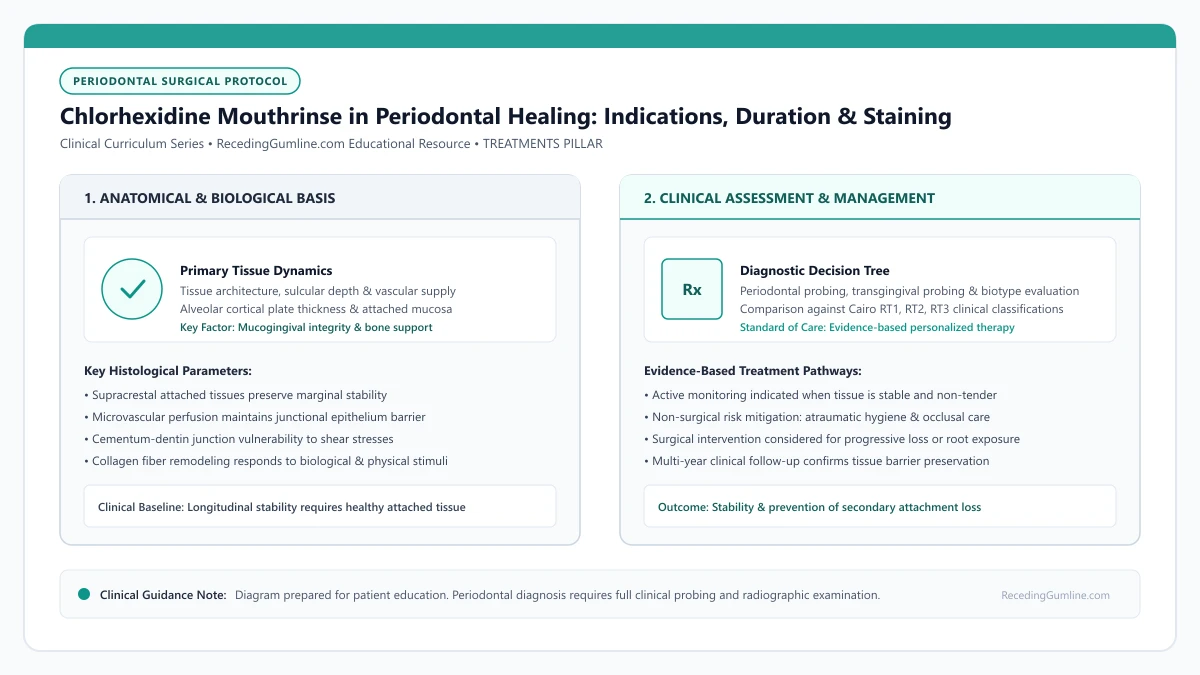
Educational illustration: Chlorhexidine Mouthrinse in Periodontal Healing: Indications, Duration & Staining. Clinical management requires comprehensive periodontal evaluation rather than isolated self-assessment.
Source: RecedingGumline.com Clinical Editorial Team (Proprietary educational diagram for RecedingGumline.com)
Key Clinical Distinctions & Diagnostic Boundaries
- Chlorhexidine is a therapeutic antimicrobial drug, not a cosmetic breath-freshening mouthwash.
- Brown tooth staining caused by chlorhexidine is extrinsic and can be polished away by a dental hygienist without damaging enamel.
- Prolonged use (> 3 weeks) alters bitter and salt taste perception and increases supragingival calculus formation.
- Alcohol-free formulations reduce the burning sensation often reported by patients with sensitive or ulcerated mucosal tissues.
Mechanism of Action: The Power of Antimicrobial Substantivity
Chlorhexidine is a cationic (positively charged) bisbiguanide compound. The cell walls of oral bacteria and the mucosal tissues of your mouth carry negative electrical charges. Because of these opposite charges, chlorhexidine molecules bind tenaciously to oral surfaces.
This property is known as substantivity. Rather than washing away within minutes, chlorhexidine remains bound to oral tissues, slowly releasing bactericidal molecules over 8 to 12 hours. It ruptures bacterial cell membranes, effectively killing both gram-positive and gram-negative pathogens.
The therapeutic benefit of 0.12% chlorhexidine gluconate stems from its high substantivity, binding to oral soft and hard tissues and slowly releasing bactericidal concentrations over 12 hours. This sustained release prevents plaque biofilm accumulation when brushing is surgically contraindicated.
Clinical Considerations:
- Positively charged molecule binds strongly to negatively charged bacterial walls
- Substantivity provides continuous bacterial killing for up to 12 hours after rinsing
- Kills periodontal pathogens and prevents bacterial colonization on surgical sutures
Clinical Protocols: Proper Usage and Toothpaste Interference
Periodontists prescribe chlorhexidine primarily following soft-tissue grafting or flap surgery. During the first two weeks, toothbrush bristles cannot touch the surgical site. A 15 ml dose of chlorhexidine rinsed gently for 60 seconds twice daily provides complete plaque control.
A vital clinical rule is never using chlorhexidine immediately after brushing your teeth with standard toothpaste. Most commercial toothpastes contain Sodium Lauryl Sulfate (SLS), an anionic surfactant that binds to and completely neutralizes chlorhexidine. Always wait at least 30 minutes between brushing and rinsing.
Extrinsic brown staining of enamel margins and tongue surfaces is a common, reversible side effect of chlorhexidine use exceeding two weeks. Patients should be reassured that professional prophylaxis readily removes surface stains once surgical healing permits standard polishing.
Clinical Considerations:
- Rinse with 15 ml twice daily for 60 seconds during post-surgical healing
- Tilt head gently rather than swishing aggressively to avoid flap strain
- Wait 30 minutes after brushing with regular toothpaste to prevent neutralization by SLS
Managing Side Effects: Staining, Taste Changes & Duration Limits
The most noticeable drawback of chlorhexidine is brown extrinsic staining on teeth, tongue, and dental fillings. The rinse reacts with dietary tannins found in coffee, tea, red wine, and berries. These stains do not indicate tooth decay; they are purely surface deposits easily polished away at your next dental visit.
To minimize staining and prevent temporary blunting of taste buds, use chlorhexidine only for the 10 to 14 days prescribed by your surgeon. Never use chlorhexidine as a permanent, daily mouthwash, as long-term use promotes supragingival calculus formation and disrupts the healthy oral microbiome.
Because chlorhexidine exhibits non-specific cytotoxicity against regenerating fibroblasts at high concentrations, rinses should be used strictly for the prescribed 10 to 14 day window. Extending chlorhexidine therapy beyond two weeks may disrupt the oral microbiome and delay soft-tissue epithelialization.
Clinical Considerations:
- Brown staining is extrinsic and safely polished away during professional cleanings
- Limit consumption of coffee, tea, and red wine during use to reduce staining severity
- Strictly discontinue after 10 to 14 days unless specifically instructed otherwise
Pharmacodynamics: The 12-Hour Substantivity Mechanism
Chlorhexidine digluconate (0.12%) is widely considered the established benchmark topical antimicrobial in periodontal post-surgical care. Its clinical efficacy is derived not only from its broad-spectrum bactericidal activity against gram-positive and gram-negative bacteria, but primarily from its unique property of "substantivity."
Chlorhexidine carries a strong positive (cationic) charge. When rinsed in the mouth, it binds electrostatically to negatively charged oral surfaces: tooth enamel, pellicle proteins, salivary mucins, and oral epithelial cell walls.
Over the subsequent 8 to 12 hours, chlorhexidine is slowly released back into the oral fluids in active bactericidal concentrations, maintaining continuous suppression of subgingival plaque formation during the critical initial phases of soft-tissue graft healing.
Clinical Considerations:
- Chlorhexidine possesses broad-spectrum bactericidal activity against oral pathogens.
- Cationic molecules bind electrostatically to oral surfaces, establishing 8-12 hours of substantivity.
- Continuous slow release maintains a sterile surgical field without requiring mechanical brushing.
Managing Side Effects: Extrinsic Staining, Calculus & Taste Alteration
Despite its antimicrobial potency, chlorhexidine therapy is strictly limited to short-term post-surgical use (typically 10 to 14 days) due to well-documented side effects. The most common adverse effect is brown extrinsic staining of tooth enamel and composite restorations.
Staining occurs when chlorhexidine reacts with dietary chromogens present in coffee, tea, red wine, and tobacco. Additionally, chlorhexidine denatures salivary proteins, temporarily altering taste perception (dysgeusia)—particularly sweet and salty sensations—and accelerating supragingival calculus deposition.
Patients are advised to avoid dietary chromogens for at least one hour after rinsing and never to combine chlorhexidine with standard toothpaste, as anionic detergents like sodium lauryl sulfate (SLS) neutralize chlorhexidine's antimicrobial efficacy.
Clinical Considerations:
- Chlorhexidine use is restricted to 10-14 days to minimize staining and taste alteration.
- Extrinsic staining is accelerated by dietary chromogens (coffee, tea, red wine).
- Sodium lauryl sulfate in conventional toothpaste inactivates chlorhexidine; rinse times must be separated.
Clinical Reality Check
Chlorhexidine should never be used as a permanent, indefinite mouthwash; prolonged use disrupts the beneficial oral microbiome and accelerates calculus accumulation.
Questions to Ask Your Periodontist or Dentist
- How many days specifically should I continue using chlorhexidine after my procedure?
- Can you recommend a sodium lauryl sulfate (SLS)-free toothpaste that won't deactivate the rinse?
- If I develop brown staining on my front teeth, will your hygienist polish it off at my follow-up visit?
- Should I dilute the rinse with water if it causes a stinging or burning sensation on my tongue?
Unsure What Your Gum Changes Mean?
Take our free, evidence-based Gum Recession Assessment — approximately 3 minutes. Identify potential risk factors, evaluate symptoms, and receive personalized discussion questions for your dentist or periodontist.
Non-diagnostic educational triage. Private, secure, completed in your browser.
Related Educational Topics
Clinical Evidence & Claim Traceability (2 Mapped Assertions)
Scientific Literature & Clinical Guidelines
3sources · Hide ▲
- Slot DE, Wiggelinkhuizen L, Rosema NA, Van der Weijden GA (2012).
"The efficacy of manual toothbrushes following a brushing exercise: a systematic review." International Journal of Dental Hygiene.
Clinical relevance: Systematic review evaluating plaque removal efficacy of manual toothbrushes following a single brushing exercise; observed that bristle design variations produce modest differences in plaque scores, while aggressive force or stiff bristles do not improve plaque removal and clinical evidence linking mechanical brushing technique directly to gingival recession remains contradictory.
- Sanz M, Herrera D, Kebschull M, Chapple ILC, Jepsen S, Beglundh T, et al. (2020).
"Treatment of stage I-III periodontitis—The EFP S3 level clinical practice guideline." Journal of Clinical Periodontology.
Clinical relevance: Evidence-based clinical practice guideline establishing the 4-step therapeutic pathway for periodontal management: Step 1 (behavioral and supragingival hygiene), Step 2 (subgingival instrumentation), Step 3 (surgical therapy where indicated), and Step 4 (supportive periodontal care at 3- to 4-month intervals).
- Tonetti MS, Greenwell H, Kornman KS (2018).
"Staging and grading of periodontitis: Framework and proposal of a new classification and case definition." Journal of Clinical Periodontology.
Clinical relevance: Consensus framework establishing the multidimensional staging (severity and extent of periodontal tissue breakdown) and grading (biological rate of disease progression, incorporating smoking and diabetes as grade modifiers) for periodontitis. It addresses periodontitis diagnosis and staging, not the classification of localized gingival recession defects.
Important Medical Notice
The contents of RecedingGumline.com, including text, graphics, self-assessment calculators, and other materials, are intended solely for educational and informational purposes. This content is not intended to replace professional dental examination, diagnosis, or treatment. Always seek the advice of a qualified dentist, periodontist, or other licensed oral healthcare provider with any questions you may have regarding a medical or dental condition. Never disregard professional medical advice or delay seeking it because of something you read on this website.