Genetics & Periodontal Biotype in Gum Recession
While external factors such as brushing habits and bacterial biofilms trigger periodontal damage, genetic predisposition dictates an individual's baseline susceptibility to tissue loss. As detailed in our receding gumline assessment guide, genetics primarily influences two critical parameters: the anatomical periodontal biotype (the thickness of the soft-tissue margin and underlying alveolar bone) and the host immune-inflammatory response. Patients who inherit a thin, delicate biotype can develop noticeable recession even when practicing exemplary oral hygiene.
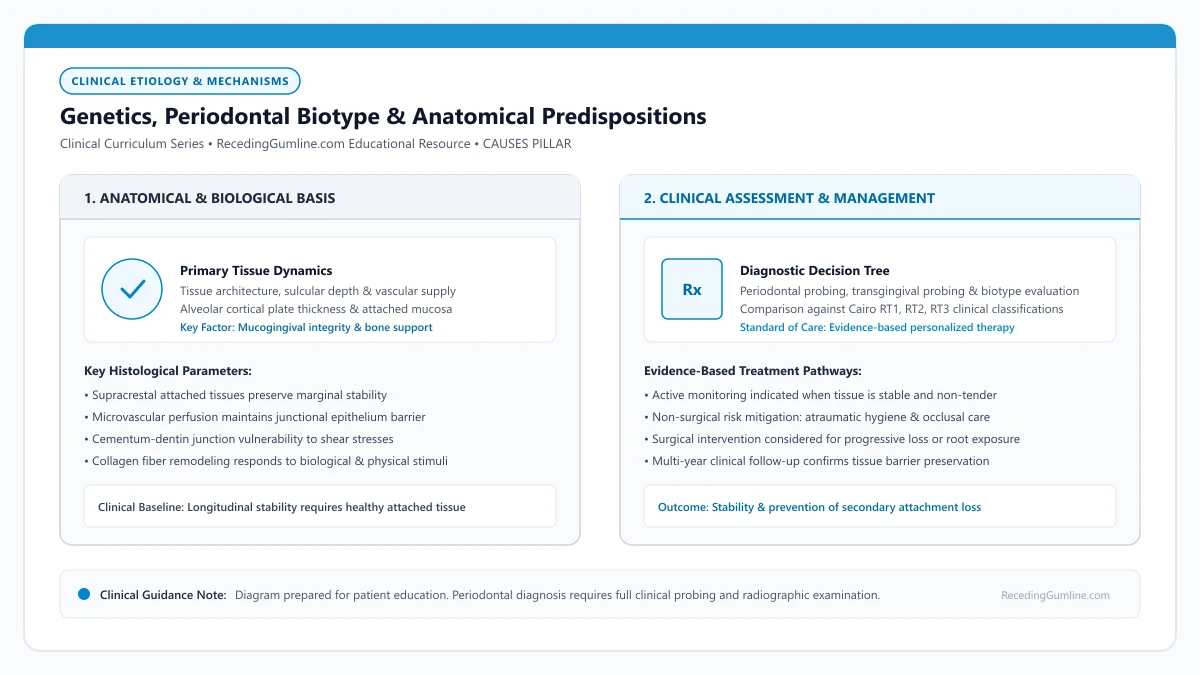
Educational illustration: Genetics, Periodontal Biotype & Anatomical Predispositions. Clinical management requires comprehensive periodontal evaluation rather than isolated self-assessment.
Source: RecedingGumline.com Clinical Editorial Team (Proprietary educational diagram for RecedingGumline.com)
Inheritance of Periodontal Biotypes & Tissue Thickness
The 2017 World Workshop on the Classification of Periodontal and Peri-Implant Diseases categorized periodontal tissues into two broad clinical phenotypes: thick-flat and thin-scalloped. This anatomical architecture is genetically inherited and varies significantly across populations and family lineages.
Individuals with an inherited thick-flat phenotype possess dense, fibrous gingiva measuring 1.5 to 2.0 mm in thickness, supported by broad, thick underlying alveolar bone plates. When exposed to mechanical abrasion or bacterial inflammation, this thick tissue responds primarily with pocket formation rather than recession.
In stark contrast, individuals who inherit a thin-scalloped phenotype possess delicate, translucent gingiva often measuring less than 0.8 mm in thickness, narrow bands of keratinized tissue, and paper-thin labial bone. This tissue offers minimal physical resistance; when challenged by minor mechanical or inflammatory insults, the fragile tissue margin collapses and recedes apically, exposing root surfaces.
Key Etiological Insights
- Periodontal phenotypes fall into genetically determined thick-flat or thin-scalloped anatomical categories.
- Thick biotypes tend to form pockets during disease; thin biotypes predominantly manifest as recession.
- A thin phenotype has a tissue thickness under 1.0 mm, easily verified when a periodontal probe shines through.
Genetic Skeletal Architecture & Alveolar Housing
Genetics governs the three-dimensional dimensions of the maxilla and mandible, as well as tooth crown and root morphology. When an individual inherits a discrepancy between jaw size and tooth dimensions, crowding, rotation, and labial displacement frequently occur during dental development.
Teeth that erupt in prominent or labially displaced positions are pushed against the outer perimeter of the alveolar ridge. In these sites, the outer cortical bone plate fails to develop fully, leaving congenital dehiscences (V-shaped bone gaps) and fenestrations (isolated bone windows).
Furthermore, root morphology—such as prominent, convex root bulges on canines and mesiobuccal roots of upper molars—compresses the overlying gingiva against the oral mucosa, creating chronic points of anatomical vulnerability where normal physiological forces trigger early recession.
Key Etiological Insights
- Inherited jaw-to-tooth discrepancies cause teeth to erupt outside the central alveolar bone housing.
- Congenital bone dehiscences and fenestrations are common on prominent, labially positioned roots.
- Convex root architecture thins the overlying gingival collar, increasing susceptibility to tissue loss.
Cytokine Gene Polymorphisms & Hyper-Inflammatory Traits
Beyond structural anatomy, genetics plays a pivotal role in regulating the host immune system's response to microbial plaque. Variations in specific genes—known as Single Nucleotide Polymorphisms (SNPs)—can alter the production and regulation of key pro-inflammatory signaling molecules.
Polymorphisms in the Interleukin-1 (IL-1A and IL-1B) and Tumor Necrosis Factor-alpha (TNF-alpha) gene clusters have been extensively documented in periodontology. Individuals carrying these hyper-inflammatory genetic traits produce up to four times more destructive inflammatory cytokines in response to ordinary subgingival biofilm accumulation.
This amplified inflammatory response hyper-activates osteoclasts and stimulates excessive release of matrix metalloproteinases (collagenases), accelerating alveolar bone resorption and supracrestal connective tissue breakdown. When combined with a thin tissue phenotype, this genetic trait dramatically accelerates the progression of periodontal recession.
Key Etiological Insights
- Single Nucleotide Polymorphisms in cytokine genes regulate the intensity of the inflammatory response.
- Hyper-inflammatory gene variants cause excessive production of tissue-destroying enzymes (MMPs).
- The combination of a hyper-inflammatory trait and a thin biotype leads to rapid, aggressive recession.
Proactive Management & Phenotype Conversion Therapy
While patients cannot alter their underlying genetic DNA, understanding one's inherited anatomical risk profile transforms periodontal management from reactive crisis intervention into proactive, long-term preservation.
Patients with a family history of receding gums or an observed thin phenotype can take decisive preventative measures. These include adopting atraumatic brushing mechanics with extra-soft bristles, utilizing low-abrasivity toothpastes (RDA < 70), scheduling rigorous 3- to 4-month professional maintenance cleanings, and seeking pre-orthodontic periodontal evaluation.
Furthermore, periodontists can surgically alter the anatomical biotype through Phenotype Modification Therapy. By performing an autogenous connective tissue graft, clinicians can biologically convert a thin, vulnerable margin into a thick, protective phenotype, providing lifelong structural defense against subsequent recession.
Key Etiological Insights
- Genetic predisposition requires personalized preventive strategies rather than standard one-size-fits-all care.
- Atraumatic hygiene protocols prevent triggering recession in genetically susceptible thin tissues.
- Surgical connective tissue grafting permanently converts a thin, fragile biotype into a thick, durable phenotype.
Precision Periodontal Management: Addressing Genetic Vulnerability
While patients cannot alter their inherited genetic code or familial bone morphotype, identifying genetic risk factors enables clinicians to design proactive, highly personalized periodontal defense strategies. Standard dental protocols that treat all mouths identically fail patients with high genetic susceptibility.
For individuals with a documented family history of premature tooth loss or a clinically diagnosed thin periodontal phenotype, precision management focuses on eliminating secondary physical and microbial triggers before irreversible attachment loss begins. Recall schedules are tightened to 3- to 4-month professional maintenance visits, preventing bacterial biofilms from reaching the critical mass needed to activate hyper-inflammatory cytokine cascades.
Crucially, periodontists can surgically modify an inherited thin biotype through proactive soft-tissue grafting. Placing an autogenous subepithelial connective tissue graft converts delicate, translucent tissue into a robust, thick phenotype, effectively overcoming genetic vulnerability and providing durable lifelong root coverage.
Key Etiological Insights
- Identifying genetic biotype vulnerability allows clinicians to design targeted, proactive care plans.
- Shortened 3- to 4-month maintenance intervals prevent plaque biofilms from triggering cytokine cascades.
- Surgical phenotype conversion permanently thickens inherited thin tissue to resist future recession.
Clinical Reality Check
Having a genetic predisposition or thin biotype does not mean tooth loss is inevitable. Rather, it indicates that the margin has lower tolerance for environmental insults (abrasion, plaque, orthodontic stress). Eliminating environmental triggers allows genetically vulnerable tissues to remain stable for a lifetime.
Questions to Ask Your Dentist or Periodontist
- Do I have an inherited thin periodontal biotype or thin alveolar bone structure?
- Did my family history of receding gums predispose me to the recession I am seeing now?
- Can you test the thickness of my gingiva using the periodontal probe transparency method?
- Would prophylactic soft-tissue grafting be recommended to thicken my vulnerable gum margins?
- What personalized hygiene regimen is best suited for my delicate tissue biotype?
Unsure What Your Gum Changes Mean?
Take our free, evidence-based Gum Recession Assessment — approximately 3 minutes. Identify potential risk factors, evaluate symptoms, and receive personalized discussion questions for your dentist or periodontist.
Non-diagnostic educational triage. Private, secure, completed in your browser.
Related Educational Topics
Scientific Literature & Clinical Guidelines
4sources · Hide ▲
- Jepsen S, Caton JG, Albandar JM, Bissada NF, Bouchard P, Cortellini P, et al. (2018).
"Periodontal manifestations of systemic diseases and developmental and acquired conditions: Consensus report of workgroup 3 of the 2017 World Workshop on the Classification of Periodontal and Peri-Implant Diseases and Conditions." Journal of Periodontology.
Clinical relevance: Consensus report defining mucogingival conditions, gingival phenotype (replacing biotype), non-carious cervical lesions, and the multifactorial etiology of gingival recession; emphasizes that recession can occur without periodontitis and classifies recession by interdental clinical attachment loss.
- Tonetti MS, Greenwell H, Kornman KS (2018).
"Staging and grading of periodontitis: Framework and proposal of a new classification and case definition." Journal of Clinical Periodontology.
Clinical relevance: Consensus framework establishing the multidimensional staging (severity and extent of periodontal tissue breakdown) and grading (biological rate of disease progression, incorporating smoking and diabetes as grade modifiers) for periodontitis. It addresses periodontitis diagnosis and staging, not the classification of localized gingival recession defects.
- Chapple ILC, Mealey BL, Van Dyke TE, Bartold PM, Dommisch H, Eickholz P, et al. (2018).
"Periodontal health and gingival diseases and conditions on an intact and a reduced periodontium: Consensus report of workgroup 1 of the 2017 World Workshop on the Classification of Periodontal and Peri-Implant Diseases and Conditions." Journal of Clinical Periodontology.
Clinical relevance: Consensus report establishing diagnostic criteria for periodontal health and gingivitis across intact and reduced periodontia, defining clinical gingival health as <10% bleeding on probing without attachment loss and strictly differentiating gingivitis from periodontitis.
- Cairo F, Nieri M, Cincinelli S, Mervelt J, Pagliaro U (2011).
"The interproximal clinical attachment level to classify gingival recessions and predict root coverage outcomes: an explorative and reliability study." Journal of Clinical Periodontology.
Clinical relevance: Exploratory and reliability study establishing the Cairo classification based on interdental clinical attachment level (CAL): RT1 (no interproximal attachment loss; complete root coverage is clinically predictable), RT2 (interproximal attachment loss <= buccal loss; partial coverage predictable), and RT3 (interproximal loss exceeds buccal recession; complete coverage not predictable).
Important Medical Notice
The contents of RecedingGumline.com, including text, graphics, self-assessment calculators, and other materials, are intended solely for educational and informational purposes. This content is not intended to replace professional dental examination, diagnosis, or treatment. Always seek the advice of a qualified dentist, periodontist, or other licensed oral healthcare provider with any questions you may have regarding a medical or dental condition. Never disregard professional medical advice or delay seeking it because of something you read on this website.