Vaping & E-Cigarettes Impact on Periodontal Gum Recession
Does vaping cause receding gums and how do e-cigarette aerosols harm periodontal tissue?
As electronic cigarettes and vaping devices have surged in popularity, clinical periodontists are witnessing distinct oral health consequences (see our gum recession). In any objective receding gumline assessment, vaping delivers concentrated nicotine, propylene glycol, vegetable glycerin, and chemical flavorants directly to oral tissues. Emerging scientific research demonstrates that vaping impairs gingival microcirculation, masks early bleeding signs, and accelerates attachment loss.
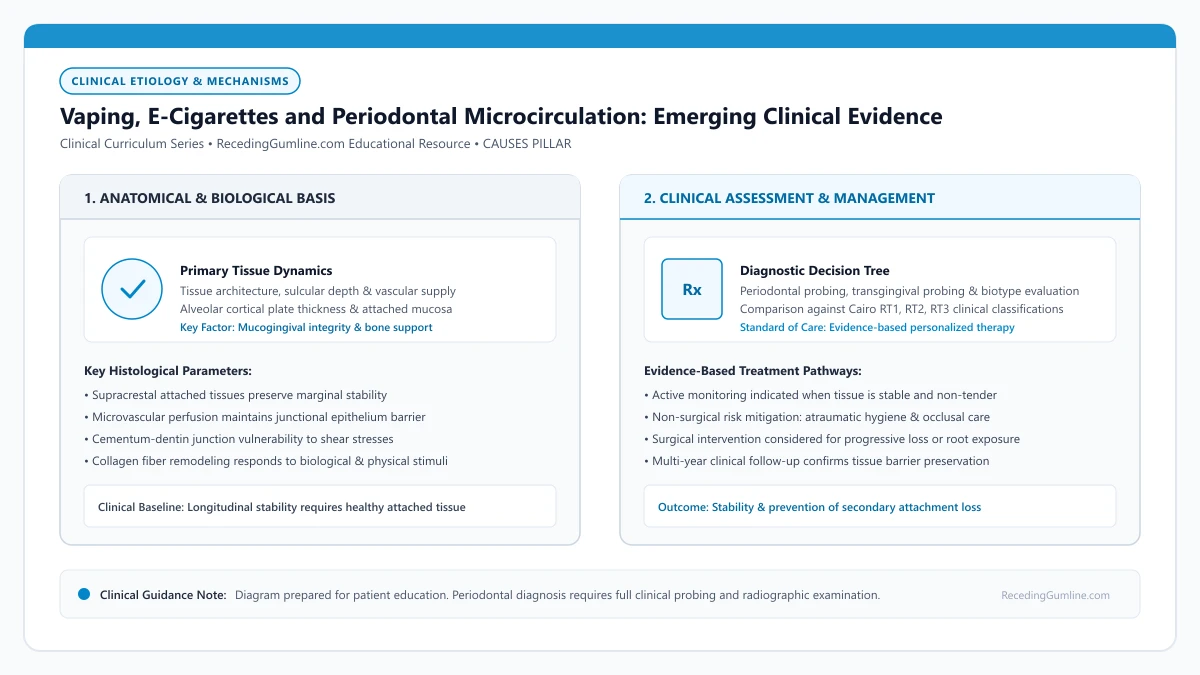
Educational illustration: Vaping, E-Cigarettes and Periodontal Microcirculation: Emerging Clinical Evidence. Clinical management requires comprehensive periodontal evaluation rather than isolated self-assessment.
Source: RecedingGumline.com Clinical Editorial Team (Proprietary educational diagram for RecedingGumline.com)
Key Clinical Distinctions & Diagnostic Boundaries
- Vaping does not produce tar or combustion byproducts, but its nicotine concentrations can equal or exceed traditional cigarettes.
- Reduced bleeding in vapers is not a sign of healthy gums; it is an artifact of nicotine-induced peripheral capillary constriction.
- Flavoring compounds (such as cinnamaldehyde and menthol) cause direct cytotoxicity to human gingival fibroblasts in laboratory studies.
- Vaping induces severe oral dryness (xerostomia), eliminating saliva's natural antimicrobial buffering capacity.
Microvascular Impairment: The Vasoconstrictive Choke Point
Nicotine is a sympathomimetic alkaloid that stimulates alpha-1 adrenergic receptors in peripheral blood vessels. When inhaled via e-cigarette vapor, nicotine is absorbed almost instantly through the oral mucosa and pulmonary capillaries, triggering immediate constriction of microvascular capillary beds in the gingiva.
This vasoconstriction reduces gingival blood flow by 30% to 50% for several hours after vaping. Starved of adequate arterial blood, marginal gum tissues experience cellular hypoxia (oxygen deprivation) and reduced delivery of defensive polymorphonuclear leukocytes (white blood cells).
Aerosolized nicotine from electronic vapor devices induces acute peripheral vasoconstriction, drastically restricting blood flow through delicate gingival microcapillaries. This severe reduction in tissue perfusion deprives the marginal gums of oxygen and essential immunological defense cells.
Clinical Considerations:
- Nicotine triggers alpha-adrenergic receptors causing peripheral capillary constriction
- Reduces gingival microvascular blood flow by up to 50%
- Tissue hypoxia impairs cellular turnover and suppresses immune defenses against bacteria
The Masked Bleeding Phenomenon: The Illusion of Health
One of the most dangerous clinical aspects of vaping is the "masked bleeding" phenomenon. Under normal circumstances, accumulating bacterial plaque causes gingivitis, marked by bleeding when brushing or flossing—an early warning signal that alerts patients to seek dental care.
Because nicotine restricts blood flow to surface capillaries, vapers with extensive plaque and deep pockets often experience zero bleeding. The gums may look pale and pink despite active destruction occurring deep beneath the surface, delaying diagnosis until severe recession or tooth mobility develops.
Propylene glycol and vegetable glycerin vapor bases act as hygroscopic desiccants, drying out oral mucosal membranes and lowering protective salivary flow. Reduced salivary lubrication amplifies friction during brushing and accelerates mechanical tearing of thin gingival tissues.
Clinical Considerations:
- Nicotine prevents normal capillary engorgement, eliminating early warning bleeding
- Vapers may have active periodontal attachment loss despite non-bleeding gums
- Delays diagnosis because patients mistakenly assume lack of bleeding equals health
Chemical Cytotoxicity: Propylene Glycol and Flavoring Aldehydes
Beyond nicotine, the carrier base of all vape liquids consists of propylene glycol (PG) and vegetable glycerin (VG). Propylene glycol is a powerful humectant that absorbs water molecules, causing severe and chronic dry mouth (xerostomia). Saliva is the mouth's primary defense; without it, virulent periodontal bacteria proliferate rapidly.
Furthermore, popular chemical flavorings—especially cinnamon, menthol, vanilla, and sweet aldehydes—have been shown in vitro to be cytotoxic to human periodontal ligament fibroblasts. These chemicals induce DNA oxidative stress and inhibit the cells responsible for repairing the collagen fibers that anchor teeth.
Patients who vape frequently present with masked gingival symptoms, exhibiting minimal bleeding on probing despite underlying periodontal degradation. Periodontal specialists advise complete smoking and vaping cessation at least four weeks prior to any soft-tissue grafting procedure to ensure graft microvascularization.
Clinical Considerations:
- Propylene glycol strips moisture from oral tissues, causing chronic xerostomia
- Lack of saliva allows pathogenic anaerobic bacteria to flourish along the gumline
- Flavoring aldehydes cause oxidative damage and inhibit collagen-producing fibroblasts
Aerosol Chemistry: Propylene Glycol, Glycerin & Vascular Constriction
Electronic nicotine delivery systems (e-cigarettes) aerosolize liquids containing propylene glycol, vegetable glycerin, nicotine, and flavor chemicals. Nicotine absorbed through the oral mucosa stimulates sympathetic adrenergic receptors, inducing profound microvascular vasoconstriction in gingival capillaries.
This localized ischemia deprives periodontal tissues of vital oxygen and nutrients while blunting the early inflammatory warning signs—such as bleeding—that typically alert patients to underlying tissue breakdown. Consequently, periodontal attachment loss and marginal recession progress silently beneath a pale, deceptively healthy-looking tissue exterior.
Furthermore, propylene glycol and glycerin humectants cause severe cellular dehydration in oral epithelial cells, compromising cell-to-cell tight junctions and accelerating the penetration of toxic bacterial lipopolysaccharides into deeper connective tissue layers.
Clinical Considerations:
- Aerosolized nicotine causes severe gingival vasoconstriction, masking tissue bleeding.
- Ischemia starves periodontal tissues of oxygen while permitting silent attachment loss.
- Humectants disrupt epithelial barrier junctions, facilitating cytotoxic bacterial penetration.
Impact on Periodontal Surgery & Connective Tissue Graft Healing
Vaping introduces severe clinical complications for patients requiring periodontal surgery. Successful soft-tissue grafting depends on rapid revascularization—the in-growth of micro-capillaries from the recipient bed into the avascular donor tissue within the first 48 to 72 hours postoperatively.
Nicotine and toxic carbonyl byproducts (such as acrolein and formaldehyde) present in vape vapor inhibit fibroblast proliferation, decrease collagen production, and paralyze neutrophil phagocytic function. This hostile biological environment dramatically increases the risk of partial graft necrosis, flap dehiscence, and surgical failure.
Periodontists strongly recommend a minimum cessation window of four weeks prior to and four weeks following periodontal plastic surgery to re-establish physiological tissue perfusion and optimize graft survival.
Clinical Considerations:
- Graft revascularization requires uncompromised microcapillary perfusion in the first 72 hours.
- Acrolein and formaldehyde in vapor suppress fibroblast migration and collagen synthesis.
- A strict 4-week pre- and post-surgical cessation protocol is necessary for predictable graft healing.
Clinical Reality Check
If you vape and switch to an ultra-soft brush or quit vaping, your gums may suddenly start bleeding; this does not mean your gums are getting worse, but that healthy microcirculation is returning.
Questions to Ask Your Periodontist or Dentist
- Do you see evidence of reduced blood flow or tissue changes related to my vaping habits?
- What were my actual periodontal pocket measurements, regardless of whether my gums bled during probing?
- Are my exposed tooth roots showing increased vulnerability to decay due to vaping-induced dry mouth?
- How long after quitting nicotine does gingival microcirculation return to normal baseline levels?
Unsure What Your Gum Changes Mean?
Take our free, evidence-based Gum Recession Assessment — approximately 3 minutes. Identify potential risk factors, evaluate symptoms, and receive personalized discussion questions for your dentist or periodontist.
Non-diagnostic educational triage. Private, secure, completed in your browser.
Related Educational Topics
Clinical Evidence & Claim Traceability (2 Mapped Assertions)
Scientific Literature & Clinical Guidelines
3sources · Hide ▲
- Pihlstrom BL, Michalowicz BS, Johnson NW (2005).
"Periodontal diseases." The Lancet.
Clinical relevance: Peer-reviewed Lancet seminar review synthesizing global periodontal epidemiology, microbial etiology, host immunopathology, and systemic interactions, emphasizing prevention, biofilm disruption, and early risk factor modification.
- Chapple ILC, Mealey BL, Van Dyke TE, Bartold PM, Dommisch H, Eickholz P, et al. (2018).
"Periodontal health and gingival diseases and conditions on an intact and a reduced periodontium: Consensus report of workgroup 1 of the 2017 World Workshop on the Classification of Periodontal and Peri-Implant Diseases and Conditions." Journal of Clinical Periodontology.
Clinical relevance: Consensus report establishing diagnostic criteria for periodontal health and gingivitis across intact and reduced periodontia, defining clinical gingival health as <10% bleeding on probing without attachment loss and strictly differentiating gingivitis from periodontitis.
- Tonetti MS, Greenwell H, Kornman KS (2018).
"Staging and grading of periodontitis: Framework and proposal of a new classification and case definition." Journal of Clinical Periodontology.
Clinical relevance: Consensus framework establishing the multidimensional staging (severity and extent of periodontal tissue breakdown) and grading (biological rate of disease progression, incorporating smoking and diabetes as grade modifiers) for periodontitis. It addresses periodontitis diagnosis and staging, not the classification of localized gingival recession defects.
Important Medical Notice
The contents of RecedingGumline.com, including text, graphics, self-assessment calculators, and other materials, are intended solely for educational and informational purposes. This content is not intended to replace professional dental examination, diagnosis, or treatment. Always seek the advice of a qualified dentist, periodontist, or other licensed oral healthcare provider with any questions you may have regarding a medical or dental condition. Never disregard professional medical advice or delay seeking it because of something you read on this website.