Using HSA and FSA Accounts for Periodontal Care: Eligible Treatments and Documentation
Can you use your HSA or FSA to pay for gum graft surgery, deep cleanings, and receded gum treatments?
Paying for specialized gingival recession treatment—such as gum grafting, scaling and root planing, or quarterly maintenance—can put serious strain on personal finances. Fortunately, the vast majority of periodontal treatments qualify as eligible medical expenses under IRS tax regulations. Utilizing pre-tax funds from Health Savings Accounts (HSA) or Flexible Spending Accounts (FSA) effectively discounts treatment costs by 20% to 35%.
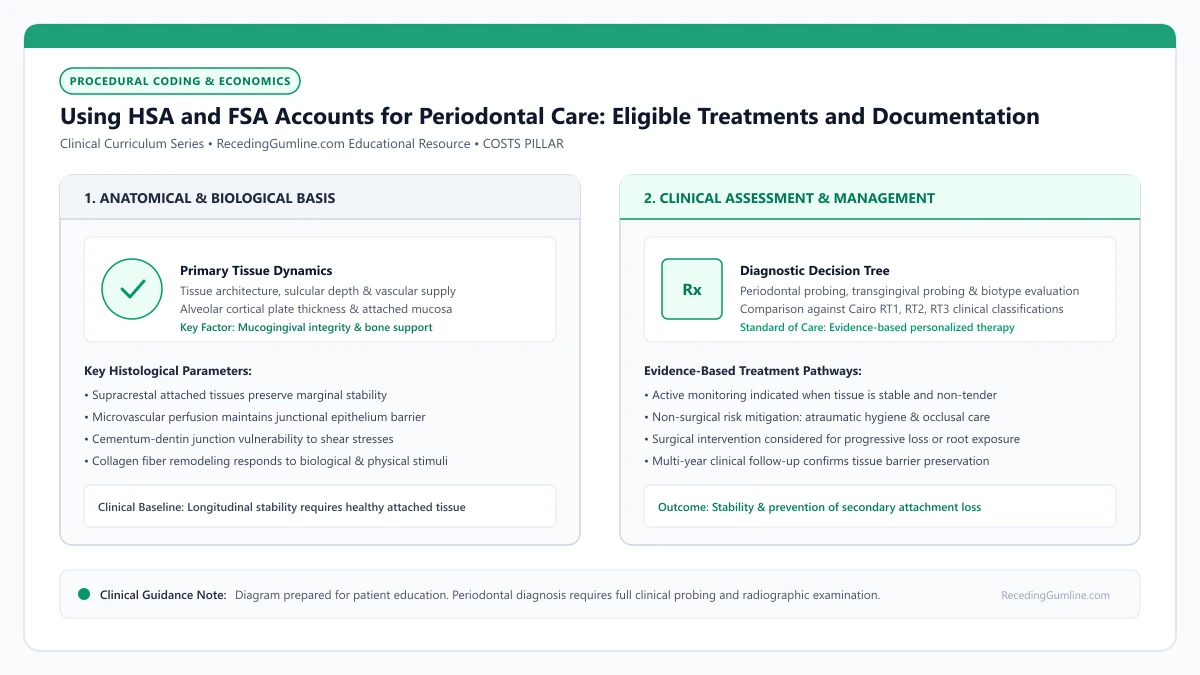
Educational illustration: Using HSA and FSA Accounts for Periodontal Care: Eligible Treatments and Documentation. Clinical management requires comprehensive periodontal evaluation rather than isolated self-assessment.
Source: RecedingGumline.com Clinical Editorial Team (Proprietary educational diagram for RecedingGumline.com)
Key Clinical Distinctions & Diagnostic Boundaries
- HSAs are owned by the individual and roll over indefinitely year after year; FSAs are employer-sponsored and forfeit unspent funds at year-end.
- Treatments performed purely for cosmetic smile enhancements are technically excluded under IRS Rule 213(d); functional treatments to prevent tooth loss are fully eligible.
- Specialist prescription rinses (such as 0.12% chlorhexidine) and high-potency fluoride pastes are eligible HSA/FSA expenses with a prescription.
- You can swipe your HSA or FSA debit card directly at the dental checkout desk for instant payment.
IRS Rule 213(d): What Periodontal Procedures Are Eligible?
Under Internal Revenue Code Section 213(d), medical care expenses are defined as amounts paid "for the diagnosis, remediation, mitigation, treatment, or prevention of disease." Because periodontitis and gingival recession are documented oral diseases, all therapeutic interventions qualify 100%.
Eligible periodontal expenses include: specialist periodontal consultations (D0180), full-mouth x-rays (D0210), scaling and root planing deep cleanings (D4341), ongoing periodontal maintenance visits (D4910), soft-tissue gum grafts (D4273/D4275), bone grafting, and custom occlusal nightguards for bruxism.
Health Savings Accounts (HSA) and Flexible Spending Accounts (FSA) allow patients to pay for qualified out-of-pocket dental expenses using pre-tax dollars. The Internal Revenue Service (IRS Publication 502) explicitly classifies periodontal surgery, scaling, root planing, and diagnostic radiographs as qualified medical expenses.
Clinical Considerations:
- 100% of diagnostic, preventive, and surgical periodontal procedures qualify
- Deep cleanings, gum grafts, bone grafts, and maintenance are fully eligible
- Custom hard nightguards to prevent clenching and recession are eligible medical expenses
The Math: How Pre-Tax Dollars Create a 30% Discount
When you contribute money to an HSA or FSA, the funds are deducted directly from your gross paycheck before federal income taxes, state taxes, and FICA (Social Security and Medicare) taxes are calculated.
For a patient in a 24% federal tax bracket and 5% state tax bracket, every dollar contributed saves roughly 30 cents in taxes. If you pay a $2,000 out-of-pocket copay for gum graft surgery using an HSA or FSA card, your real out-of-pocket cost is only about $1,400, saving you $600 simply by routing the payment through a tax-advantaged account.
Because soft-tissue grafting treats structural attachment loss and prevents premature tooth loss, it qualifies as medically necessary periodontal therapy rather than elective cosmetic surgery. Utilizing HSA or FSA pre-tax funds effectively provides an immediate 20% to 35% discount on out-of-pocket surgical costs depending on the patient’s tax bracket.
Clinical Considerations:
- HSA/FSA contributions bypass federal, state, and FICA payroll taxes
- Creates an effective 20% to 35% discount on all out-of-pocket dental costs
- A $2,000 surgical copay saves $500 to $700 in net income taxes
FSA Deadlines: Year-End Surgical Scheduling Strategies
Unlike Health Savings Accounts (which roll over indefinitely and can be invested), Flexible Spending Accounts (FSAs) enforce a strict "use-it-or-lose-it" rule. Any unspent funds remaining in your FSA at the end of the plan year (usually December 31, or March 15 under a grace period) are permanently forfeited to your employer.
If you have $1,500 sitting in your FSA in late autumn, scheduling your gum graft surgery or scaling and root planing in November or December is the smartest way to deploy those funds. You solve an active oral health problem while protecting your hard-earned money from forfeiture.
Patients utilizing FSA accounts must be mindful of use-it-or-lose-it year-end forfeiture rules by scheduling necessary periodontal consultations and surgeries before plan deadlines. Keeping itemized receipts, diagnostic coding statements, and written clinical necessity letters on file protects against tax audit inquiries.
Clinical Considerations:
- FSA funds expire at the end of the year; unused balances are forfeited
- Late-autumn periodontal surgery is ideal for utilizing expiring FSA balances
- HSA funds never expire and can be saved or used for future dental care
IRS Tax Guidelines: Publication 502 & Medically Necessary Periodontics
Health Savings Accounts (HSAs) and Flexible Spending Accounts (FSAs) allow patients to pay for eligible medical and dental expenses using pre-tax dollars, effectively saving 20% to 35% depending on federal and state income tax brackets. Under IRS Publication 502, dental treatments that diagnose, treat, mitigate, or prevent dental disease qualify as deductible medical care.
Because periodontal therapies—including comprehensive exams, scaling and root planing, and soft-tissue grafting for progressive attachment loss—treat an active pathological condition, they are 100% eligible for HSA/FSA reimbursement.
However, purely cosmetic dental procedures (such as tooth whitening or cosmetic gum re-contouring) are explicitly excluded by the IRS. The treating periodontist must provide itemized statements documenting diagnostic codes to substantiate medical necessity.
Clinical Considerations:
- HSAs and FSAs permit pre-tax payment for periodontal care, reducing effective costs by 20% to 35%.
- Under IRS Publication 502, treatments that treat, mitigate, or prevent disease are fully eligible.
- Cosmetic procedures are excluded; itemized receipts with diagnostic codes prove eligibility.
Eligible Expense Inventory: Sedation, Rinses, Stents & Travel Costs
Patients utilizing HSA/FSA funds can apply pre-tax dollars to a wide array of ancillary expenses associated with gum recession treatment beyond primary surgical fees.
Eligible expenses include: (1) oral and intravenous sedation fees administered during surgical procedures; (2) diagnostic 3D CBCT scans and periapical radiographs; (3) custom-fabricated palatal surgical stents; and (4) prescription medications, including 0.12% chlorhexidine rinses, antibiotics, and post-surgical analgesics.
Additionally, IRS regulations permit deduction of transportation and travel expenses primarily incurred to receive specialized medical care, including mileage, parking fees, and public transit fares to specialist appointments.
Clinical Considerations:
- Intravenous and oral conscious sedation fees are fully eligible for HSA/FSA reimbursement.
- Prescription antimicrobial rinses (chlorhexidine), palatal stents, and analgesics qualify.
- Mileage, parking, and transit expenses to specialist appointments are deductible medical expenses.
Clinical Reality Check
Standard commercial electric toothbrushes and over-the-counter pastes are not HSA/FSA eligible; however, prescription mouthrinses like chlorhexidine and prescription fluorides are fully eligible.
Questions to Ask Your Periodontist or Dentist
- Can I pay my out-of-pocket surgical balance using my HSA or FSA debit card?
- Can your office provide an itemized receipt with specific ADA codes for my FSA administrator?
- If my FSA administrator requests a Letter of Medical Necessity, can your doctor sign one?
- Can we schedule my treatment before December 31 so I can use my expiring FSA balance?
Unsure What Your Gum Changes Mean?
Take our free, evidence-based Gum Recession Assessment — approximately 3 minutes. Identify potential risk factors, evaluate symptoms, and receive personalized discussion questions for your dentist or periodontist.
Non-diagnostic educational triage. Private, secure, completed in your browser.
Related Educational Topics
Clinical Evidence & Claim Traceability (1 Mapped Assertions)
Scientific Literature & Clinical Guidelines
1source · Hide ▲
- American Dental Association (2026).
"Code on Dental Procedures and Nomenclature (CDT)." American Dental Association.Coding Standard Official Publication
Clinical relevance: Standardized dental procedure nomenclature maintained and updated annually by the American Dental Association (ADA, currently referencing CDT 2026/2027) for administrative classification and billing (including codes D4273, D4275, D4277, D4341, D4910). The site references CDT procedure numbers for high-level educational and administrative context and does not reproduce proprietary CDT descriptors or substantial CDT text. Commercial use/licensing requirements should be reviewed separately with the ADA or qualified counsel. Procedure codes facilitate administrative reporting and do not dictate clinical necessity or insurance benefit coverage.
Important Medical Notice
The contents of RecedingGumline.com, including text, graphics, self-assessment calculators, and other materials, are intended solely for educational and informational purposes. This content is not intended to replace professional dental examination, diagnosis, or treatment. Always seek the advice of a qualified dentist, periodontist, or other licensed oral healthcare provider with any questions you may have regarding a medical or dental condition. Never disregard professional medical advice or delay seeking it because of something you read on this website.