Dental Insurance Coverage Rules for Gum Grafts: Medical Necessity Criteria & Exclusions
What rules do dental insurance companies use to decide whether to pay for a gum graft?
As highlighted in our receding gumline options overview, dental insurance coverage for gum graft surgery is not automatic. Many patients are stunned when an insurance claim for a gum graft is denied with the explanation: "Procedure deemed not medically necessary or cosmetic in nature." Understanding how insurance claim adjudicators evaluate medical necessity—and what clinical records your periodontist must submit—ensures your claim is approved and reimbursed.
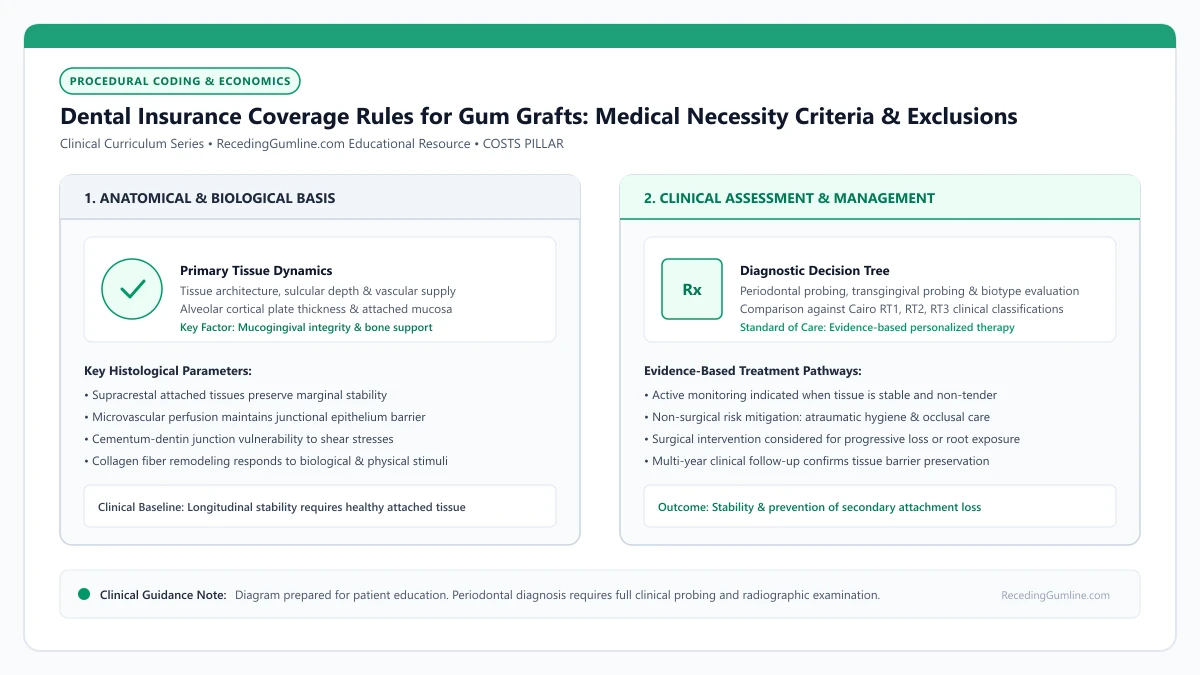
Educational illustration: Dental Insurance Coverage Rules for Gum Grafts: Medical Necessity Criteria & Exclusions. Clinical management requires comprehensive periodontal evaluation rather than isolated self-assessment.
Source: RecedingGumline.com Clinical Editorial Team (Proprietary educational diagram for RecedingGumline.com)
Key Clinical Distinctions & Diagnostic Boundaries
- Grafting on teeth with documented clinical attachment loss and inflammation is covered; grafting purely to cover a root for looks is denied.
- Insurance companies maintain proprietary "Clinical Guidelines" defining exactly how many millimeters of attached tissue qualify for coverage.
- Submitting high-resolution intraoral photographs showing tissue blanching or root exposure is the single most effective way to overturn a denial.
- Pre-authorization (predetermination of benefits) takes 4 to 6 weeks but provides written confirmation of coverage before surgery.
The Battleground: Functional Medical Necessity vs. Cosmetic Denial
Virtually all dental benefit contracts contain an explicit exclusion clause stating: "Procedures performed primarily for cosmetic reasons or to alter appearance are not covered." When a claim for a gum graft is submitted, insurance claim adjusters immediately scrutinize it to determine if it can be labeled cosmetic.
To qualify as medically necessary, the surgical record must prove that the graft is required to preserve the tooth, halt active disease, or restore lost functional architecture. If the clinician writes "patient unhappy with appearance of long tooth," the claim will be rejected instantly.
Dental insurers evaluate soft-tissue grafting claims (CDT codes D4270, D4273, D4275) based on strict biological criteria of medical and structural necessity. Coverage approval requires objective clinical evidence, including pre-operative photographs showing severe mucogingival defects and documented clinical attachment loss.
Clinical Considerations:
- Insurers universally exclude procedures performed primarily for cosmetic appearance
- Clinical documentation must prove functional necessity to prevent tooth mortality
- Surgeon notes must focus on lack of attached tissue, progressive attachment loss, and hygiene access
The Four Evidence Requirements: What Insurers Demand
Insurance claim adjusters do not accept a dentist's word alone; they require objective, quantifiable physical evidence. To secure approval, your periodontist must submit four specific records:
1. Periodontal Probing Chart: Documenting probing depths, recession depth in millimeters, and bleeding on probing. 2. Diagnostic Radiographs: Showing bone crest height and rule out hopeless prognosis. 3. Intraoral Photographs: Clearly showing root exposure and lack of keratinized tissue. 4. Narrative of Medical Necessity: Explaining that less than 1 mm of attached gingiva remains, that the muscle pull threatens margin stability, or that documented recession progression has occurred.
Insurers routinely classify gum grafting as a major periodontal service, providing reimbursement at 50% of the carrier’s usual, customary, and reasonable (UCR) fee schedule. A waiting period of 6 to 12 months for major periodontal services commonly applies to new dental insurance policyholders.
Clinical Considerations:
- Full-mouth probing chart with documented recession measurements in millimeters
- Diagnostic periapical radiographs demonstrating bone crest support
- Color intraoral photographs proving root exposure and absence of attached gingiva
- Clinical narrative detailing functional impairment and progression risk
What to Do If Denied: The Clinical Appeal Protocol
If your gum graft claim is initially denied, do not panic. Initial denials are frequently generated by automated computer algorithms or non-clinical reviewers looking for missing attachments. Over 50% of denied periodontal claims are successfully overturned on appeal.
Have your periodontist submit a formal "First-Level Appeal" requesting a peer-to-peer review with a licensed dental consultant. The appeal should include enlarged, annotated photographs and citations to peer-reviewed periodontal literature proving that lack of attached gingiva leads to progressive attachment loss.
Submitting a detailed pre-treatment estimate along with calibrated periodontal probing charts and high-resolution diagnostic intraoral photographs minimizes administrative claim denials. If a claim is denied as cosmetic, the periodontist can submit a clinical appeal emphasizing tooth retention and functional stability.
Clinical Considerations:
- Initial claim denials are frequently automated and can be overturned on appeal
- Request a formal peer-to-peer review with an insurance dental consultant
- Submit annotated color photos and peer-reviewed clinical citations to prove necessity
Insurance Approval Standards: Documenting Clinical Attachment Loss (CAL)
Dental insurance carriers routinely scrutinize gum graft claims to determine whether the procedure is "medically necessary" or purely "cosmetic." Most insurance policies have explicit exclusion clauses denying benefits for cosmetic gumline corrections.
To establish medical necessity and secure reimbursement, the periodontist must submit comprehensive objective clinical documentation. This includes a full-mouth periodontal charting showing probing depths, millimeters of gingival recession, and calculated clinical attachment loss.
Crucially, insurance guidelines require documented absence or deficiency of attached keratinized tissue (< 1.0 mm), accompanied by high-resolution clinical photographs demonstrating visible root exposure, active bleeding on probing, or tissue blanching under muscle pull.
Clinical Considerations:
- Insurance carriers strictly exclude cosmetic procedures; medical necessity must be proven.
- Claims require full-mouth periodontal charting with probing depths and calibrated recession measurements.
- Documenting < 1 mm attached gingiva and high-resolution clinical photos is essential for approval.
Pre-Determination Filings & Clinical Narrative Defense Strategies
Because periodontal surgery fees often exceed $1,500, submitting a formal Pre-Determination of Benefits (pre-estimate) prior to surgery is strongly recommended. The dental office submits CDT codes, radiographs, and intraoral photographs to the insurer for advance adjudication.
If a claim is initially denied as cosmetic, the periodontist submits an appeal with a written clinical narrative. The narrative cites peer-reviewed clinical guidelines, emphasizing that untreated progressive recession threatens tooth retention due to cervical root decay, hypersensitivity, and impending cortical bone dehiscence.
Citing the 2017 AAP/EFP consensus definitions on mucogingival conditions provides authoritative documentation that frequently overturns initial claim denials.
Clinical Considerations:
- A formal pre-determination confirms insurance allowances and out-of-pocket shares in advance.
- Written specialist narratives defend medical necessity against automated insurance denials.
- Appeals referencing AAP/EFP consensus guidelines successfully overturn cosmetic exclusion claims.
Clinical Reality Check
Make sure your dentist never uses the word "cosmetic" or "aesthetic" on your insurance paperwork; the clinical notes must emphasize "inadequate attached keratinized tissue" and "progressive attachment loss."
Questions to Ask Your Periodontist or Dentist
- Will your office submit a predetermination of benefits to my dental insurer before we schedule surgery?
- Does my chart document that I have less than 1 mm of attached tissue to satisfy insurance guidelines?
- Will you be including color intraoral photographs and diagnostic x-rays with the insurance claim?
- What is your office's protocol for filing a clinical appeal if the insurer initially denies coverage?
Unsure What Your Gum Changes Mean?
Take our free, evidence-based Gum Recession Assessment — approximately 3 minutes. Identify potential risk factors, evaluate symptoms, and receive personalized discussion questions for your dentist or periodontist.
Non-diagnostic educational triage. Private, secure, completed in your browser.
Related Educational Topics
Clinical Evidence & Claim Traceability (2 Mapped Assertions)
Scientific Literature & Clinical Guidelines
3sources · Hide ▲
- American Dental Association (2026).
"Code on Dental Procedures and Nomenclature (CDT)." American Dental Association.Coding Standard Official Publication
Clinical relevance: Standardized dental procedure nomenclature maintained and updated annually by the American Dental Association (ADA, currently referencing CDT 2026/2027) for administrative classification and billing (including codes D4273, D4275, D4277, D4341, D4910). The site references CDT procedure numbers for high-level educational and administrative context and does not reproduce proprietary CDT descriptors or substantial CDT text. Commercial use/licensing requirements should be reviewed separately with the ADA or qualified counsel. Procedure codes facilitate administrative reporting and do not dictate clinical necessity or insurance benefit coverage.
- Cairo F, Nieri M, Cincinelli S, Mervelt J, Pagliaro U (2011).
"The interproximal clinical attachment level to classify gingival recessions and predict root coverage outcomes: an explorative and reliability study." Journal of Clinical Periodontology.
Clinical relevance: Exploratory and reliability study establishing the Cairo classification based on interdental clinical attachment level (CAL): RT1 (no interproximal attachment loss; complete root coverage is clinically predictable), RT2 (interproximal attachment loss <= buccal loss; partial coverage predictable), and RT3 (interproximal loss exceeds buccal recession; complete coverage not predictable).
- Jepsen S, Caton JG, Albandar JM, Bissada NF, Bouchard P, Cortellini P, et al. (2018).
"Periodontal manifestations of systemic diseases and developmental and acquired conditions: Consensus report of workgroup 3 of the 2017 World Workshop on the Classification of Periodontal and Peri-Implant Diseases and Conditions." Journal of Periodontology.
Clinical relevance: Consensus report defining mucogingival conditions, gingival phenotype (replacing biotype), non-carious cervical lesions, and the multifactorial etiology of gingival recession; emphasizes that recession can occur without periodontitis and classifies recession by interdental clinical attachment loss.
Important Medical Notice
The contents of RecedingGumline.com, including text, graphics, self-assessment calculators, and other materials, are intended solely for educational and informational purposes. This content is not intended to replace professional dental examination, diagnosis, or treatment. Always seek the advice of a qualified dentist, periodontist, or other licensed oral healthcare provider with any questions you may have regarding a medical or dental condition. Never disregard professional medical advice or delay seeking it because of something you read on this website.