How Dental Deductibles and Annual Maximums Apply to Periodontal Procedures
How does your dental deductible affect the cost of gum treatments and deep cleanings?
Navigating dental insurance can be bewildering (see our gum recession overview). When dealing with periodontal therapy—such as deep cleanings, maintenance visits, or soft-tissue grafting—patients are confronted with insurance jargon: annual deductibles, coinsurance tiers, and maximum allowable charges. Understanding how these financial mechanisms interact determines exactly what you owe at the dental front desk.
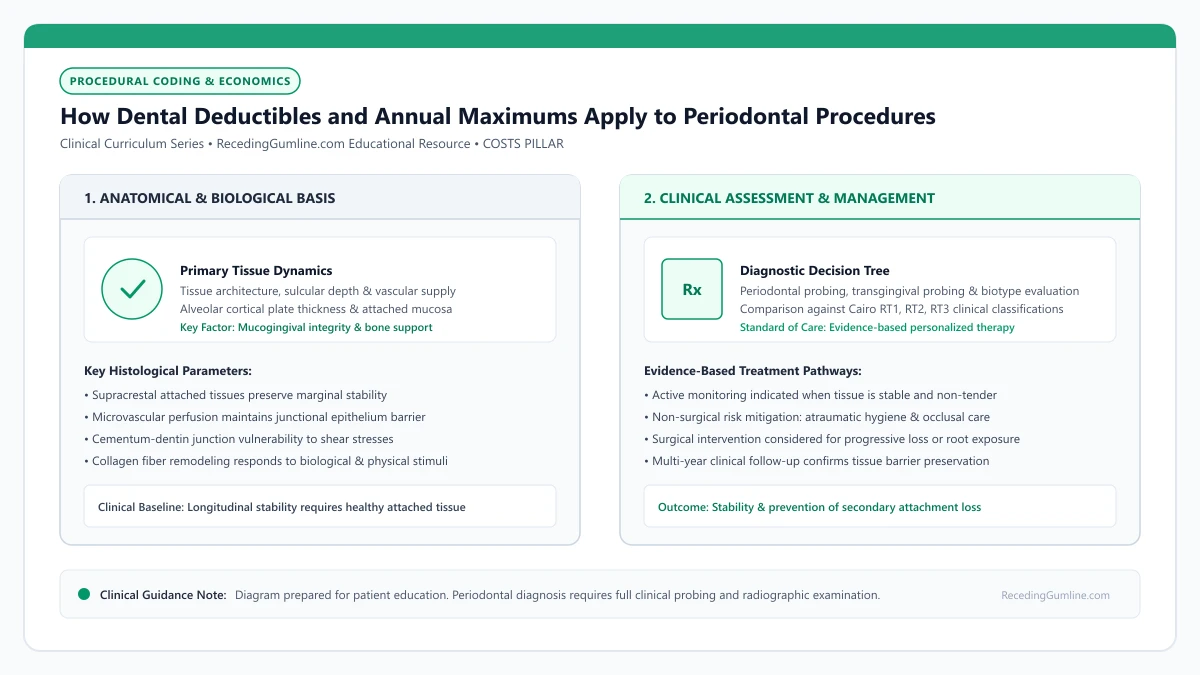
Educational illustration: How Dental Deductibles and Annual Maximums Apply to Periodontal Procedures. Clinical management requires comprehensive periodontal evaluation rather than isolated self-assessment.
Source: RecedingGumline.com Clinical Editorial Team (Proprietary educational diagram for RecedingGumline.com)
Key Clinical Distinctions & Diagnostic Boundaries
- A dental deductible is the fixed dollar amount you must pay out-of-pocket each year before your insurance begins contributing.
- Standard 6-month cleanings usually bypass the deductible, but periodontal maintenance (D4910) is subject to the deductible.
- In-network providers must honor contracted fee caps; out-of-network providers can balance-bill you for charges exceeding the insurer's allowable limit.
- Dental deductibles reset every calendar year (January 1) or benefit year, requiring a new payment before benefits kick in.
The Deductible Surprise: Why Periodontal Care Triggers a Deductible
Most patients are accustomed to their routine six-month checkups and cleanings being "100% free" with zero copay. This is because dental plans classify routine prophylaxis (CDT D1110) and exams as Class I Preventive services, routinely waiving the annual deductible.
However, once you are diagnosed with receding gums or periodontitis, your care transitions out of Class I. Scaling and root planing (D4341) and periodontal maintenance (D4910) are classified as Class II Basic services, while gum grafting (D4273) is classified as Class III Major surgery. All Class II and Class III services require you to pay your full annual deductible first.
Annual dental insurance deductibles typically range from $50 to $150 for individual policies and up to $300 for family plans. Before insurance benefits contribute toward periodontal scaling or gum grafting, the patient must fully satisfy this deductible amount out of pocket.
Clinical Considerations:
- Routine cleanings bypass the deductible; periodontal therapies do not
- Periodontal maintenance (D4910) triggers your annual deductible ($50–$100)
- Deep cleanings and gum grafts fall into Class II and Class III benefit tiers
Coinsurance Calculations: 80/20 vs. 50/50 Coverage Splits
Once your deductible is satisfied, your dental insurance covers a specified percentage of the allowable procedure cost, and you are responsible for the remainder—known as your coinsurance.
For Class II Basic periodontal services (such as scaling and root planing), insurance typically pays 80%, leaving you with a 20% copay. For Class III Major surgical services (such as soft-tissue grafting and bone grafts), insurance typically pays only 50%, leaving you responsible for 50% of the total surgical fee.
Deductibles reset at the beginning of each calendar year or policy anniversary, requiring strategic scheduling when multiple periodontal procedures are planned. While diagnostic preventive exams may be exempt from the deductible, all basic and major periodontal surgical treatments are subject to it.
Clinical Considerations:
- Class II Basic (Scaling and Root Planing): Insurer pays 80%, patient pays 20%
- Class III Major (Gum Graft Surgery): Insurer pays 50%, patient pays 50%
- Percentages apply strictly to the insurer's contracted allowable fee schedule
In-Network Savings: Maximum Allowable Charges
A decisive factor governing your deductible and coinsurance is whether your periodontist is an in-network participating provider. In-network clinicians sign contracts agreeing to Maximum Allowable Charges (MAC) that discount procedures by 25% to 45% off standard cash fees.
If an out-of-network surgeon charges $1,500 for a graft and your plan's allowable fee is $1,000, your 50% insurance will pay $500, but the out-of-network surgeon can "balance-bill" you for the remaining $1,000. An in-network surgeon is legally prohibited from balance-billing, saving you hundreds of dollars.
Patients facing extensive multi-quadrant grafting can benefit from coordinating treatment across the end of one calendar year and the beginning of the next. This phasing strategy maximizes annual maximum reimbursements while satisfying the deductible efficiently across consecutive benefit periods.
Clinical Considerations:
- In-network periodontists discount fees by 25% to 45% based on contracted fee schedules
- In-network providers are legally barred from balance-billing beyond allowable fees
- Out-of-network providers can balance-bill the difference between their cash fee and insurance allowance
Deductible Mechanics: Individual vs. Family Accumulation in Periodontics
A dental insurance deductible is the fixed dollar amount a patient must pay out-of-pocket each calendar year before the insurance plan begins contributing toward covered services. For individual plans, annual deductibles typically range from $50 to $150; for family plans, deductibles are capped at $150 to $450.
While preventive services (such as routine cleanings and exams) often waive the deductible, periodontal therapy (scaling and root planing, gum grafting, and osseous surgery) is categorized as a Basic or Major service, meaning the annual deductible is strictly applied to the first surgical claim.
In family plans, expenses incurred by family members across preventive and basic dental treatments count toward satisfying the overall family deductible, reducing the remaining out-of-pocket deductible for surgical care.
Clinical Considerations:
- Annual dental deductibles typically range from $50 to $150 per individual.
- Preventive cleanings often waive deductibles, but periodontal surgery strictly requires deductible payment.
- Family deductibles aggregate family dental expenses to satisfy the threshold early in the plan year.
Strategic Timing: Plan Year Renewals & Benefit Reset Optimization
Most dental insurance policies operate on a standard calendar year (January 1 through December 31), resetting all deductibles and annual benefit maximums to zero on January 1. Understanding this renewal schedule allows patients to optimize out-of-pocket expenses.
If a patient has already met their annual deductible through routine cleanings or basic fillings earlier in the year, scheduling gum graft surgery in October or November ensures that 100% of insurance contributions go directly toward surgical fees without deductible deductions.
Conversely, if comprehensive treatment spans multiple quadrants, completing the first phase in December and the second phase in January applies benefits across two consecutive plan years, tapping into two annual maximums.
Clinical Considerations:
- Most dental plans reset deductibles and benefit caps on January 1.
- Scheduling surgery late in the year leverages previously satisfied deductibles.
- Splitting multi-quadrant care between December and January utilizes two consecutive benefit maximums.
Clinical Reality Check
If you have a $50 deductible and need four quadrants of deep cleaning, you pay the $50 only once for the entire benefit year, not on every quadrant appointment.
Questions to Ask Your Periodontist or Dentist
- Has my annual dental insurance deductible already been met for this benefit year?
- Does your office participate as an in-network provider with my specific dental plan?
- What is my exact coinsurance percentage (20% or 50%) for the recommended procedure?
- What is the contracted maximum allowable fee for each code on my treatment plan?
Unsure What Your Gum Changes Mean?
Take our free, evidence-based Gum Recession Assessment — approximately 3 minutes. Identify potential risk factors, evaluate symptoms, and receive personalized discussion questions for your dentist or periodontist.
Non-diagnostic educational triage. Private, secure, completed in your browser.
Related Educational Topics
Clinical Evidence & Claim Traceability (1 Mapped Assertions)
Scientific Literature & Clinical Guidelines
1source · Hide ▲
- American Dental Association (2026).
"Code on Dental Procedures and Nomenclature (CDT)." American Dental Association.Coding Standard Official Publication
Clinical relevance: Standardized dental procedure nomenclature maintained and updated annually by the American Dental Association (ADA, currently referencing CDT 2026/2027) for administrative classification and billing (including codes D4273, D4275, D4277, D4341, D4910). The site references CDT procedure numbers for high-level educational and administrative context and does not reproduce proprietary CDT descriptors or substantial CDT text. Commercial use/licensing requirements should be reviewed separately with the ADA or qualified counsel. Procedure codes facilitate administrative reporting and do not dictate clinical necessity or insurance benefit coverage.
Important Medical Notice
The contents of RecedingGumline.com, including text, graphics, self-assessment calculators, and other materials, are intended solely for educational and informational purposes. This content is not intended to replace professional dental examination, diagnosis, or treatment. Always seek the advice of a qualified dentist, periodontist, or other licensed oral healthcare provider with any questions you may have regarding a medical or dental condition. Never disregard professional medical advice or delay seeking it because of something you read on this website.