Dental Savings Plans vs. Insurance for Periodontal Treatment: Structure & Savings
How do dental savings plans work for gum recession treatments, and are they better than insurance?
For patients facing expensive receding gumline assessment who lack dental insurance—or whose insurance annual maximum has already run out—Dental Savings Plans (also known as dental discount plans) represent an increasingly popular financial alternative. Rather than operating as insurance, these membership programs provide immediate contracted discounts of 20% to 50% across participating dental providers with zero waiting periods and zero annual maximums.
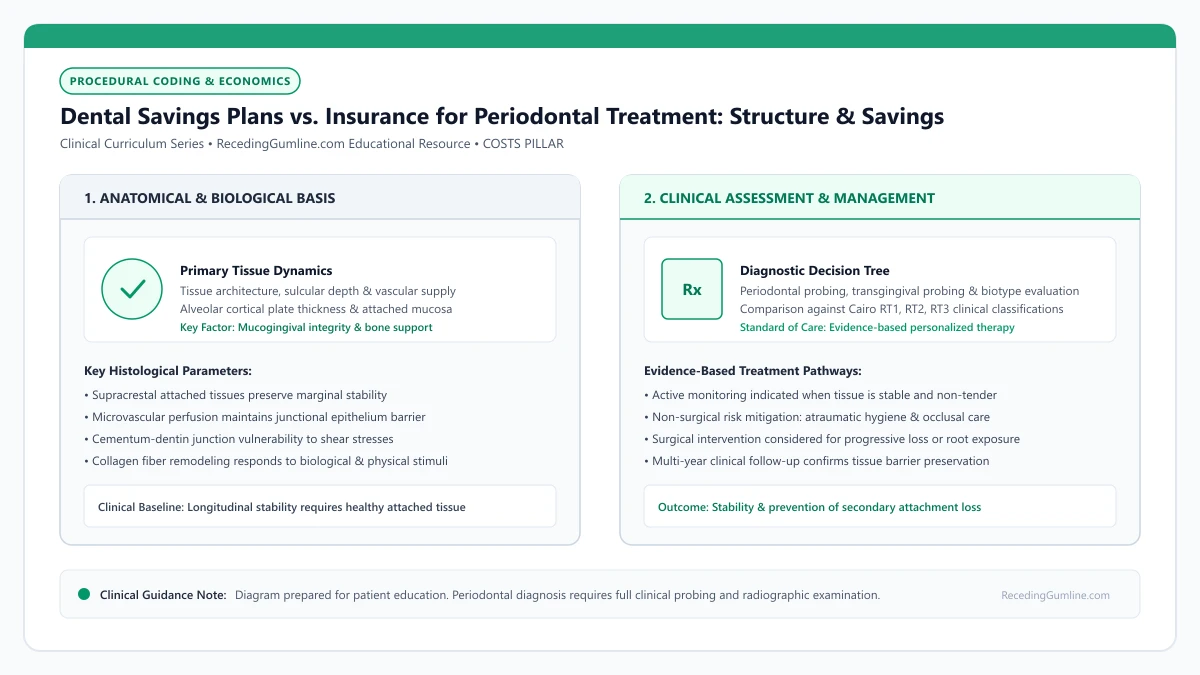
Educational illustration: Dental Savings Plans vs. Insurance for Periodontal Treatment: Structure & Savings. Clinical management requires comprehensive periodontal evaluation rather than isolated self-assessment.
Source: RecedingGumline.com Clinical Editorial Team (Proprietary educational diagram for RecedingGumline.com)
Key Clinical Distinctions & Diagnostic Boundaries
- Insurance involves monthly premiums, deductibles, coinsurance, annual maximums, and claim approvals; savings plans involve a simple membership fee and discounted cash payment.
- You cannot combine insurance and a savings plan on the same procedure; you must choose one contracted fee schedule.
- Savings plans activate within 24 to 48 hours with no waiting periods for major surgical grafting.
- Not all periodontists participate in dental savings plans; you must verify that your chosen specialist accepts the specific plan.
How Dental Discount Plans Work: The Membership Model
A dental savings plan operates similarly to a Costco or warehouse club membership. You pay an annual membership fee—typically $100 to $150 for an individual, or $175 to $250 for a family. In exchange, you receive a membership card that grants access to a national network of participating dentists and periodontists.
Participating clinicians agree to accept predetermined, discounted fees for their services—typically 20% to 50% below standard cash prices. When you visit the specialist, you pay the discounted rate directly at the time of service. There are no insurance claim forms to submit, no pre-authorizations, and no waiting for reimbursements.
Dental savings plans (also known as discount dental plans) serve as an affordable alternative to traditional dental insurance, offering 20% to 50% discounts on specialist periodontal procedures in exchange for an annual membership fee. Unlike insurance, discount plans feature zero waiting periods, zero annual maximum payout caps, and zero claim denial hassles.
Clinical Considerations:
- Annual membership fee of $100 to $150 grants access to contracted discounted fees
- Participating periodontists discount procedures by 20% to 50% off standard cash fees
- Direct payment at the time of service with zero claims paperwork or denials
Head-to-Head Comparison: Savings Plans vs. Traditional Insurance
The greatest advantage of a dental savings plan over traditional insurance is the total absence of restrictions. Traditional insurance plans enforce 6- to 12-month waiting periods for major gum surgery and cap annual payouts at $1,000 to $1,500.
If a gum graft costs $3,000, an insurance policy will pay up to its $1,500 cap and stop, leaving you with the rest. With a dental savings plan, there is no annual maximum. If the plan offers a 30% discount, a $3,000 surgery is immediately reduced to $2,100, saving you $900 with zero waiting periods.
Participating periodontists agree to contracted fee schedules for common recession treatments including consultations, scaling and root planing, and soft-tissue grafting. A patient requiring $3,000 in grafting can save $600 to $1,200 immediately upon plan activation without waiting for insurance pre-authorizations.
Clinical Considerations:
- Zero waiting periods: activate in 24 hours and schedule surgery immediately
- Zero annual maximum caps: save 20% to 50% whether your treatment costs $500 or $10,000
- Zero claims denials: discounts apply automatically to all services on the fee schedule
Essential Checklist: Verifying Your Periodontist Participates
The single most important step before purchasing a dental savings plan is verifying that your chosen periodontist participates in that specific network (such as Aetna Dental Access, Careington, or Cigna Dental Plans).
Never buy a plan online assuming all dental offices accept it. Call your periodontal specialist's financial coordinator first and ask: "Which dental savings discount plans do you participate with?" Purchase the exact plan they recommend to ensure your discounts apply smoothly on surgery day.
Discount dental plans cannot be combined directly with commercial dental insurance for the same procedure, but they can be utilized once annual insurance maximums are exhausted. Verifying that the chosen periodontist is actively contracted with the specific discount network ensures seamless fee reductions at checkout.
Clinical Considerations:
- Always call your periodontist's office first to ask which specific discount plans they accept
- Popular national networks include Careington 500, Aetna Dental Access, and DentalPlans.com
- Cannot be combined with insurance on the same procedure, but can be used after insurance caps out
Fee Mechanics: Dental Savings Plans vs. Conventional PPO Insurance
For patients who lack dental insurance or whose annual maximum has been exhausted, Dental Savings Plans (also known as discount dental plans) offer a viable alternative. Unlike insurance, dental savings plans are not insurance policies; they are membership networks where participating providers agree to accept discounted fee schedules.
Members pay an annual fee (typically $100 to $200 per year) to access contracted fee reductions ranging from 20% to 50% across general and specialist dental services.
For periodontal procedures, contracted savings plan fees are established based on fair market benchmarks. For example, a $1,500 gum graft may be discounted to $950-$1,100, providing immediate, predictable out-of-pocket savings without claim submissions.
Clinical Considerations:
- Dental savings plans are membership discount networks, not conventional insurance policies.
- Members pay $100-$200 annually to access contracted fee discounts of 20% to 50%.
- Surgical fees are discounted immediately at the time of service with zero claim paperwork.
Key Advantages: Zero Waiting Periods & Unlimited Annual Usage
Dental savings plans provide critical structural advantages over conventional dental insurance for patients requiring immediate, high-cost periodontal surgery. Traditional insurance policies routinely impose 6- to 12-month "waiting periods" on basic and major services, preventing newly enrolled patients from accessing immediate surgical benefits.
Dental savings plans feature zero waiting periods; discounts activate immediately upon membership enrollment. Furthermore, savings plans have zero annual maximum limits; patients can utilize the discounted rates for unlimited procedures throughout the membership year.
Additionally, dental savings plans do not exclude pre-existing conditions or require complex pre-authorization narratives, making them an ideal financial tool for patients needing immediate multi-quadrant care.
Clinical Considerations:
- Zero waiting periods allow patients to access discounted surgical rates immediately upon enrollment.
- Zero annual maximums permit unlimited procedure usage throughout the membership year.
- No pre-existing condition exclusions or pre-authorization delays streamline surgical scheduling.
Clinical Reality Check
Dental savings plans are not insurance policies; they are contracted discount networks. You must pay the discounted fee in full at the time of service.
Questions to Ask Your Periodontist or Dentist
- Which dental savings discount plans (such as Careington or Aetna Dental Access) does your office accept?
- What is your contracted fee under that savings plan for code D4273 (gum graft) and D4341 (deep cleaning)?
- Can I join a savings plan today and use it for my procedure next week without a waiting period?
- If my insurance maximum runs out, will you allow me to use a dental savings plan for my next quadrant?
Unsure What Your Gum Changes Mean?
Take our free, evidence-based Gum Recession Assessment — approximately 3 minutes. Identify potential risk factors, evaluate symptoms, and receive personalized discussion questions for your dentist or periodontist.
Non-diagnostic educational triage. Private, secure, completed in your browser.
Related Educational Topics
Clinical Evidence & Claim Traceability (1 Mapped Assertions)
Scientific Literature & Clinical Guidelines
1source · Hide ▲
- American Dental Association (2026).
"Code on Dental Procedures and Nomenclature (CDT)." American Dental Association.Coding Standard Official Publication
Clinical relevance: Standardized dental procedure nomenclature maintained and updated annually by the American Dental Association (ADA, currently referencing CDT 2026/2027) for administrative classification and billing (including codes D4273, D4275, D4277, D4341, D4910). The site references CDT procedure numbers for high-level educational and administrative context and does not reproduce proprietary CDT descriptors or substantial CDT text. Commercial use/licensing requirements should be reviewed separately with the ADA or qualified counsel. Procedure codes facilitate administrative reporting and do not dictate clinical necessity or insurance benefit coverage.
Important Medical Notice
The contents of RecedingGumline.com, including text, graphics, self-assessment calculators, and other materials, are intended solely for educational and informational purposes. This content is not intended to replace professional dental examination, diagnosis, or treatment. Always seek the advice of a qualified dentist, periodontist, or other licensed oral healthcare provider with any questions you may have regarding a medical or dental condition. Never disregard professional medical advice or delay seeking it because of something you read on this website.