Post-Surgical Gum Graft Recovery Expenses & Ancillary Care
When planning for receding gumline clinical guide, patients frequently focus solely on the primary surgical fee while overlooking ancillary and indirect expenses associated with the recovery phase. Following gingival graft surgery, successful tissue revascularization requires strict adherence to specialized postoperative protocols during the critical initial 2 to 3 weeks of healing. From custom protective palatal stents and prescription antimicrobial rinses to specialized soft-food diets and temporary time away from work, budgeting for these recovery items ensures a smooth, stress-free healing experience.
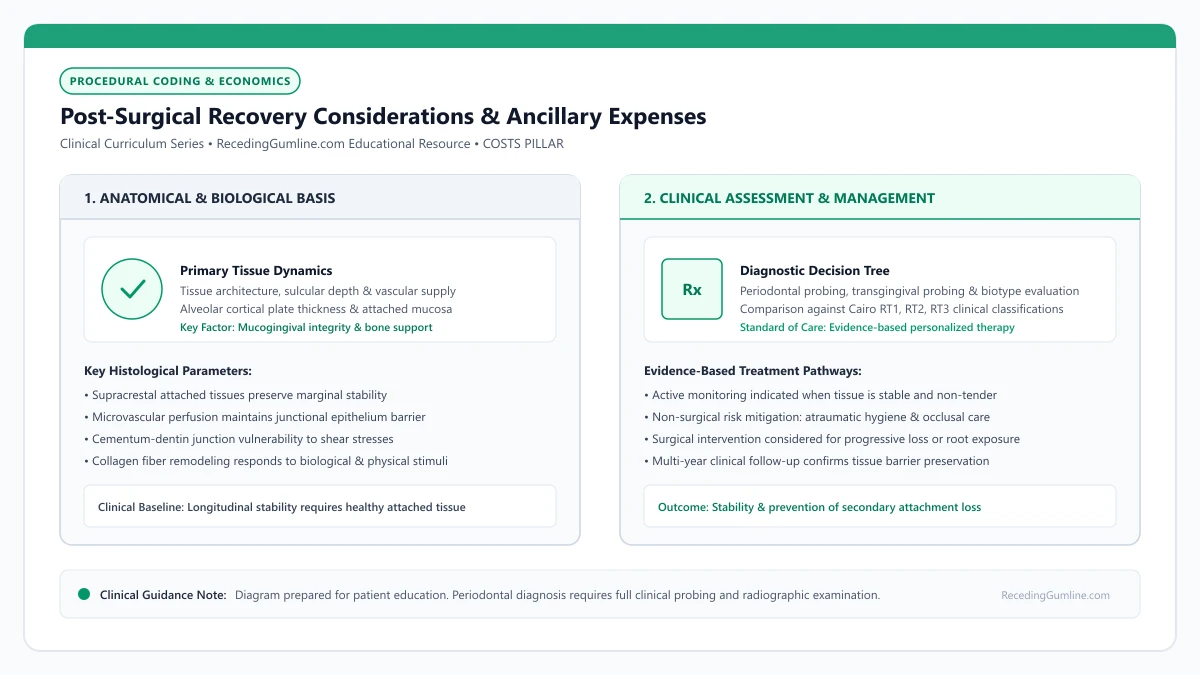
Educational illustration: Post-Surgical Recovery Considerations & Ancillary Expenses. Clinical management requires comprehensive periodontal evaluation rather than isolated self-assessment.
Source: RecedingGumline.com Clinical Editorial Team (Proprietary educational diagram for RecedingGumline.com)
The Palatal Protective Stent: Comfort & Wound Shielding
For patients undergoing autogenous connective tissue grafting (CTG) or free gingival grafting (FGG), the palatal donor site is frequently the primary source of postoperative discomfort. The palatal wound resembles a severe thermal burn on the roof of the mouth, with exposed sensory nerve endings that are easily irritated by the tongue and food boluses.
To minimize this discomfort, periodontists fabricate a custom Palatal Protective Stent (often called a surgical splint or retainer). Before surgery, an intraoral digital scan or alginate impression is taken, and a clear, rigid thermoplastic stent is thermo-formed over the maxillary arch, terminating just short of the palatal gingival margins.
Worn continuously during meals and sleep for the first 5 to 7 days, the stent creates a rigid physical barrier that shields the healing palatal wound from tongue contact and food abrasion. While custom stents typically incur an ancillary fee of 150 dollars to 250, dollars patients universally report that the stent transforms an otherwise painful recovery into a manageable healing experience.
Key Cost Insights
- The palatal donor wound resembles a burn and is sensitive to tongue contact and food pressure.
- A custom thermoplastic palatal stent shields exposed donor nerves, dramatically reducing pain.
- Wearing the stent during eating and sleeping is essential for the first 5 to 7 days post-surgery.
Prescription Pharmaceuticals & Specialized Antimicrobial Rinses
Because mechanical toothbrushing and flossing are strictly prohibited on the surgical recipient site for 2 to 3 weeks post-surgery, patients rely on chemical plaque biofilm control to maintain a sterile healing environment. The established clinical benchmark prescribed agent is 0.12% Chlorhexidine Digluconate (such as Peridex or Periogard).
Chlorhexidine possesses unique substantivity—it binds to oral soft tissues and tooth surfaces, slowly releasing over 12 hours to kill bacterial pathogens and prevent plaque accumulation on the newly sutured graft. A 16-ounce bottle typically costs 15 dollars to 30 dollars out-of-pocket.
In addition, surgical recovery requires pain management and infection prophylaxis. Prescriptions typically include a combination of non-steroidal anti-inflammatory drugs (ibuprofen 600-800 mg) and acetaminophen, occasionally supplemented with a short course of mild opioids for breakthrough pain, and oral antibiotics (such as amoxicillin or clindamycin) to prevent wound infection, adding 30 dollars to 60 dollars in pharmacy expenses.
Key Cost Insights
- Mechanical brushing is forbidden on the graft; chlorhexidine 0.12% provides essential chemical plaque control.
- Chlorhexidine exhibits high substantivity, releasing continuously for 12 hours to suppress bacteria.
- Prescription pain medications and prophylactic antibiotics add 30 dollars to 60 dollars in out-of-pocket pharmacy costs.
Nutritional Adaptations & The Soft-Food Diet
Maintaining adequate systemic nutrition while protecting delicate surgical sutures requires transitioning to a strict soft-food diet for 10 to 14 days post-operatively. Masticatory pressure from hard, crunchy, sharp, or chewy foods (such as chips, nuts, crusty bread, and raw vegetables) can dislodge the graft or tear micro-sutures.
Patients should budget for specialized soft, nutrient-dense groceries: protein shakes, Greek yogurt, pureed soups, scrambled eggs, avocados, smoothies (consumed with a spoon, never through a straw), and applesauce. Using a drinking straw is strictly prohibited because the negative intraoral suction can rupture fragile capillary buds and dislodge blood clots.
Investing in high-protein, vitamin C-rich foods accelerates fibroblast collagen synthesis and microvascular endothelial proliferation, supporting rapid graft revascularization and reducing total recovery time.
Key Cost Insights
- A strict soft-food diet must be maintained for 10 to 14 days to prevent graft dislodgement.
- Hard, crunchy, or chewy foods can tear delicate micro-sutures and cause graft failure.
- Drinking through straws is strictly forbidden; negative suction can rupture newly formed capillary buds.
Indirect Costs: Time Away from Work & Physical Restrictions
Beyond direct pharmacy and grocery expenses, patients must account for indirect costs associated with time away from professional work and daily routines. While gum graft surgery is performed as an outpatient procedure under local or conscious sedation, the body requires physical rest to establish stable blood clotting.
Most patients require 1 to 3 days off from work following surgery, particularly if their profession involves continuous public speaking, physical exertion, or heavy lifting. Strenuous cardiovascular exercise, weightlifting, and bending over increase cranial blood pressure, which can provoke secondary hemorrhage from the palatal donor site or graft recipient bed.
Patients working in desk-based or remote roles can frequently resume light computer work within 24 to 48 hours, while those in physically demanding jobs should budget for up to 5 days of modified duty to protect their surgical investment.
Key Cost Insights
- Budget for 1 to 3 days of time off from work to allow primary blood clot stabilization.
- Strenuous physical exertion and heavy lifting must be avoided for 7 to 10 days to prevent bleeding.
- Speaking-intensive professions require voice rest during the first several days to protect anterior sutures.
Clinical Reality Check
Cutting corners during the recovery phase to save time or money is the most common cause of graft failure. Chewing hard food too early or brushing the graft prematurely destroys the delicate capillary network, resulting in complete graft loss and requiring a costly revision surgery.
Questions to Ask Your Dentist or Periodontist
- Will you be providing a custom palatal stent to protect my donor site during eating?
- How many days off work should I request based on the specific number of teeth being grafted?
- What prescription pain medications and mouthwashes will I receive, and when should I fill them?
- How long must I wait before resuming cardiovascular exercise and weightlifting after surgery?
- What emergency contact protocols do you have in place if I experience postoperative bleeding at home?
Unsure What Your Gum Changes Mean?
Take our free, evidence-based Gum Recession Assessment — approximately 3 minutes. Identify potential risk factors, evaluate symptoms, and receive personalized discussion questions for your dentist or periodontist.
Non-diagnostic educational triage. Private, secure, completed in your browser.
Related Educational Topics
Scientific Literature & Clinical Guidelines
4sources · Hide ▲
- Chambrone L, Salinas Ortega MA, Sukekava F, Rotundo R, Kalemaj Z, Buti J, Pini Prato GP (2018).
"Root coverage procedures for treating localised and multiple recession-type defects." Cochrane Database of Systematic Reviews.
Clinical relevance: Cochrane systematic review evaluating root-coverage procedures for localized and multiple recession-type defects. While subepithelial connective tissue grafts (SCTG) combined with coronally advanced flaps demonstrated higher rates of complete root coverage and keratinized tissue gain compared to flap advancement alone, evidence quality varied across outcomes and clinical decisions must balance donor site morbidity and patient-reported outcomes.
- Cairo F, Nieri M, Cincinelli S, Mervelt J, Pagliaro U (2011).
"The interproximal clinical attachment level to classify gingival recessions and predict root coverage outcomes: an explorative and reliability study." Journal of Clinical Periodontology.
Clinical relevance: Exploratory and reliability study establishing the Cairo classification based on interdental clinical attachment level (CAL): RT1 (no interproximal attachment loss; complete root coverage is clinically predictable), RT2 (interproximal attachment loss <= buccal loss; partial coverage predictable), and RT3 (interproximal loss exceeds buccal recession; complete coverage not predictable).
- Slot DE, Wiggelinkhuizen L, Rosema NA, Van der Weijden GA (2012).
"The efficacy of manual toothbrushes following a brushing exercise: a systematic review." International Journal of Dental Hygiene.
Clinical relevance: Systematic review evaluating plaque removal efficacy of manual toothbrushes following a single brushing exercise; observed that bristle design variations produce modest differences in plaque scores, while aggressive force or stiff bristles do not improve plaque removal and clinical evidence linking mechanical brushing technique directly to gingival recession remains contradictory.
- Zucchelli G, Mounssif I (2015).
"Periodontal plastic surgery." Periodontology 2000.
Clinical relevance: Peer-reviewed review of periodontal plastic surgery modalities, detailing flap design, coronally advanced flaps, autogenous connective tissue grafting, tunneling techniques, and anatomical factors governing aesthetic and functional root coverage.
Important Medical Notice
The contents of RecedingGumline.com, including text, graphics, self-assessment calculators, and other materials, are intended solely for educational and informational purposes. This content is not intended to replace professional dental examination, diagnosis, or treatment. Always seek the advice of a qualified dentist, periodontist, or other licensed oral healthcare provider with any questions you may have regarding a medical or dental condition. Never disregard professional medical advice or delay seeking it because of something you read on this website.