Dental Insurance Frequency Limitations on Deep Cleanings and Gum Grafts
How often will dental insurance pay for deep cleanings, maintenance visits, and gum grafts?
One of the most frustrating reasons for insurance claim denials in periodontics is the "frequency limitation." Even when your periodontist proves that you urgently need a deep cleaning or a gum graft, your insurance company may refuse payment simply because not enough months or years have passed since you last had a similar procedure. Understanding these contractual time locks prevents costly surprises.
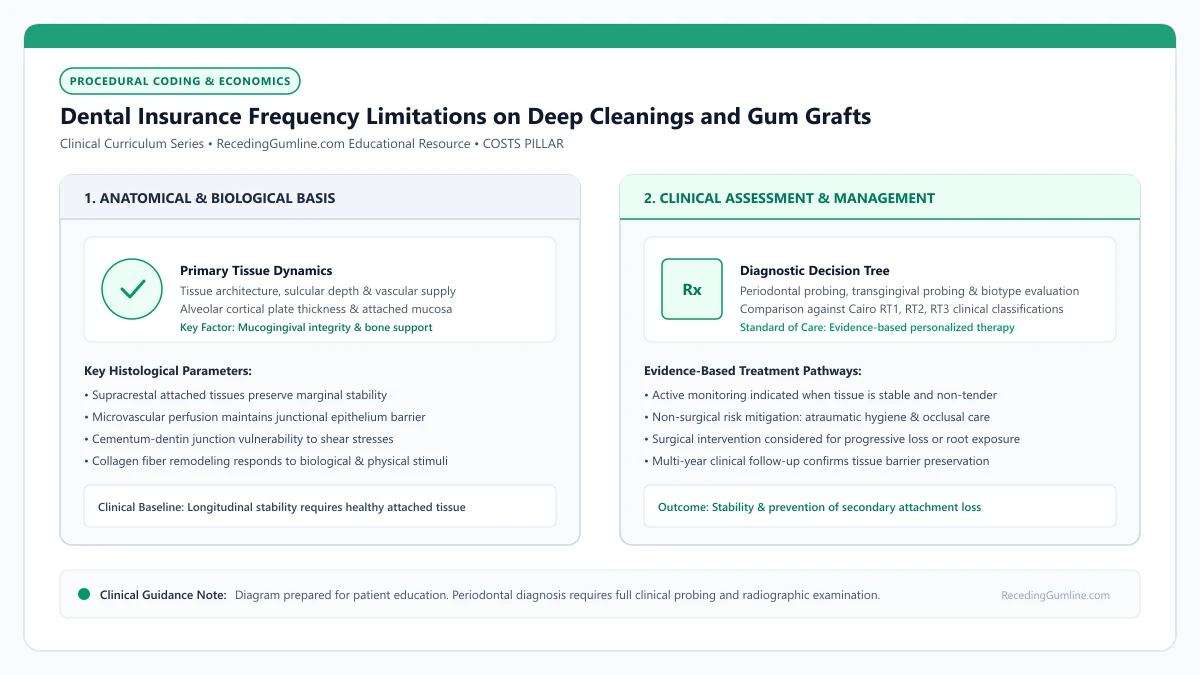
Educational illustration: Dental Insurance Frequency Limitations on Deep Cleanings and Gum Grafts. Clinical management requires comprehensive periodontal evaluation rather than isolated self-assessment.
Source: RecedingGumline.com Clinical Editorial Team (Proprietary educational diagram for RecedingGumline.com)
Key Clinical Distinctions & Diagnostic Boundaries
- Frequency limitations are contractual rules between your employer and the insurer; they do NOT reflect biological or medical guidelines.
- Periodontal bacteria repopulate pockets every 90 days; insurance frequency limits often restrict cleanings to every 180 days.
- Paying out-of-pocket for non-covered quarterly maintenance visits is essential to prevent disease recurrence.
- Prior history of scaling at a different general dental office follows you and can trigger a denial at your new periodontist.
Deep Cleaning Limits: The 24- to 36-Month Lockout
Under most dental insurance policies, scaling and root planing (CDT D4341 or D4342) is restricted by a strict frequency clause: covered only once per quadrant every 24 to 36 months (and in some restrictive policies, once every 5 years).
If you had deep cleaning performed 18 months ago, but active periodontitis has flared up again with 6 mm bleeding pockets, your periodontist cannot bill insurance for a new deep cleaning. The insurer will automatically deny the claim based on the calendar restriction, leaving you responsible for the full fee.
Dental benefit plans impose rigid frequency limitations on periodontal procedures, such as covering scaling and root planing (D4341) only once every 24 to 36 months per quadrant. Soft-tissue grafting procedures often face strict limits permitting coverage only once every 3 to 5 years per tooth site.
Clinical Considerations:
- Scaling and root planing is typically covered only once every 24 to 36 months per quadrant
- Applies strictly to the calendar date of previous treatment, even if performed by a different dentist
- Disease flare-ups within the lockout window must be managed out-of-pocket or via maintenance
The Maintenance Conflict: 2 Visits vs. 4 Needed per Year
The most widespread frequency conflict in periodontics involves periodontal maintenance (CDT D4910). Peer-reviewed medical science proves that bacteria repopulate pockets every 90 days, requiring 4 maintenance visits per year to prevent bone loss.
However, many low-cost dental plans have a contractual clause stating: "Periodontal maintenance limited to two visits in any 12-month period, combined with routine prophylaxis." Under this rule, insurance pays for visits 1 and 3, while you must pay 100% out-of-pocket for visits 2 and 4.
Periodontal maintenance visits (CDT code D4910) are frequently capped at two visits per calendar year under standard employer policies, despite clinical guidelines mandating three-month intervals. When patients attend the clinically necessary third and fourth annual maintenance visits, insurers often deny coverage or reclassify visits as routine cleanings.
Clinical Considerations:
- Science dictates 4 maintenance cleanings per year; many plans pay for only 2
- Insurers frequently combine prophylaxis and maintenance into a shared 2-visit cap
- Paying out-of-pocket for the alternating 2 visits is vital to prevent tooth loss
Gum Grafting Limitations: Lifetime and Multi-Year Restrictions
Soft-tissue grafting procedures (CDT D4273 and D4275) also face stringent frequency caps. Many dental policies enforce a "once per tooth per lifetime" rule. If a tooth received a gum graft five years ago and now exhibits recurrent recession, insurance will reject any subsequent graft on that specific tooth.
Other policies enforce a 36- to 60-month waiting period before a graft can be repeated on the same tooth. If surgery is required before the lockout window expires, patients must rely on HSA/FSA funds, medical savings plans, or practice payment arrangements.
To navigate frequency restrictions, dental billing coordinators can submit letters of medical necessity documenting active bleeding on probing and refractory pocketing. When insurance refuses additional maintenance coverage, paying out of pocket for the extra visits protects the thousands of dollars invested in initial periodontal stabilization.
Clinical Considerations:
- Many policies enforce a "once per tooth per lifetime" restriction on gum grafts
- Other plans impose a 36- to 60-month waiting period between repeat grafting procedures
- Prior claims submitted under the same tooth number trigger automated rejection
Site-Specific Exclusions: The 24-to-36 Month Re-Grafting Frequency Clause
Dental insurance contracts contain strict frequency limitations that restrict how often specific procedure codes can be billed on the same anatomical tooth site. For soft-tissue grafting (CDT codes D4273, D4275, D4276), policies commonly enforce a 24- to 36-month frequency limitation.
If a patient develops recurrent recession on a previously grafted tooth within two to three years of the initial surgery, the insurance carrier will automatically deny reimbursement for a revision graft, categorizing it as an excluded repeat service.
Similarly, Scaling and Root Planing (D4341/D4342) enforces strict 24-month limitations per quadrant. Billing SRP on the same quadrant sooner than 24 months triggers immediate claim rejection unless documented by severe refractory disease.
Clinical Considerations:
- Insurance policies enforce 24- to 36-month frequency limitations on soft-tissue grafting per tooth site.
- Revision surgery within the exclusion window is automatically denied regardless of medical need.
- Scaling and root planing enforces strict 24-month quadrant frequency restrictions.
Overcoming Frequency Denials: Documenting Secondary Disease & Refractory Progression
When clinical necessity requires performing surgery or deep cleaning within an active frequency limitation window, the periodontist can submit an evidence-based appeal with formal narrative justification.
To successfully overturn a frequency denial, the provider must demonstrate that the current procedure addresses a new, separate clinical condition rather than a failure of previous treatment. For example, if recession developed on an adjacent root surface or if systemic changes (uncontrolled diabetes, new medications) precipitated rapid secondary breakdown, this must be documented.
Submitting calibrated before-and-after periodontal charts, intraoral photographs, and a narrative from the treating specialist can prompt an insurance medical review director to grant a frequency exception.
Clinical Considerations:
- Appealing frequency denials requires proving new or refractory periodontal pathology.
- Distinguishing between initial procedural failure and new secondary disease is crucial.
- Comparative periodontal probing charts and clinical photographs support successful appeals.
Clinical Reality Check
Do not skip your 3-month periodontal maintenance cleaning just because insurance only pays for two per year; skipping those visits allows bone loss to resume, leading to thousands in future surgeries.
Questions to Ask Your Periodontist or Dentist
- What are the exact frequency limitations on deep cleanings (D4341) and maintenance (D4910) under my plan?
- Does my plan cover 2 or 4 periodontal maintenance cleanings per calendar year?
- If insurance denies my 3-month cleaning, what is your out-of-pocket cash fee for that maintenance visit?
- Has this specific receded tooth ever had a previous gum graft billed to my insurance policy?
Unsure What Your Gum Changes Mean?
Take our free, evidence-based Gum Recession Assessment — approximately 3 minutes. Identify potential risk factors, evaluate symptoms, and receive personalized discussion questions for your dentist or periodontist.
Non-diagnostic educational triage. Private, secure, completed in your browser.
Related Educational Topics
Clinical Evidence & Claim Traceability (2 Mapped Assertions)
Scientific Literature & Clinical Guidelines
2sources · Hide ▲
- American Dental Association (2026).
"Code on Dental Procedures and Nomenclature (CDT)." American Dental Association.Coding Standard Official Publication
Clinical relevance: Standardized dental procedure nomenclature maintained and updated annually by the American Dental Association (ADA, currently referencing CDT 2026/2027) for administrative classification and billing (including codes D4273, D4275, D4277, D4341, D4910). The site references CDT procedure numbers for high-level educational and administrative context and does not reproduce proprietary CDT descriptors or substantial CDT text. Commercial use/licensing requirements should be reviewed separately with the ADA or qualified counsel. Procedure codes facilitate administrative reporting and do not dictate clinical necessity or insurance benefit coverage.
- Ramfjord SP, Caffesse RG, Morrison EC, Burgett FG, Nissle RR, Shick RA (1987).
"4 modalities of periodontal treatment compared over 5 years." Journal of Clinical Periodontology.
Clinical relevance: Longitudinal clinical trial comparing four periodontal treatment modalities over 5 years; established that rigorous professional maintenance at 3-month intervals successfully maintains clinical attachment levels and prevents further periodontal tissue breakdown regardless of the initial surgical or non-surgical modality used.
Important Medical Notice
The contents of RecedingGumline.com, including text, graphics, self-assessment calculators, and other materials, are intended solely for educational and informational purposes. This content is not intended to replace professional dental examination, diagnosis, or treatment. Always seek the advice of a qualified dentist, periodontist, or other licensed oral healthcare provider with any questions you may have regarding a medical or dental condition. Never disregard professional medical advice or delay seeking it because of something you read on this website.