Periodontal Maintenance Frequency: Clinical Rationale for 3- to 4-Month Recalls
Why is a 3- to 4-month recall frequency biologically necessary after periodontal treatment?
Following active treatment for receding gums—whether scaling and root planing or surgical grafting—patients are universally placed on a 3- to 4-month periodontal maintenance schedule. This strict recall interval is not an arbitrary dental scheduling habit; it is grounded in landmark microbiological and clinical trials tracking the exact repopulation timeline of pathogenic subgingival biofilms.
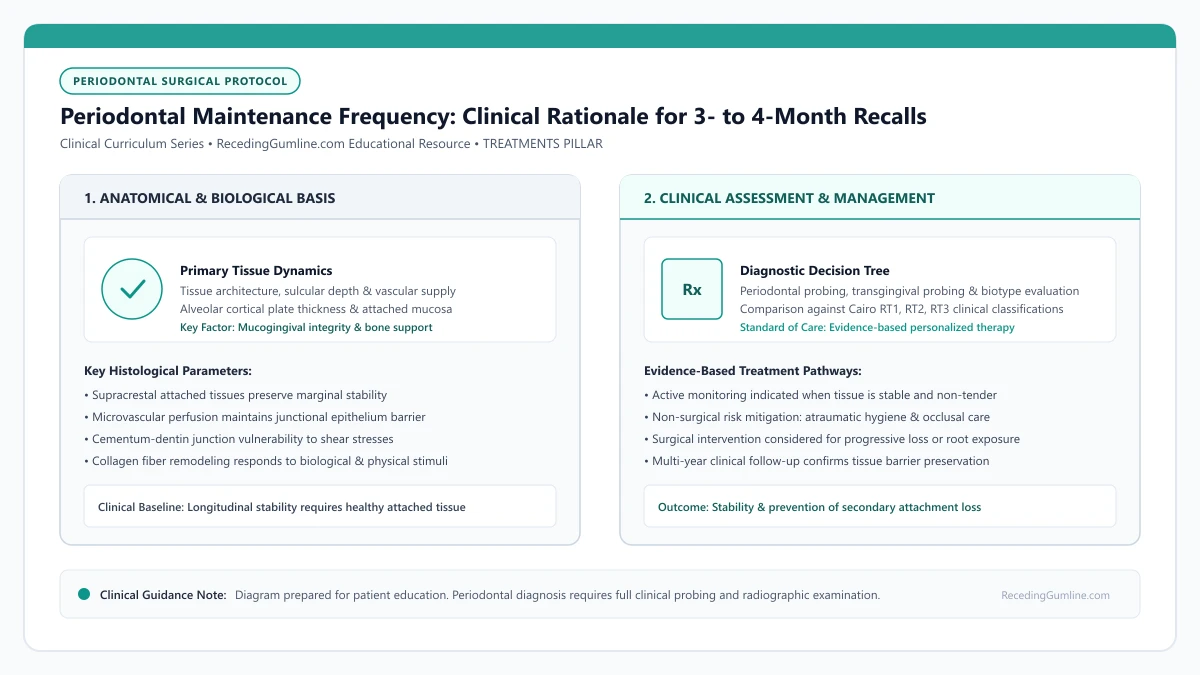
Educational illustration: Periodontal Maintenance Frequency: Clinical Rationale for 3- to 4-Month Recalls. Clinical management requires comprehensive periodontal evaluation rather than isolated self-assessment.
Source: RecedingGumline.com Clinical Editorial Team (Proprietary educational diagram for RecedingGumline.com)
Key Clinical Distinctions & Diagnostic Boundaries
- A 6-month cleaning interval is calibrated for patients who have never lost periodontal bone or attachment.
- Once periodontal pockets exist, subgingival bacteria can flourish at depths where floss and toothbrushes cannot reach (> 3 mm).
- Missing maintenance visits is the single most common cause of recurrent attachment loss and failed surgical grafts.
- Dental insurance policies that only cover two cleanings per year do not dictate medical necessity; biology dictates recall frequency.
The Bacterial Succession Timeline: Why Biofilms Recover at 90 Days
When a skilled clinician performs scaling and root planing, subgingival bacterial loads are reduced by over 99%. However, bacteria are microscopic organisms inhabiting deep dentinal tubules and tissue micro-crevices, meaning the subgingival pocket is never completely sterilized.
In the weeks following debridement, beneficial pioneer streptococcal species colonize the pocket first. However, between 9 and 12 weeks, virulent anaerobic pathogens—including Porphyromonas gingivalis, Treponema denticola, and Tannerella forsythia—regain predominance. Disrupting this pathogenic shift at the 12-week mark stops tissue destruction before attachment loss resumes.
Clinical microbiology demonstrates that pathogenic anaerobic bacterial complexes recolonize subgingival periodontal pockets within 9 to 12 weeks following thorough mechanical debridement. A 3-month recall interval disrupts this repopulation cycle before mature pathogenic biofilms can trigger bone destruction.
Clinical Considerations:
- Scaling reduces subgingival bacteria dramatically but cannot sterilize pockets
- Beneficial pioneer bacteria are gradually replaced by virulent anaerobes over 9 to 12 weeks
- Quarterly professional debridement resets the biofilm clock before bone destruction triggers
Clinical Proof: The Landmark Michigan and Scandinavian Studies
The clinical necessity of the 3-month recall was proven in historic longitudinal studies led by Dr. Sigurd Ramfjord at the University of Michigan and researchers in Gothenburg, Sweden. Across 10- to 15-year trials, patients who received thorough periodontal maintenance every 3 months maintained their bone levels and suffered almost zero tooth loss.
Conversely, patients who received excellent initial treatment but were returned to unmonitored standard 6-month cleanings experienced recurrent pocket deepening, accelerated bone resorption, and high rates of tooth extraction. The maintenance schedule, not the initial surgery alone, proved to be the ultimate protector of teeth.
During maintenance visits, selective subgingival scaling is performed at persistent deep sites alongside targeted topical antimicrobial irrigation. Evaluating bleeding on probing and gingival margin stability at each recall allows rapid intervention before systemic attachment loss advances.
Clinical Considerations:
- Patients on 3-month recalls maintained bone levels over 15+ years of tracking
- Patients returning to 6-month intervals suffered recurrent pocketing and tooth loss
- Supportive maintenance is the critical determinant of long-term tooth preservation
What Happens During a Periodontal Maintenance Visit (D4910)
A periodontal maintenance appointment is vastly more comprehensive than a standard polish. The clinician performs full-mouth probing to compare millimeter numbers against previous visits, detecting any localized disease reactivation immediately.
They provide localized subgingival debridement with ultrasonic tips and fine curettes in all sites exhibiting 4 mm depths or bleeding, evaluate tooth mobility, review home hygiene effectiveness, and apply topical fluoride or desensitizing agents to exposed root surfaces.
Patients diagnosed with generalized severe periodontitis or medical comorbidities like diabetes may require 8-week maintenance intervals during active stabilization phases. Maintaining strict adherence to prescribed recall schedules is the single most reliable predictor of long-term tooth retention.
Clinical Considerations:
- Comprehensive probing comparison against baseline records at every visit
- Targeted subgingival instrumentation in residual or recurrent pockets
- Application of remineralizing varnishes to protect receded root surfaces from decay
Microbial Kinetics: The 90-Day Subgingival Biofilm Recolonization Cycle
The scientific justification for scheduling periodontal maintenance at 3-month (90-day) intervals is rooted in bacterial recolonization microbiology. Following thorough professional subgingival debridement, pathogenic subgingival microflora are drastically suppressed, replaced by benign, aerobic gram-positive cocci.
However, in patients with a history of periodontitis, red-complex pathogens (including Porphyromonas gingivalis, Treponema denticola, and Tannerella forsythia) gradually re-emerge and repopulate deep periodontal pockets over a 9 to 12-week period.
If undisturbed beyond 90 days, these pathogens reach critical virulent densities capable of re-initiating inflammatory attachment loss and bone destruction. A 3-month maintenance interval physically disrupts the biofilm before it can re-establish its pathogenic potential.
Clinical Considerations:
- Subgingival debridement resets the pocket microbiome to a healthy, non-pathogenic state.
- Red-complex pathogens recolonize deep pockets and regain virulence within 9 to 12 weeks.
- A 3-month recall interval disrupts maturing biofilms before tissue destruction can restart.
Risk-Stratified Recall Scheduling: Modifying Maintenance Frequency
While a 3-month interval is the standard clinical baseline for treated periodontal patients, maintenance schedules must be customized according to individual patient risk profiles. Clinicians utilize the Periodontal Risk Assessment (PRA) tool to stratify patients into low-, moderate-, or high-risk categories.
High-risk patients—such as active smokers, individuals with poorly controlled diabetes (HbA1c > 7.5%), or those with persistent bleeding on probing in > 16% of sites—frequently require more frequent 2-month maintenance intervals to prevent disease recurrence.
Conversely, patients who demonstrate exemplary home plaque control, zero bleeding sites, and stable attachment levels over two consecutive years may be evaluated for lengthening the recall interval to 4 or 6 months.
Clinical Considerations:
- Maintenance intervals are customized using standardized Periodontal Risk Assessment metrics.
- High-risk patients (smokers, diabetics, high bleeding scores) benefit from 2-month recall visits.
- Stable patients with exemplary hygiene may transition to 4-month maintenance after 2 years.
Clinical Reality Check
If your dental insurance only pays for cleanings every 6 months, paying out-of-pocket for the alternating visits is the single most cost-effective investment in preventing tooth loss and expensive gum surgeries.
Questions to Ask Your Periodontist or Dentist
- What specific pocket depths or bleeding scores determine my current 3- or 4-month recall interval?
- If my pockets stabilize at 2 to 3 millimeters, will I ever be able to transition back to 6-month recalls?
- How does your team document my measurements from visit to visit to track longitudinal stability?
- What home hygiene tools (interdental brushes, water flossers) will best support my maintenance visits?
Unsure What Your Gum Changes Mean?
Take our free, evidence-based Gum Recession Assessment — approximately 3 minutes. Identify potential risk factors, evaluate symptoms, and receive personalized discussion questions for your dentist or periodontist.
Non-diagnostic educational triage. Private, secure, completed in your browser.
Related Educational Topics
Clinical Evidence & Claim Traceability (3 Mapped Assertions)
Scientific Literature & Clinical Guidelines
3sources · Hide ▲
- Ramfjord SP, Caffesse RG, Morrison EC, Burgett FG, Nissle RR, Shick RA (1987).
"4 modalities of periodontal treatment compared over 5 years." Journal of Clinical Periodontology.
Clinical relevance: Longitudinal clinical trial comparing four periodontal treatment modalities over 5 years; established that rigorous professional maintenance at 3-month intervals successfully maintains clinical attachment levels and prevents further periodontal tissue breakdown regardless of the initial surgical or non-surgical modality used.
- Sanz M, Herrera D, Kebschull M, Chapple ILC, Jepsen S, Beglundh T, et al. (2020).
"Treatment of stage I-III periodontitis—The EFP S3 level clinical practice guideline." Journal of Clinical Periodontology.
Clinical relevance: Evidence-based clinical practice guideline establishing the 4-step therapeutic pathway for periodontal management: Step 1 (behavioral and supragingival hygiene), Step 2 (subgingival instrumentation), Step 3 (surgical therapy where indicated), and Step 4 (supportive periodontal care at 3- to 4-month intervals).
- Pihlstrom BL, Michalowicz BS, Johnson NW (2005).
"Periodontal diseases." The Lancet.
Clinical relevance: Peer-reviewed Lancet seminar review synthesizing global periodontal epidemiology, microbial etiology, host immunopathology, and systemic interactions, emphasizing prevention, biofilm disruption, and early risk factor modification.
Important Medical Notice
The contents of RecedingGumline.com, including text, graphics, self-assessment calculators, and other materials, are intended solely for educational and informational purposes. This content is not intended to replace professional dental examination, diagnosis, or treatment. Always seek the advice of a qualified dentist, periodontist, or other licensed oral healthcare provider with any questions you may have regarding a medical or dental condition. Never disregard professional medical advice or delay seeking it because of something you read on this website.