Clinical Attachment Level (CAL) vs. Probing Depth: True Measurement of Periodontal Stability
What is Clinical Attachment Level (CAL), and how is it calculated from pocket depths and recession?
In dental examinations, patients frequently hear their hygienist call out numbers like "2, 2, 3" or "4, 5, 4." During a formal receding gumline assessment, while numbers represent probing pocket depths, probing depth alone can be dangerously deceptive. A tooth can have an apparently "healthy" 2 mm pocket while suffering from severe, advanced recession. Understanding Clinical Attachment Level (CAL)—the established benchmark clinical metric in periodontics—reveals the true measurement of tooth stability.
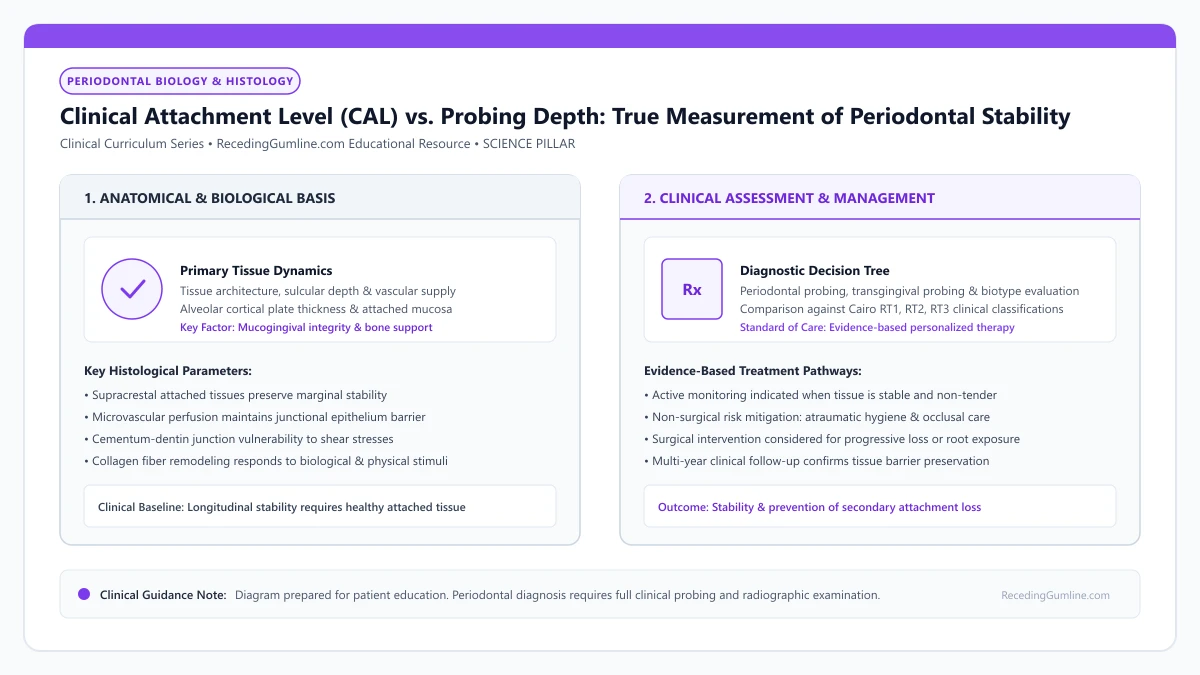
Educational illustration: Clinical Attachment Level (CAL) vs. Probing Depth: True Measurement of Periodontal Stability. Clinical management requires comprehensive periodontal evaluation rather than isolated self-assessment.
Source: RecedingGumline.com Clinical Editorial Team (Proprietary educational diagram for RecedingGumline.com)
Key Clinical Distinctions & Diagnostic Boundaries
- Probing depth fluctuates when gums swell (pseudopockets) or shrink; CAL provides an unshifting, longitudinal baseline.
- The cementoenamel junction (CEJ) is a permanent, stationary anatomical landmark on the tooth.
- If the gum margin is swollen above the CEJ (gingival hyperplasia), recession is recorded as a negative number when calculating CAL.
- Tracking CAL increases over 6 to 12 months is the only validated clinical proof of active, ongoing periodontal disease progression.
The Diagnostic Trap: Why Probing Depth Alone Is Deceptive
When a clinician slides a probe into the gingival sulcus, the measurement recorded is probing pocket depth (PPD). This is the distance from the crest of the gingival margin down to the bottom of the pocket.
However, the gingival margin is a moving, variable boundary. If a patient has severe gingival recession—say, 4 millimeters of exposed root—the tissue margin has moved far down the tooth. If the probe measures a shallow 2 mm pocket from this receded margin, an uneducated patient might assume their gums are in pristine health, completely missing the fact that 6 millimeters of biological support has been destroyed.
Clinical Attachment Level (CAL) represents the true biological distance from a fixed anatomical landmark—the cementoenamel junction (CEJ)—to the bottom of the periodontal pocket. Unlike probing pocket depth, which fluctuates with gingival swelling or recession, CAL provides an immutable baseline for longitudinal tracking.
Clinical Considerations:
- Probing depth uses the moving gingival margin as its reference point
- A shallow pocket (2 mm) does not mean a tooth is healthy if the gum has receded 4 mm
- Relies on a variable boundary that changes with inflammation, swelling, or recession
The CAL Formula: Anchoring to the Cementoenamel Junction
To overcome this flaw, periodontists calculate Clinical Attachment Level (CAL). CAL uses an unchanging, permanent anatomical landmark: the Cementoenamel Junction (CEJ)—the exact microscopic line where the white enamel crown meets the root cementum.
CAL measures the distance from the CEJ down to the bottom of the periodontal pocket. The clinical formula is straightforward: CAL = Probing Depth + Recession. If a tooth has a 3 mm probing depth and 3 mm of marginal recession, the Clinical Attachment Loss is 6 millimeters.
In a patient with gingival overgrowth, a 5 mm probing depth might exist with zero attachment loss because the tissue margin has moved coronally above the CEJ. Conversely, a tooth with severe 4 mm recession and a shallow 2 mm pocket has suffered 6 mm of irreversible clinical attachment loss.
Clinical Considerations:
- CEJ serves as the permanent, unshifting anatomical landmark on the tooth
- Formula: Clinical Attachment Loss (CAL) = Probing Pocket Depth + Recession Distance
- Reflects the true total millimeter loss of periodontal ligament fibers and bone support
Staging Disease: How CAL Determines Treatment Urgency
Under the 2018 AAP/EFP global staging framework, CAL is the definitive metric that stages periodontal disease. Stage I (mild) involves 1 to 2 mm of CAL; Stage II (moderate) involves 3 to 4 mm of CAL; and Stage III or IV (severe) involves 5 mm or more of CAL.
Tracking CAL across successive recall appointments allows your dental team to calculate your disease progression rate. If your CAL increases by 1 to 2 mm over 12 months, your disease is classified as rapidly progressing (Grade C), signaling an immediate need for aggressive periodontal therapy.
The AAP/EFP staging framework relies strictly on interdental clinical attachment loss to classify periodontitis severity from Stage I through Stage IV. Monitoring CAL over sequential six-month recall appointments allows dental clinicians to definitively verify disease arrest or active progression.
Clinical Considerations:
- Stage I: 1–2 mm CAL; Stage II: 3–4 mm CAL; Stage III/IV: ≥ 5 mm CAL
- Sequential increases in CAL ≥ 2 mm prove active, ongoing periodontal disease progression
- Dictates whether conservative monitoring, deep cleaning, or surgical grafting is required
The Diagnostic established clinical benchmark: CAL vs. Pocket Probing Depth
In periodontics, pocket probing depth (PPD) alone is an unreliable measure of true cumulative tissue destruction. Probing depth measures only the distance from the free gingival margin to the base of the sulcus; because the gingival margin can move coronally (due to inflammatory swelling) or apically (due to recession), PPD fluctuates independently of true bone support.
Clinical Attachment Level (CAL) is the definitive biological standard because it measures the distance from a fixed, permanent anatomical landmark—the cementoenamel junction (CEJ)—to the base of the sulcular pocket. CAL is mathematically calculated as: CAL = Probing Depth + Recession Depth.
For example, a tooth with a shallow 2 mm probing depth but 4 mm of exposed root recession has 6 mm of clinical attachment loss. Recognizing this true attachment loss ensures that severe recession is never misdiagnosed as healthy based on shallow pocket depths alone.
Clinical Considerations:
- Pocket probing depth fluctuates with tissue swelling and recession, making it an incomplete metric.
- Clinical Attachment Level (CAL) measures true biological loss from the fixed cementoenamel junction.
- CAL = Probing Depth + Recession Depth; shallow pockets can mask severe attachment loss.
Identifying the CEJ in Worn, Restored & Abfraction Sites
Accurately measuring CAL requires unambiguous identification of the cementoenamel junction. In virgin, unworn teeth, the CEJ is easily detected as a subtle horizontal step or textural transition where smooth enamel meets softer root cementum.
However, in patients with severe toothbrush abrasion, abfraction notches, or cervical restorations, the anatomical CEJ is frequently obliterated. In these complex scenarios, periodontists locate the reference baseline using adjacent anatomical landmarks.
Clinicians extrapolate the CEJ position by measuring the clinical crown length of contralateral homologous teeth, projecting the curvature of adjacent interproximal enamel margins, or referencing the restoration margin if pre-operative records document its biological placement.
Clinical Considerations:
- The CEJ provides the fixed reference point separating anatomical crown enamel from root cementum.
- Abfraction notches and cervical fillings often obliterate or mask the true anatomical CEJ.
- Clinicians use contralateral crown lengths and interdental curvature projections to identify baselines.
Clinical Reality Check
Always ask your dentist what your Clinical Attachment Loss is, not just your pocket depth; calculating CAL is the only way to know if your receding gums are truly stable or worsening.
Questions to Ask Your Periodontist or Dentist
- What is my maximum Clinical Attachment Loss (CAL) number when you factor in my gum recession?
- What periodontal disease stage (Stage I, II, III, or IV) does my CAL place me in?
- Has my CAL increased on any specific teeth compared to my previous checkup charts?
- Is my recession associated with deep pockets between my teeth or shallow, clean sulci?
Unsure What Your Gum Changes Mean?
Take our free, evidence-based Gum Recession Assessment — approximately 3 minutes. Identify potential risk factors, evaluate symptoms, and receive personalized discussion questions for your dentist or periodontist.
Non-diagnostic educational triage. Private, secure, completed in your browser.
Related Educational Topics
Clinical Evidence & Claim Traceability (2 Mapped Assertions)
Scientific Literature & Clinical Guidelines
3sources · Hide ▲
- Tonetti MS, Greenwell H, Kornman KS (2018).
"Staging and grading of periodontitis: Framework and proposal of a new classification and case definition." Journal of Clinical Periodontology.
Clinical relevance: Consensus framework establishing the multidimensional staging (severity and extent of periodontal tissue breakdown) and grading (biological rate of disease progression, incorporating smoking and diabetes as grade modifiers) for periodontitis. It addresses periodontitis diagnosis and staging, not the classification of localized gingival recession defects.
- Cairo F, Nieri M, Cincinelli S, Mervelt J, Pagliaro U (2011).
"The interproximal clinical attachment level to classify gingival recessions and predict root coverage outcomes: an explorative and reliability study." Journal of Clinical Periodontology.
Clinical relevance: Exploratory and reliability study establishing the Cairo classification based on interdental clinical attachment level (CAL): RT1 (no interproximal attachment loss; complete root coverage is clinically predictable), RT2 (interproximal attachment loss <= buccal loss; partial coverage predictable), and RT3 (interproximal loss exceeds buccal recession; complete coverage not predictable).
- Pihlstrom BL, Michalowicz BS, Johnson NW (2005).
"Periodontal diseases." The Lancet.
Clinical relevance: Peer-reviewed Lancet seminar review synthesizing global periodontal epidemiology, microbial etiology, host immunopathology, and systemic interactions, emphasizing prevention, biofilm disruption, and early risk factor modification.
Important Medical Notice
The contents of RecedingGumline.com, including text, graphics, self-assessment calculators, and other materials, are intended solely for educational and informational purposes. This content is not intended to replace professional dental examination, diagnosis, or treatment. Always seek the advice of a qualified dentist, periodontist, or other licensed oral healthcare provider with any questions you may have regarding a medical or dental condition. Never disregard professional medical advice or delay seeking it because of something you read on this website.