Receding Gums and Persistent Bad Breath: Subgingival Biofilm Reservoirs
Why do receding gums cause bad breath, and how can periodontal halitosis be eliminated?
Persistent bad breath (chronic halitosis) that does not resolve after brushing, flossing, or using commercial mouthwash is a frequent and distressing symptom in individuals with gum recession overview. When gum tissue detaches from tooth roots, it creates subgingival pockets that serve as oxygen-deprived biological incubators for virulent anaerobic bacteria that produce foul-smelling sulfur gases.
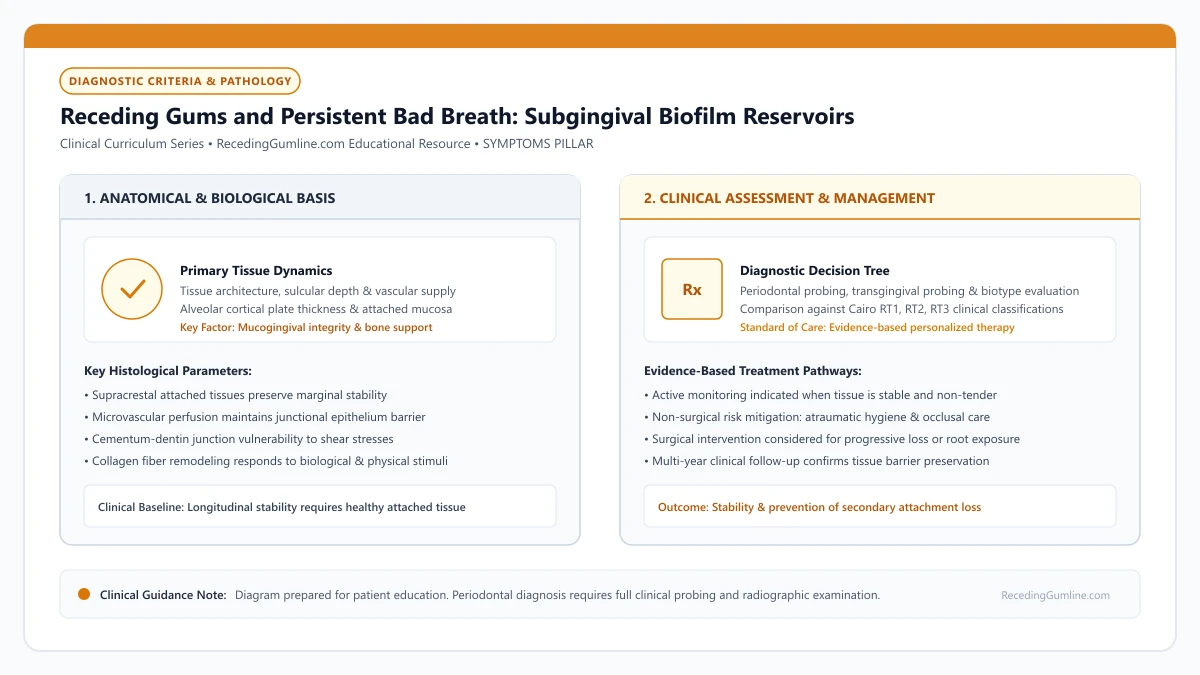
Educational illustration: Receding Gums and Persistent Bad Breath: Subgingival Biofilm Reservoirs. Clinical management requires comprehensive periodontal evaluation rather than isolated self-assessment.
Source: RecedingGumline.com Clinical Editorial Team (Proprietary educational diagram for RecedingGumline.com)
Key Clinical Distinctions & Diagnostic Boundaries
- Morning breath or dietary garlic odor is temporary and physiological; periodontal halitosis is persistent, pathological, and originates from subgingival bacteria.
- The foul taste often described as "metallic," "salty," or "sour" is caused by blood breakdown products and purulent exudate weeping from inflamed pockets.
- Recession caused purely by mechanical toothbrushing does NOT produce halitosis; halitosis indicates active microbial periodontitis.
- Tongue scraping removes dorsum bacteria but cannot reach pathogens thriving 5 mm beneath the gumline.
The Chemistry of Odor: Volatile Sulfur Compounds (VSCs)
The unpleasant odor associated with gum disease is not caused by rotting food particles; it is the metabolic waste product of specific anaerobic bacteria. Bacteria such as Porphyromonas gingivalis, Treponema denticola, and Fusobacterium nucleatum feed on proteins found in saliva, dead epithelial cells, and bleeding pocket fluid.
As these bacteria digest sulfur-containing amino acids (cysteine and methionine), they excrete Volatile Sulfur Compounds (VSCs). The two primary culprits are hydrogen sulfide (which smells like rotten eggs) and methyl mercaptan (which smells like decaying cabbage and feces).
Deep periodontal pockets and exposed root concavities associated with receding gums create stagnant anaerobic niches that trap food debris and biofilm. Colonizing anaerobic bacteria, such as Porphyromonas gingivalis, metabolize sulfur-containing amino acids into volatile sulfur compounds (VSCs).
Clinical Considerations:
- Anaerobic bacteria metabolize sulfur-rich proteins in blood and tissue exudate
- Hydrogen sulfide (rotten egg smell) and methyl mercaptan (decay smell) are excreted
- Methyl mercaptan is highly toxic and accelerates periodontal collagen breakdown
The Subgingival Incubator: Why Toothbrushes Cannot Reach the Odor
In healthy mouths, the gingival sulcus is shallow (1 to 3 mm) and well-oxygenated. However, when periodontal disease causes attachment loss and gum recession, deep pockets (4 to 8 mm) form between the root and the loose tissue collar.
These deep pockets become anaerobic chambers where atmospheric oxygen cannot penetrate. Toothbrush bristles and dental floss can only reach 2 to 3 mm subgingivally, leaving the bottom 5 millimeters of bacterial sludge completely undisturbed. This is why patients can brush five times a day and still have persistent halitosis.
These volatile sulfur compounds, including hydrogen sulfide and methyl mercaptan, produce distinct, persistent oral malodor that cannot be masked by mouthwashes. The presence of bleeding sulci provides bacterial pathogens with iron-rich hemoglobin, fueling accelerated anaerobic proliferation.
Clinical Considerations:
- Deep pockets (> 4 mm) create zero-oxygen environments where virulent anaerobes flourish
- Toothbrush bristles and floss penetrate only 2 to 3 mm beneath the gumline
- Deep bacterial reservoirs remain untouched by normal home brushing and mouthwash
Clinical Elimination: Subgingival Debridement and Pocket Reduction
Eliminating periodontal bad breath requires professional intervention. The dentist or periodontist performs scaling and root planing (deep cleaning) to mechanically flush out subgingival calculus, bacterial colonies, and endotoxins using ultrasonic cavitation tips.
Once the root surfaces are cleaned, the pocket tissues shrink and readapt to the tooth, collapsing the anaerobic incubator. Patients should support healing with tongue scrapers (as 50% of oral bacteria reside on the posterior tongue) and therapeutic antimicrobial rinses prescribed by their dental team.
Eradicating halitosis linked to gum recession requires thorough professional subgingival debridement to decontaminate root surfaces and pocket environments. Daily interdental cleaning using correctly sized interproximal brushes physically removes the bacterial colonies producing foul-smelling sulfur gases.
Clinical Considerations:
- Ultrasonic scaling mechanically dislodges subgingival bacterial colonies and toxins
- Collapsing deep pockets re-introduces oxygen, killing strict anaerobic pathogens
- Tongue scraping and interdental cleaning maintain low microbial counts long-term
Biochemical Pathophysiology: Volatile Sulfur Compounds (VSCs)
Chronic halitosis (bad breath) accompanying receding gums is predominantly driven by the metabolic byproducts of anaerobic gram-negative periodontal bacteria residing in deep subgingival pockets and exposed root niches. Pathogens such as Porphyromonas gingivalis, Treponema denticola, and Fusobacterium nucleatum thrive in oxygen-depleted subgingival environments.
These proteolytic microorganisms metabolize sulfur-containing amino acids (cysteine and methionine) derived from gingival crevicular fluid, blood, and desquamated epithelial cells. This enzymatic breakdown produces Volatile Sulfur Compounds (VSCs)—principally hydrogen sulfide (H2S), methyl mercaptan (CH3SH), and dimethyl sulfide.
Methyl mercaptan is exceptionally cytotoxic; in addition to producing a pungent malodor, it increases mucosal permeability and stimulates host collagenase activity, directly accelerating periodontal attachment loss and recession.
Clinical Considerations:
- Halitosis accompanying recession stems from subgingival anaerobic bacteria in deep pockets.
- Pathogens metabolize sulfur-rich amino acids to produce volatile sulfur compounds (VSCs).
- Methyl mercaptan creates severe oral malodor while simultaneously degrading periodontal tissues.
Therapeutic Elimination: Subgingival Debridement & Zinc Formulations
Resolving halitosis associated with gum recession cannot be achieved with superficial breath mints or alcohol-based mouthwashes, which dry oral tissues and exacerbate bacterial stagnation. Treatment requires thorough professional subgingival scaling and root planing to disrupt anaerobic biofilms.
Once subgingival colonies are debrided, home care protocols incorporate interdental micro-brushes and oral irrigators to cleanse the enlarged interproximal embrasures created by receding gums. Cleaning the dorsum of the tongue with a mechanical tongue scraper removes a major reservoir of VSC-producing bacteria.
Therapeutic oral rinses containing zinc acetate or zinc chloride neutralize volatile sulfur compounds on contact. Zinc ions bind with sulfur precursors to form non-volatile, odorless zinc sulfide precipitates, providing lasting breath freshness while periodontal tissues heal.
Clinical Considerations:
- Alcohol-based mouthwashes dry tissues and worsen halitosis; professional SRP is required.
- Interdental micro-brushes and oral irrigators flush bacteria from enlarged recession embrasures.
- Zinc-containing oral rinses convert volatile sulfur compounds into odorless precipitates.
Clinical Reality Check
If your gums are receded and pale with zero bleeding or pocketing (pure toothbrush abrasion), your bad breath is likely originating from your tongue dorsum, tonsil crypts, or sinuses rather than your gums.
Questions to Ask Your Periodontist or Dentist
- Are my receded gums accompanied by deep periodontal pockets that could be causing bad breath?
- Did my probing examination show bleeding or suppuration (pus) in any specific areas?
- Will scaling and root planing help eliminate the foul taste and odor in my mouth?
- What specific therapeutic mouthrinse or tongue cleaner do you recommend for my bacterial profile?
Unsure What Your Gum Changes Mean?
Take our free, evidence-based Gum Recession Assessment — approximately 3 minutes. Identify potential risk factors, evaluate symptoms, and receive personalized discussion questions for your dentist or periodontist.
Non-diagnostic educational triage. Private, secure, completed in your browser.
Related Educational Topics
Clinical Evidence & Claim Traceability (2 Mapped Assertions)
Scientific Literature & Clinical Guidelines
3sources · Hide ▲
- Tonetti MS, Greenwell H, Kornman KS (2018).
"Staging and grading of periodontitis: Framework and proposal of a new classification and case definition." Journal of Clinical Periodontology.
Clinical relevance: Consensus framework establishing the multidimensional staging (severity and extent of periodontal tissue breakdown) and grading (biological rate of disease progression, incorporating smoking and diabetes as grade modifiers) for periodontitis. It addresses periodontitis diagnosis and staging, not the classification of localized gingival recession defects.
- Pihlstrom BL, Michalowicz BS, Johnson NW (2005).
"Periodontal diseases." The Lancet.
Clinical relevance: Peer-reviewed Lancet seminar review synthesizing global periodontal epidemiology, microbial etiology, host immunopathology, and systemic interactions, emphasizing prevention, biofilm disruption, and early risk factor modification.
- Löe H, Theilade E, Jensen SB (1965).
"Experimental gingivitis in man." The Journal of Periodontology.
Clinical relevance: Classic experimental gingivitis study demonstrating that withdrawal of oral hygiene leads to bacterial plaque accumulation and reversible marginal gingival inflammation within 10 to 21 days, establishing the microbial etiology of gingival inflammation. It serves as foundational evidence for plaque-induced gingivitis, not modern comprehensive models of periodontitis or gingival recession.
Important Medical Notice
The contents of RecedingGumline.com, including text, graphics, self-assessment calculators, and other materials, are intended solely for educational and informational purposes. This content is not intended to replace professional dental examination, diagnosis, or treatment. Always seek the advice of a qualified dentist, periodontist, or other licensed oral healthcare provider with any questions you may have regarding a medical or dental condition. Never disregard professional medical advice or delay seeking it because of something you read on this website.