Receding Gums Without Pain: Why Asymptomatic Recession Occurs
Why can gums recede without causing pain, and why does absence of symptoms not guarantee that the site is healthy?
As explained in our receding gums overview, pain is often considered the primary indicator of dental problems, yet gingival recession and periodontal attachment loss frequently develop without noticeable discomfort. Many patients assume that because exposed roots do not ache or react to cold foods, the condition is harmless or clinically stable. However, periodontal conditions frequently progress asymptomatically, making absence of pain an unreliable measure of periodontal health.
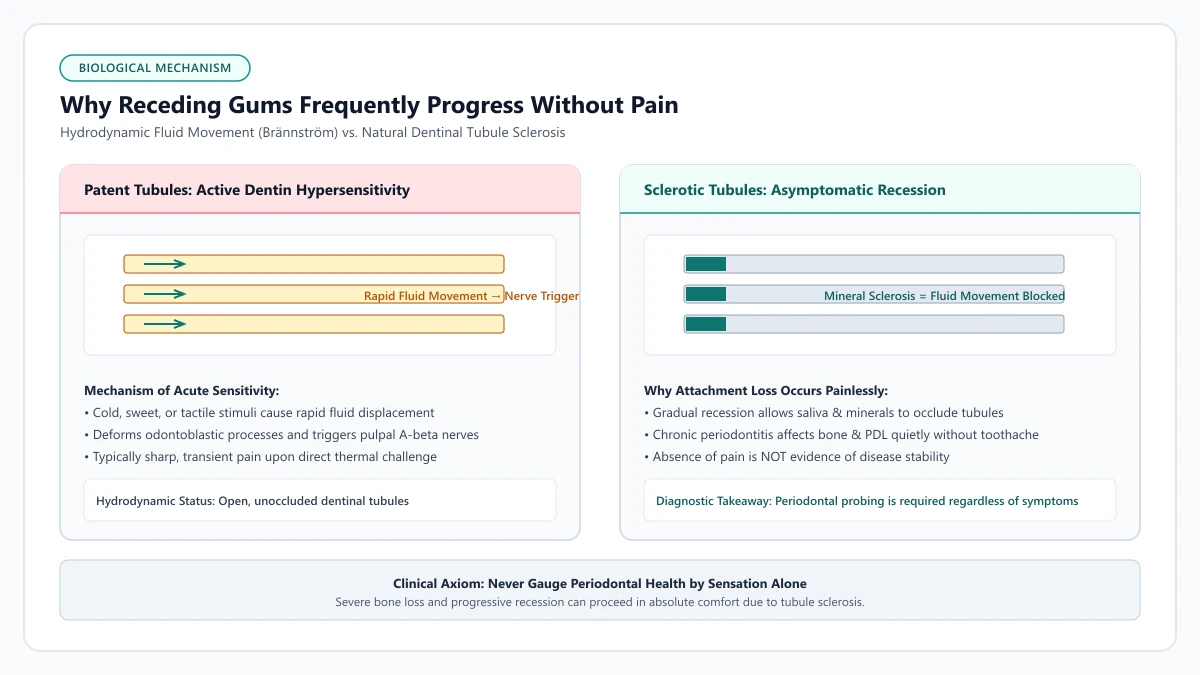
Educational illustration: Root exposure beneath a receded margin. Dentin hypersensitivity varies significantly among individuals, and the absence of pain does not indicate that attachment loss has stabilized.
Source: RecedingGumline.com Clinical Editorial Team (Proprietary educational diagram for RecedingGumline.com)
Key Clinical Distinctions & Diagnostic Boundaries
- Absence of pain does not determine the underlying cause or severity of gingival recession; clinical probing is necessary to assess tissue attachment.
- Dentin hypersensitivity occurs via hydrodynamic fluid movement, but natural mineral occlusion within tubules can diminish sensitivity over time.
- Chronic periodontal tissue breakdown progresses through low-grade inflammatory pathways rather than acute pulpal pain cascades.
- Painless recession does not automatically imply active progressive disease, but requires clinical measurements to distinguish stable sites from progressing attachment loss.
Why Periodontal Changes Frequently Occur Without Pain
Unlike acute dental caries that penetrates the dentin-pulp complex or an acute abscess that creates painful pressure, chronic periodontal inflammation and gingival recession operate through low-grade, persistent pathways (Löe et al., 1965).
The breakdown of connective tissue attachment and alveolar bone remodeling are mediated by complex host inflammatory responses and enzymatic cascades (Pihlstrom et al., 2005). Because this process typically unfolds slowly over months or years, it rarely triggers the acute pain pathways associated with sudden trauma or pulpal infection.
Additionally, the gingival sulcus provides an open pathway into the oral cavity, meaning inflammatory exudate generally does not produce the enclosed pressure that causes severe throbbing toothaches. As a result, meaningful attachment changes can occur across multiple teeth without generating patient-perceived discomfort.
Clinical Considerations:
- Chronic periodontal changes develop through persistent, low-grade inflammatory mechanisms
- Enzymatic remodeling of connective tissue attachment typically occurs without acute pain sensations
- Open sulcular drainage prevents the trapped pressure that characterizes acute pulpal infections
- Subjective physical comfort does not provide dependable evidence of periodontal stability
Dentin Hypersensitivity & Natural Tubule Occlusion
When gum recession initially exposes root surfaces, patients may experience sharp, transient sensitivity to cold or touch. According to Brännström’s widely accepted hydrodynamic theory, physical stimuli cause rapid fluid movement within microscopic dentinal tubules, stimulating pulpal nerve endings.
However, sensitivity levels vary considerably among individuals and can change over time. Systematic reviews evaluating dentin hypersensitivity (West et al., 2015) explain that symptoms depend on whether dentinal tubules remain patent (open) or become occluded.
Over time, exposure to saliva minerals, dietary components, and natural pulp-dentin responses can lead to mineral crystal deposition within the tubules. This gradual occlusion reduces hydrodynamic fluid movement, which explains why an exposed root surface may lose its sensitivity and feel completely comfortable even while remaining exposed.
Clinical Considerations:
- Dentin hypersensitivity is driven by hydrodynamic fluid movement within open dentinal tubules
- Not all exposed roots are sensitive; tubule patency varies significantly between sites and individuals
- Gradual mineral precipitation within tubules can naturally reduce fluid movement and diminish sensitivity
- A lack of cold sensitivity does not indicate that gum tissue has recovered or returned to normal levels
Clinical Risks Associated with Asymptomatic Recession
Because painless recession rarely causes daily distress, individuals often postpone professional evaluation. This delay can lead to clinical consequences that might have been managed more conservatively if identified early.
Exposed root cementum and dentin have a lower mineral content and higher critical demineralization pH than dental enamel, rendering root surfaces more vulnerable to cervical caries (root cavities). These lesions can develop beneath plaque margins without causing early pain.
Furthermore, if recession progresses unchecked and involves interdental bone, the defect may transition from an easily treatable presentation to one where complete root coverage is no longer biologically predictable. Timely professional evaluation helps identify progression before structural options are compromised.
Clinical Considerations:
- Exposed root dentin is more susceptible to cervical decay than protective dental enamel
- Root caries can develop silently beneath plaque accumulations without triggering acute discomfort
- Progressive attachment loss may compromise interproximal bone support if left unmonitored
- Early clinical detection allows conservative management before complex interventions are considered
How Dental Professionals Objectively Measure Periodontal Health
Because patient symptoms do not reliably indicate periodontal status, clinicians utilize standardized objective diagnostic measurements. During a comprehensive examination, the dentist or periodontist uses a calibrated probe to evaluate specific parameters around each tooth.
Key diagnostic measurements include probing depth (the depth of the sulcus or pocket), clinical attachment level (the distance from the cementoenamel junction to the base of the pocket), and bleeding on probing (BOP). Bleeding on probing indicates micro-ulceration within the sulcular lining, confirming active inflammation even when no pain is felt.
Periodic diagnostic radiographs complement these clinical measurements by evaluating interdental bone crest height and density. By comparing standardized charting over time, the dental team can determine whether a painless site is genuinely stable or experiencing subtle progression.
Clinical Considerations:
- Calibrated periodontal probing evaluates pocket depth and clinical attachment level accurately
- Bleeding on probing identifies microscopic inflammation independently of patient symptoms
- Digital radiographs visualize interdental bone crest architecture and support
- Sequential clinical charting over consecutive visits distinguishes stable sites from progressing defects
Clinical Reality Check
A painless receding gumline is not necessarily an active periodontal emergency, nor does it guarantee that the site is harmless. Because chronic inflammatory conditions and mechanical recession both frequently lack acute pain, regular professional periodontal probing provides the only dependable means of monitoring attachment stability.
Questions to Ask Your Periodontist or Dentist
- Although I have no pain or sensitivity, are my clinical probing depths and attachment levels stable?
- Is there any bleeding on probing around the teeth with visible recession, indicating active inflammation?
- Are my exposed root surfaces showing any signs of root decay or non-carious cervical wear?
- What recall interval is recommended to monitor these sites and verify that recession is not progressing?
Unsure What Your Gum Changes Mean?
Take our free, evidence-based Gum Recession Assessment — approximately 3 minutes. Identify potential risk factors, evaluate symptoms, and receive personalized discussion questions for your dentist or periodontist.
Non-diagnostic educational triage. Private, secure, completed in your browser.
Related Educational Topics
Clinical Evidence & Claim Traceability (3 Mapped Assertions)
Scientific Literature & Clinical Guidelines
3sources · Hide ▲
- Löe H, Theilade E, Jensen SB (1965).
"Experimental gingivitis in man." The Journal of Periodontology.
Clinical relevance: Classic experimental gingivitis study demonstrating that withdrawal of oral hygiene leads to bacterial plaque accumulation and reversible marginal gingival inflammation within 10 to 21 days, establishing the microbial etiology of gingival inflammation. It serves as foundational evidence for plaque-induced gingivitis, not modern comprehensive models of periodontitis or gingival recession.
- Pihlstrom BL, Michalowicz BS, Johnson NW (2005).
"Periodontal diseases." The Lancet.
Clinical relevance: Peer-reviewed Lancet seminar review synthesizing global periodontal epidemiology, microbial etiology, host immunopathology, and systemic interactions, emphasizing prevention, biofilm disruption, and early risk factor modification.
- West NX, Seong J, Davies M (2015).
"Management of dentine hypersensitivity: efficacy of professionally and self-administered agents." Journal of Clinical Periodontology.
Clinical relevance: Systematic review evaluating professionally and self-administered desensitizing agents; found evidence supporting tubule-occluding dentifrices and potassium-based nerve desensitizers in providing transient to moderate symptom relief, with substantial heterogeneity across clinical trials.
Important Medical Notice
The contents of RecedingGumline.com, including text, graphics, self-assessment calculators, and other materials, are intended solely for educational and informational purposes. This content is not intended to replace professional dental examination, diagnosis, or treatment. Always seek the advice of a qualified dentist, periodontist, or other licensed oral healthcare provider with any questions you may have regarding a medical or dental condition. Never disregard professional medical advice or delay seeking it because of something you read on this website.