Receding Gums on Canine Teeth: Root Prominence and Toothbrush Angulation
Why do canine teeth recede more than other teeth, and how can they be repaired?
The canine teeth (often called eyeteeth or cuspids) are the cornerstone of the human dental arch. Possessing the longest and most massive roots in the mouth, canines sit directly at the corner where the dental arch transitions from the front to the sides. This anatomical prominence makes canines the number one target for aggressive toothbrushing friction and mechanical receding gumline clinical guide trauma.
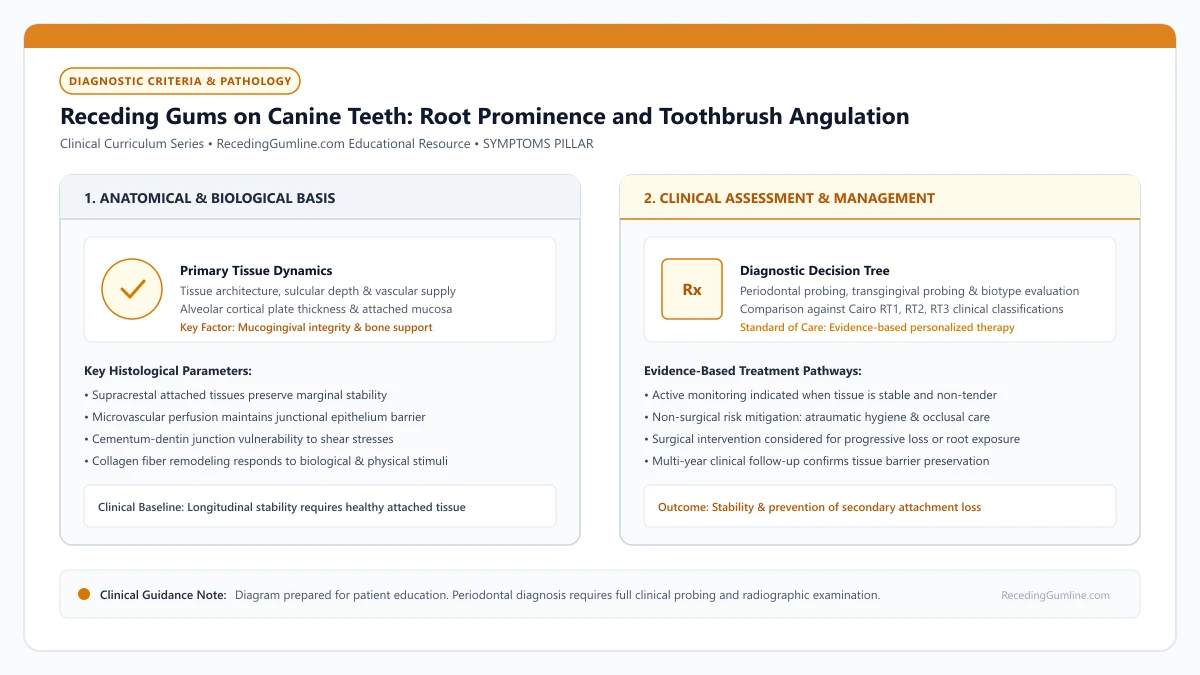
Educational illustration: Receding Gums on Canine Teeth: Root Prominence and Toothbrush Angulation. Clinical management requires comprehensive periodontal evaluation rather than isolated self-assessment.
Source: RecedingGumline.com Clinical Editorial Team (Proprietary educational diagram for RecedingGumline.com)
Key Clinical Distinctions & Diagnostic Boundaries
- Canine recession is overwhelmingly mechanical (toothbrush abrasion) and anatomical, rather than bacterial periodontitis.
- Because canines have long, sturdy roots, mild recession does not immediately threaten tooth stability, but can cause severe cold sensitivity.
- The receded margin on a canine is usually knife-edged, pale pink, and completely free of bleeding.
- Grafting canines requires careful flap mobilization around the corner of the arch to avoid tension.
Arch Geometry: The "Cornerstone" Prominence
The canine tooth is situated at the exact intersection where the flat anterior dental arch turns 90 degrees to form the posterior arch. To anchor this vital tooth, the canine root is exceptionally long, conical, and bulky.
This massive root creates a pronounced outward ridge in the facial jawbone known as the canine eminence. Because the root protrudes so far facially, the cortical bone plate covering its outer surface is paper-thin, and in many individuals, developmental alveolar dehiscences leave the cervical third covered only by soft tissue.
Maxillary and mandibular canines form the prominent architectural corners of the dental arch, featuring thick roots that project buccally into the facial vestibule. Because they occupy the corner turning point, canines absorb the greatest lateral frictional forces during manual toothbrushing strokes.
Clinical Considerations:
- Canines sit at the 90-degree turning corner of the dental arch
- Bulky root creates an outward structural ridge called the canine eminence
- Facial cortical bone over the canine eminence is naturally thin or absent
Brushing Mechanics: The Apex of Hand Acceleration
When people brush their teeth, their arm and wrist movements follow a predictable biomechanical path. As the brush sweeps across the front teeth and prepares to turn along the side teeth, the hand naturally pivots at the canine.
This pivot point causes the toothbrush bristles to smash directly into the prominent canine root with maximum velocity and compressive force. Horizontal scrubbing acts like sandpaper over the prominent root bulge, rapidly scouring away the delicate gingival margin and exposing the underlying cementum.
During lateral chewing excursions, canine-guided occlusion concentrates intense mechanical stress across the cervical root concavity. The combination of root prominence, thin facial bone, and heavy canine guidance makes these teeth the most frequent site of severe localized recession.
Clinical Considerations:
- Wrist movement naturally accelerates and pivots at the canine corner
- Bristles hit the protruding canine root with maximum mechanical friction
- Horizontal scrubbing selectively abrades canines faster than neighboring teeth
Surgical Repair: Achieving Predictable Canine Coverage
Because canine recession is usually driven by mechanical abrasion in patients with healthy interdental bone, it almost always presents as a Cairo RT1 defect. This means surgical root coverage has an exceptionally high success rate (85% to 95% complete coverage).
Periodontists treat receded canines using a coronally advanced flap combined with a subepithelial connective tissue graft (CAF + SCTG) or tunneling procedure. The transplanted tissue creates a thick, resilient cushion over the canine eminence that permanently shields the root from future brushing wear.
Managing canine recession requires adjusting premature occlusal contacts during lateral excursions alongside periodontal plastic surgical coverage. Connective tissue grafting restores thick attached gingiva that resists ongoing shearing stresses during normal mastication.
Clinical Considerations:
- High predictability for 90% to 100% root coverage due to intact interdental bone (RT1)
- Coronally advanced flap plus connective tissue graft provides ideal thickness and aesthetics
- Surgically thickened tissue permanently buffers the prominent root against brushing wear
Arch Prominence & Canine Guidance Biomechanics
Maxillary and mandibular canines occupy the "cornerstone" position of the dental arch, situated at the transition between the anterior and posterior segments. Because canines have the longest and most prominent roots in the mouth, their facial root surfaces naturally protrude outward beyond the skeletal base.
This natural prominence leaves the overlying labial bone plate exceptionally thin. Furthermore, in ideal occlusion, canines provide "canine guidance"—bearing the entire lateral shear load when the jaw moves sideways, protecting the premolars and molars from destructive lateral forces.
When patients grind or clench their teeth (bruxism), the canines endure heavy lateral friction and cyclical tooth flexure. This intense occlusal loading, combined with their anatomical vulnerability, makes canines a prime target for severe abfraction and gingival recession.
Clinical Considerations:
- Canines occupy the arch corner with prominent roots that naturally protrude through thin bone.
- Canine guidance subjects these teeth to high lateral shear forces during jaw movement.
- Heavy occlusal load combined with prominent anatomy accelerates abfraction and gum recession.
Management: Occlusal Adjustment, Nightguards & Surgical Coverage
Managing canine recession requires coordinating bite equilibration with soft-tissue reconstruction. Prior to surgical grafting, the periodontist and restorative dentist evaluate the patient's lateral excursions to ensure lateral forces are distributed safely across the arch or cushioned by an occlusal nightguard.
Surgically, prominent canines are prime candidates for coronally advanced flaps with connective tissue grafts. Because the interdental papillae between the lateral incisor and first premolar are typically robust and well-vascularized, canine defects offer excellent recipient beds for graft revascularization.
If an abfraction notch is present at the canine CEJ, the deep notch is smoothed and re-contoured to create a smooth, biologically receptive root surface before the connective tissue graft is secured.
Clinical Considerations:
- Occlusal equilibration and nightguards neutralize destructive lateral forces on canines.
- Robust adjacent interdental papillae provide an excellent vascular bed for graft healing.
- Smoothing cervical notches creates an optimal root bed for connective tissue reattachment.
Clinical Reality Check
To stop wearing down your canines, switch to a modified brushing technique: brush the front teeth and side teeth as two separate flat zones rather than aggressively wrapping the brush around the corner.
Questions to Ask Your Periodontist or Dentist
- Is my canine recession caused primarily by root prominence and my brushing path?
- Do my canines have intact interdental bone that makes them good candidates for a gum graft?
- Can you show me how to angle my toothbrush to avoid hitting the canine corners so hard?
- Would a connective tissue graft permanently cover this exposed root and stop my cold sensitivity?
Unsure What Your Gum Changes Mean?
Take our free, evidence-based Gum Recession Assessment — approximately 3 minutes. Identify potential risk factors, evaluate symptoms, and receive personalized discussion questions for your dentist or periodontist.
Non-diagnostic educational triage. Private, secure, completed in your browser.
Related Educational Topics
Clinical Evidence & Claim Traceability (3 Mapped Assertions)
Scientific Literature & Clinical Guidelines
3sources · Hide ▲
- Jepsen S, Caton JG, Albandar JM, Bissada NF, Bouchard P, Cortellini P, et al. (2018).
"Periodontal manifestations of systemic diseases and developmental and acquired conditions: Consensus report of workgroup 3 of the 2017 World Workshop on the Classification of Periodontal and Peri-Implant Diseases and Conditions." Journal of Periodontology.
Clinical relevance: Consensus report defining mucogingival conditions, gingival phenotype (replacing biotype), non-carious cervical lesions, and the multifactorial etiology of gingival recession; emphasizes that recession can occur without periodontitis and classifies recession by interdental clinical attachment loss.
- Zucchelli G, Mounssif I (2015).
"Periodontal plastic surgery." Periodontology 2000.
Clinical relevance: Peer-reviewed review of periodontal plastic surgery modalities, detailing flap design, coronally advanced flaps, autogenous connective tissue grafting, tunneling techniques, and anatomical factors governing aesthetic and functional root coverage.
- Wennström JL (1987).
"Lack of association between width of attached gingiva and development of soft tissue recession. A 5-year longitudinal study." Journal of Clinical Periodontology.
Clinical relevance: Clinical study demonstrating that in the presence of meticulous plaque control, an extremely narrow zone or absence of attached keratinized gingiva does not inevitably lead to soft-tissue breakdown or recession progression, qualifying historical mandatory width dogmas.
Important Medical Notice
The contents of RecedingGumline.com, including text, graphics, self-assessment calculators, and other materials, are intended solely for educational and informational purposes. This content is not intended to replace professional dental examination, diagnosis, or treatment. Always seek the advice of a qualified dentist, periodontist, or other licensed oral healthcare provider with any questions you may have regarding a medical or dental condition. Never disregard professional medical advice or delay seeking it because of something you read on this website.