Sensitivity to Sweet & Acidic Foods from Receding Gums
Why do sweet and acidic foods cause sharp pain on teeth with receding gums?
While cold temperature is the most recognized trigger of sensitive teeth, many individuals with gum recession experience sharp, painful winces when eating sweets (chocolate, candy) or consuming acidic foods and drinks (citrus, vinegar, wine). Understanding the osmotic and chemical mechanisms behind sweet and acidic sensitivity clarifies why exposed root surfaces react violently to ordinary dietary choices.
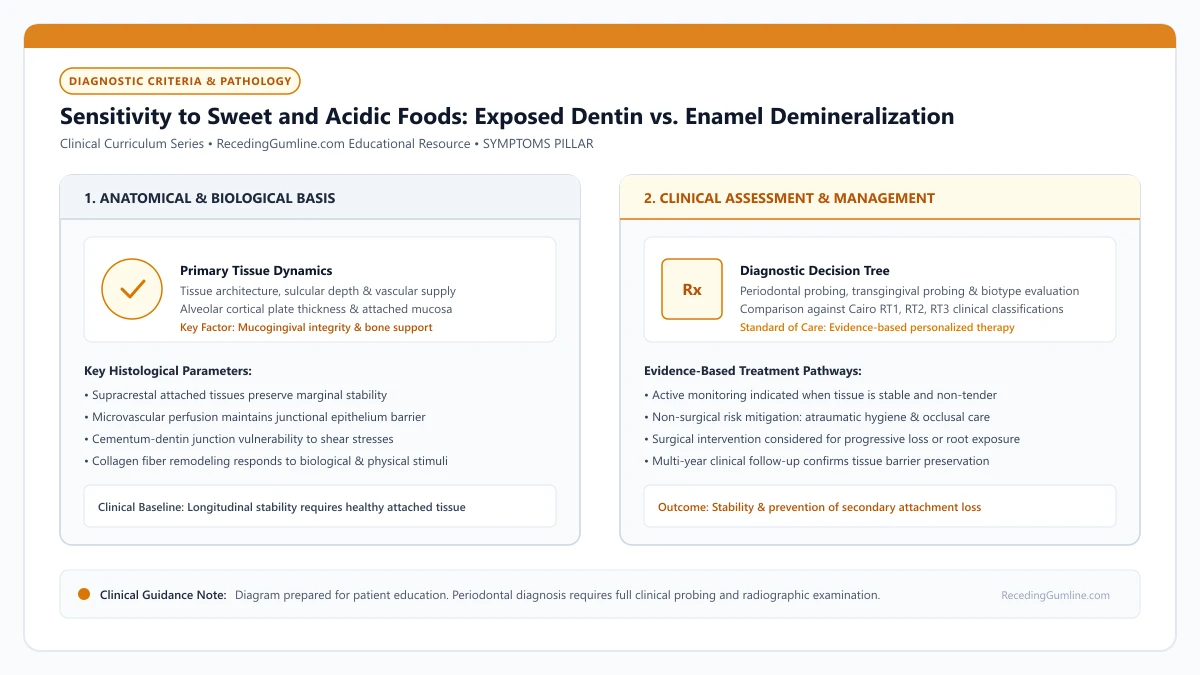
Educational illustration: Sensitivity to Sweet and Acidic Foods: Exposed Dentin vs. Enamel Demineralization. Clinical management requires comprehensive periodontal evaluation rather than isolated self-assessment.
Source: RecedingGumline.com Clinical Editorial Team (Proprietary educational diagram for RecedingGumline.com)
Key Clinical Distinctions & Diagnostic Boundaries
- Sweet sensitivity on an intact tooth crown usually signals an active cavity; on a receded root, it can indicate simple osmotic tubule exposure or early root caries.
- Acidic sensitivity dissolves the smear layer, making the tooth progressively more sensitive to subsequent cold and tactile brushing.
- Brushing teeth immediately after consuming acidic citrus or wine accelerates tooth wear, as softened dentin is easily scrubbed away.
- Dietary acid erosion (biocorrosion) works synergistically with mechanical abrasion to deepen cervical root defects.
The Osmotic Mechanism: How Concentrated Sugar Draws Fluid
Tooth enamel is virtually impermeable to sugar molecules. However, when gum recession exposes root dentin, the open dentinal tubules act as microscopic fluid conduits directly connected to the dental pulp.
When you eat a concentrated sweet food (such as caramel or chocolate), the sugar creates a hypertonic solution at the tooth surface—meaning its solute concentration is vastly higher than the fluid inside your dentinal tubules. Following the laws of osmosis, water rapidly rushes outward through the tubules toward the higher sugar concentration.
Hypertonic sucrose solutions and acidic citrus beverages generate rapid osmotic fluid shifts across exposed dentinal tubules toward the tooth surface. This sudden osmotic pressure differential directly stimulates pulpal nociceptors, producing intense, sharp cervical twinges.
Clinical Considerations:
- Enamel blocks sugar; exposed root dentin allows direct osmotic fluid contact
- Hypertonic sweet solutions generate a powerful osmotic pull
- Dentinal fluid rushes outward at high velocity, triggering A-delta sensory nerve impulses
Acidic Dissolution: How Citrus, Soda & Wine Strip Root Plugs
Acidic foods and drinks—including lemon juice, sports drinks, carbonated sodas, balsamic vinegar, and white wine—operate through chemical demineralization. Hydroxyapatite crystals in dentin begin dissolving at a critical pH of 6.2 to 6.7 (compared to 5.5 for enamel), making roots far more acid-vulnerable.
When dietary acids touch an exposed root, they dissolve the microscopic mineral plugs and salivary pellicle that naturally shield tubule openings. Within seconds, tubule diameters widen, allowing greater fluid movement and multiplying sensitivity to all subsequent stimuli.
Frequent consumption of acidic sports drinks, sodas, or carbonated waters strips away the protective salivary smear layer that naturally plugs open tubules. Without a salivary smear layer, tubule apertures remain wide open and hyper-sensitive to ordinary dietary foods.
Clinical Considerations:
- Root dentin dissolves at a higher pH (6.5) than crown enamel (5.5)
- Dietary acids dissolve the microscopic smear plugs that naturally block tubules
- Widened tubule apertures leave the tooth hyper-reactive to temperature and touch
Protective Protocols: Buffering Acids and Remineralizing Roots
Managing chemical and osmotic sensitivity requires dietary timing adjustments. Immediately after eating sweets or drinking acidic beverages, do not brush your teeth. Acid-softened dentin is easily scrubbed away by bristles. Instead, rinse thoroughly with plain tap water or a baking soda rinse (1/2 teaspoon baking soda in a cup of water) to neutralize the pH.
Incorporate stannous fluoride or arginine-calcium carbonate toothpastes into your daily routine. Stannous fluoride creates an insoluble, acid-resistant tin-fluoride mineral barrier over tubule openings, shielding them against future osmotic and chemical challenges.
Patients are advised to rinse thoroughly with neutral tap water immediately following acidic intake rather than brushing vigorously with abrasive pastes. Incorporating remineralizing amorphous calcium phosphate gels helps re-establish protective intratubular mineral plugs.
Clinical Considerations:
- Never brush immediately after acidic foods; wait at least 30 minutes for saliva to re-harden dentin
- Rinse with plain water or a mild baking soda solution to neutralize oral acidity instantly
- Use stannous fluoride toothpastes to deposit acid-resistant protective mineral layers
Osmotic Dynamics: Hypertonic Solutions & Outward Fluid Siphonage
Sensitivity triggered by concentrated sweets (such as chocolate, candy, or honey) operates through an osmotic mechanism rather than thermal contraction. Concentrated sugars create a hypertonic environment in the oral cavity relative to the physiological fluid within dentinal tubules.
Through basic osmotic principles, water molecules are drawn rapidly from areas of lower solute concentration (the dental pulp and tubules) toward areas of higher concentration (the oral cavity). This sudden outward fluid siphonage exerts mechanical traction on pulpal odontoblasts, firing pain signals.
Acidic foods and beverages (citrus fruits, sodas, salad dressings, and wines) act through a dual mechanism: their low pH dissolves the superficial smear layer that plugs tubule openings, while hypertonic fruit acids simultaneously trigger osmotic fluid shifts.
Clinical Considerations:
- Concentrated sugary foods create hypertonic environments that pull tubular fluid outward.
- Osmotic fluid siphonage exerts mechanical tension on odontoblastic processes in the pulp.
- Dietary acids dissolve protective smear plugs, exposing fresh dentin to osmotic shifts.
Protecting the Acquired Pellicle: Dietary Timing & Remineralization
The primary biological defense against osmotic and acidic sensitivity is the acquired salivary pellicle—an acellular, protective protein film derived from saliva that coats exposed tooth surfaces within minutes. The pellicle acts as an organic diffusion barrier, moderating fluid flow across tubules.
However, frequent consumption of acidic beverages strips away the pellicle and erodes superficial root dentin. Dentists counsel patients to consume acidic foods exclusively during main meals, when stimulated salivary flow provides rich bicarbonate buffering capacity.
Following acidic consumption, patients should immediately rinse thoroughly with plain water or a neutralizing sodium bicarbonate solution. Brushing must be deferred for at least 30 to 45 minutes to permit salivary calcium and phosphate to remineralize the softened dentin surface.
Clinical Considerations:
- The salivary pellicle acts as a natural protein barrier, buffering osmotic fluid movement.
- Acidic foods should be confined to mealtimes when stimulated salivary buffering is highest.
- Rinsing with water and delaying brushing for 30 minutes prevents abrading softened root dentin.
Clinical Reality Check
If sweet sensitivity is concentrated on a single tooth and lingers for several seconds after swallowing, your dentist must inspect the exposed root with an explorer to rule out an active root cavity (root caries).
Questions to Ask Your Periodontist or Dentist
- Is my sweet sensitivity caused by simple open dentinal tubules or does that receded root have an early cavity?
- Do you see evidence of acid erosion (biocorrosion) on my exposed root surfaces?
- Can you recommend an acid-resistant remineralizing paste or varnish for my receded teeth?
- How long after eating acidic foods should I wait before it is safe to brush my teeth?
Unsure What Your Gum Changes Mean?
Take our free, evidence-based Gum Recession Assessment — approximately 3 minutes. Identify potential risk factors, evaluate symptoms, and receive personalized discussion questions for your dentist or periodontist.
Non-diagnostic educational triage. Private, secure, completed in your browser.
Related Educational Topics
Clinical Evidence & Claim Traceability (2 Mapped Assertions)
Scientific Literature & Clinical Guidelines
3sources · Hide ▲
- Brännström M (1966).
"Sensitivity of dentine." Oral Surgery, Oral Medicine, Oral Pathology.
Clinical relevance: Foundational paper formulating the hydrodynamic theory of dentin hypersensitivity: rapid fluid displacement within patent dentinal tubules physically deforms intradental nerve endings at the pulp-dentin boundary, explaining thermal, mechanical, and evaporative root sensitivity.
- West NX, Seong J, Davies M (2015).
"Management of dentine hypersensitivity: efficacy of professionally and self-administered agents." Journal of Clinical Periodontology.
Clinical relevance: Systematic review evaluating professionally and self-administered desensitizing agents; found evidence supporting tubule-occluding dentifrices and potassium-based nerve desensitizers in providing transient to moderate symptom relief, with substantial heterogeneity across clinical trials.
- Pihlstrom BL, Michalowicz BS, Johnson NW (2005).
"Periodontal diseases." The Lancet.
Clinical relevance: Peer-reviewed Lancet seminar review synthesizing global periodontal epidemiology, microbial etiology, host immunopathology, and systemic interactions, emphasizing prevention, biofilm disruption, and early risk factor modification.
Important Medical Notice
The contents of RecedingGumline.com, including text, graphics, self-assessment calculators, and other materials, are intended solely for educational and informational purposes. This content is not intended to replace professional dental examination, diagnosis, or treatment. Always seek the advice of a qualified dentist, periodontist, or other licensed oral healthcare provider with any questions you may have regarding a medical or dental condition. Never disregard professional medical advice or delay seeking it because of something you read on this website.